What polypharmacy actually is
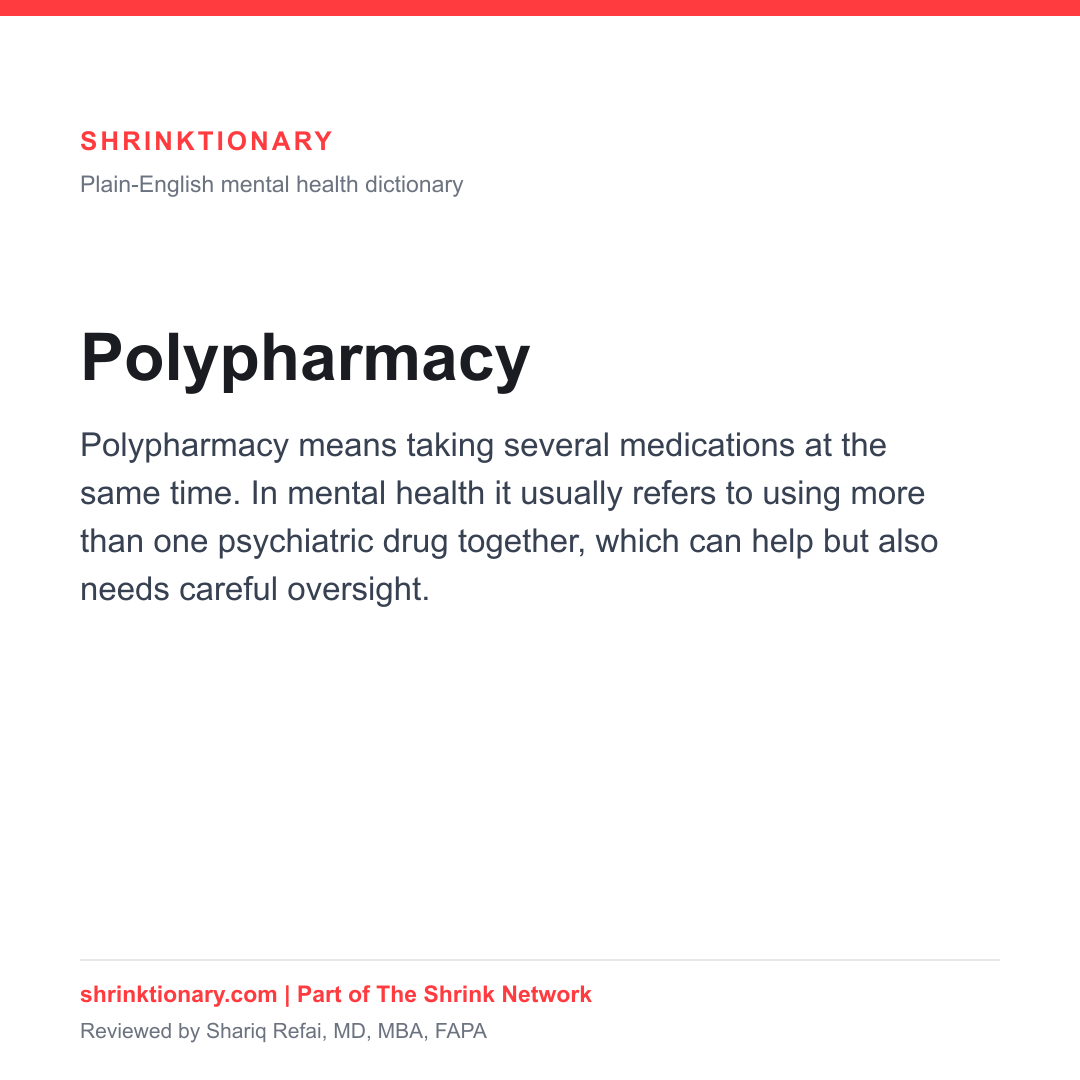
Polypharmacy is the use of multiple medications at once. The word itself just means “many drugs.” In psychiatry it often describes someone taking more than one mental health medication, but it can also include medications for physical conditions on top of that. Many definitions set a rough threshold of five or more medications, though the exact number matters less than whether each one still has a job.
Sometimes polypharmacy is planned and helpful. Other times it builds up over years as different prescribers add things, and the full list deserves a fresh look. The term is neutral. It describes a situation, not a mistake, and it’s especially common when someone has comorbidity, meaning more than one condition to treat at the same time. Older adults tend to accumulate more medications, which is why medication reviews get more important with age.
How it works
There are good reasons several medications might be used together. One drug might treat depression while another steadies mood, or a medication might be added to ease a side effect of the first. This deliberate layering is augmentation when the aim is to boost a partial response. A prescriber chooses each one for a purpose and expects them to work as a set rather than as a random collection.
The challenge is that every added medication raises the chance of interactions, side effects, and confusion about what’s doing what. More moving parts means more to track, and some pairings are a contraindication that shouldn’t be combined at all. Factors like each drug’s half-life affect how long they linger and overlap in the body. That’s why a careful prescriber periodically reviews the whole list and trims anything that’s no longer pulling its weight, a practice sometimes called deprescribing.
What it isn’t
Polypharmacy isn’t automatically bad. A thoughtful combination can be exactly the right plan for someone with more than one condition. The concern is unplanned or unreviewed stacking, not the simple fact of taking more than one drug. Clinicians sometimes call the risky version “problematic polypharmacy” to draw that line.
It also isn’t something you should fix by quietly stopping pills on your own. Removing the wrong medication, or stopping one abruptly, can cause real problems, including withdrawal-type effects from some drugs and a flare of the condition it was treating. The safe move is a review, not a solo edit of your regimen. It’s also not the same as taking a single medication at a high dose, which raises its own separate questions.
Related terms you’ll see next
What to do about it
Keep an up-to-date list of everything you take, including over-the-counter products and supplements, and share it with every prescriber and pharmacist. If your list feels long or you’re unsure why you’re on something, ask for a medication review. A prescriber can check for interactions, look for anything that’s outlived its purpose, and decide, safely, whether anything can be simplified. Bringing your actual bottles to a visit can make that review faster and more accurate. A single pharmacy that sees all your prescriptions can also catch overlaps that separate prescribers might miss.
When this word matters
The distinction matters when someone takes several medications at once, since combining drugs can be appropriate and helpful but raises the chance of interactions and side effects, so it needs careful oversight.
Commonly confused with
Frequently asked questions
What does polypharmacy mean?
Polypharmacy means taking several medications at the same time. In psychiatry it often describes someone taking more than one mental health medication, sometimes alongside medications for physical conditions.
Is polypharmacy always a bad thing?
No, it isn't automatically bad. A thoughtful combination can be exactly the right plan for someone with more than one condition, and the concern is usually unplanned or unreviewed stacking rather than the simple fact of taking more than one drug.
Why does taking several medications need careful oversight?
Every added medication raises the chance of interactions, side effects, and confusion about what each one is doing. That's why a careful prescriber periodically reviews the whole list, including over-the-counter products and supplements.
Related terms
Sources
- Mental Health Medications , National Institute of Mental Health
Use or cite this definition
Free to reuse with attribution. Paste the block into your own page, or grab a citation.
Embed on your site
<blockquote>
<p><strong>Polypharmacy:</strong> Polypharmacy means taking several medications at the same time. In mental health it usually refers to using more than one psychiatric drug together, which can help but also needs careful oversight.</p>
<p>— <a href="https://shrinktionary.com/terms/polypharmacy/">Shrinktionary</a>, a plain-English mental health dictionary, medically reviewed by a board certified psychiatrist.</p>
</blockquote>Cite (APA)
Refai, S. (2026). Polypharmacy. Shrinktionary. https://shrinktionary.com/terms/polypharmacy/
Cite (MLA)
"Polypharmacy." Shrinktionary, https://shrinktionary.com/terms/polypharmacy/. Accessed September 26, 2026.
Your next step in The Shrink Network
You are here: Shrinktionary, the language layer of The Shrink Network.
Each site in the network has one job. No matter where you enter, we help you find the next step that makes sense.
Want to understand more first?
See how this connects to everything else in the Term Web →
Take it with you
Free printable references you can save or share. For education, not medical advice.