What anticholinergic actually means
Acetylcholine is one of the body’s chemical messengers. It’s involved in memory and attention, and it also runs a lot of unglamorous background work: saliva, tears, digestion, bladder control, the focusing of your eyes.
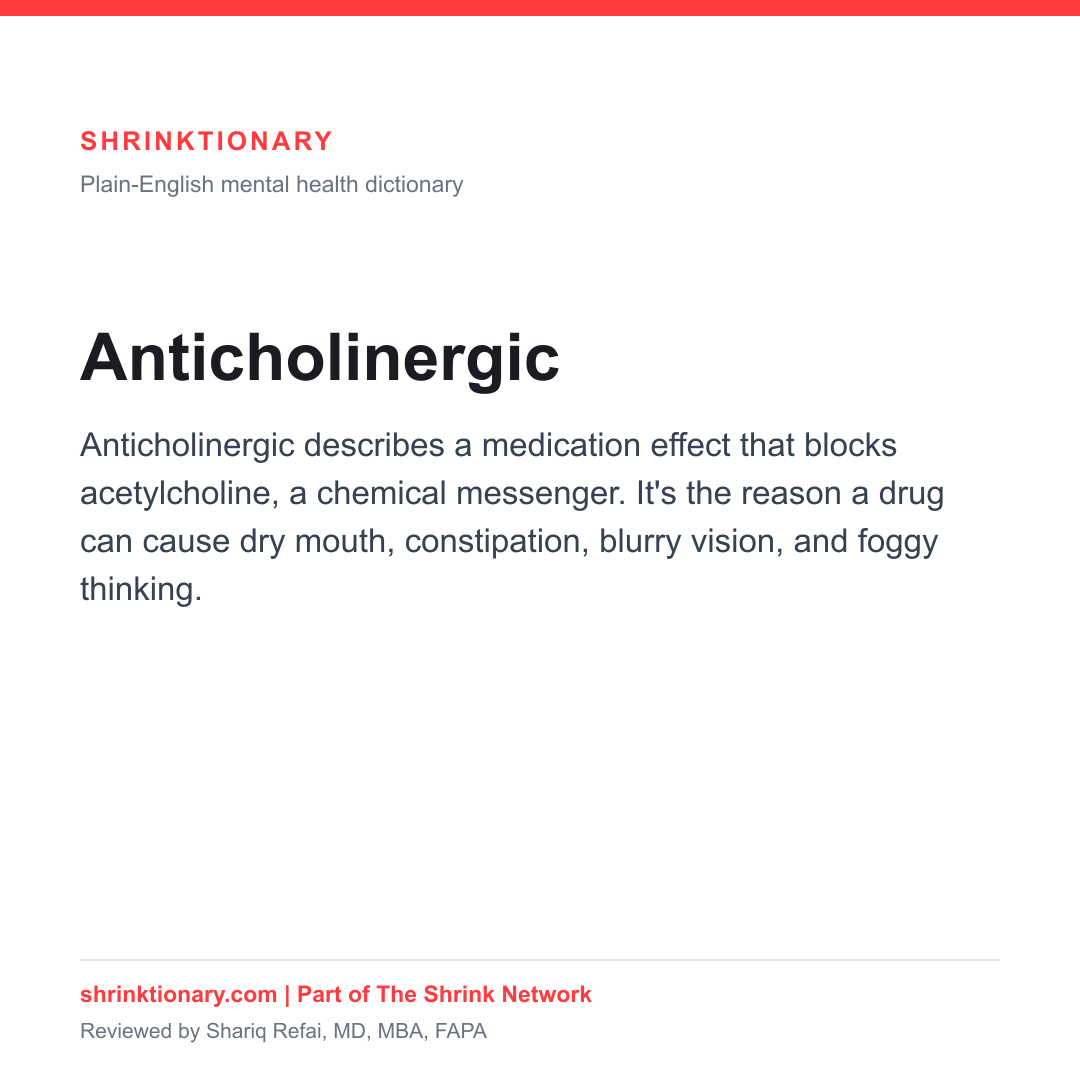
A medication described as anticholinergic blocks some of that signaling. Sometimes that’s the point of the drug. Very often it’s just a side effect that comes along for the ride.
Where you’ll meet the word
You’ll meet it in the side effect list, and once you know what it means, a scattered list of complaints suddenly makes sense as one thing. Dry mouth, constipation, blurry vision, difficulty urinating, a racing heart, and a foggy, slowed-down feeling in the head are all the same mechanism showing up in different places.
Older tricyclic antidepressants are strongly anticholinergic, which is a large part of why they’re used less often now that gentler options exist. Some antipsychotics carry it. So do a surprising number of ordinary drugs people don’t think of as psychiatric at all, including some antihistamines and over-the-counter sleep aids.
You’ll also hear the phrase “anticholinergic burden,” which is the total anticholinergic load from everything a person takes added together. It matters most in older adults, where the cognitive effects can look a lot like confusion or memory trouble and get mistaken for something else.
What anticholinergic isn’t
It isn’t a class of drug. It’s an effect, and drugs from completely unrelated categories can have it.
It also isn’t automatically a reason to avoid a medication. Sometimes the effect is mild, sometimes it fades, and sometimes it’s a fair price for a drug that’s working. But it isn’t nothing either, particularly when several anticholinergic drugs stack up, which is one more reason polypharmacy is worth looking at.
Related terms you’ll see next
When to seek professional care
Tell your prescriber about dry mouth, constipation, blurry vision, or trouble urinating on a medication rather than assuming you have to live with it, because dose changes and alternatives exist. Get help promptly for an inability to urinate, severe confusion, or a fast, irregular heartbeat. In an older adult, new confusion or memory trouble after a medication is started deserves a hard look at the medication list before it gets attributed to age. If you have thoughts of harming yourself, get help right away by calling 911, or call or text 988 in the US to reach the Suicide and Crisis Lifeline.
When this word matters
It matters in older adults, where the mental fog these drugs can cause looks a great deal like memory trouble and gets blamed on age instead of on the medication list.
Commonly confused with
Frequently asked questions
What are anticholinergic side effects?
Dry mouth, constipation, blurry vision, difficulty urinating, a racing heart, and a foggy, slowed-down feeling in the head. They look like a scattered list of complaints, but they're all the same mechanism showing up in different places.
Which medications are anticholinergic?
Older tricyclic antidepressants strongly so, some antipsychotics, and a surprising number of ordinary drugs people don't think of as psychiatric at all, including some antihistamines and over-the-counter sleep aids.
What is anticholinergic burden?
The total anticholinergic load from everything a person takes, added together. It matters most in older adults, where the cognitive effects can look like confusion or memory trouble and get mistaken for something else.
Related terms
In these language clusters
Sources
- Amitriptyline: MedlinePlus Drug Information , MedlinePlus (U.S. National Library of Medicine)
- Mental Health Medications , National Institute of Mental Health
Use or cite this definition
Free to reuse with attribution. Paste the block into your own page, or grab a citation.
Embed on your site
<blockquote>
<p><strong>Anticholinergic:</strong> Anticholinergic describes a medication effect that blocks acetylcholine, a chemical messenger. It's the reason a drug can cause dry mouth, constipation, blurry vision, and foggy thinking.</p>
<p>— <a href="https://shrinktionary.com/terms/anticholinergic/">Shrinktionary</a>, a plain-English mental health dictionary, medically reviewed by a board certified psychiatrist.</p>
</blockquote>Cite (APA)
Refai, S. (2026). Anticholinergic. Shrinktionary. https://shrinktionary.com/terms/anticholinergic/
Cite (MLA)
"Anticholinergic." Shrinktionary, https://shrinktionary.com/terms/anticholinergic/. Accessed September 29, 2026.
Your next step in The Shrink Network
You are here: Shrinktionary, the language layer of The Shrink Network.
Each site in the network has one job. No matter where you enter, we help you find the next step that makes sense.
Want to understand more first?
See how this connects to everything else in the Term Web →
Take it with you
Free printable references you can save or share. For education, not medical advice.