What remission actually is
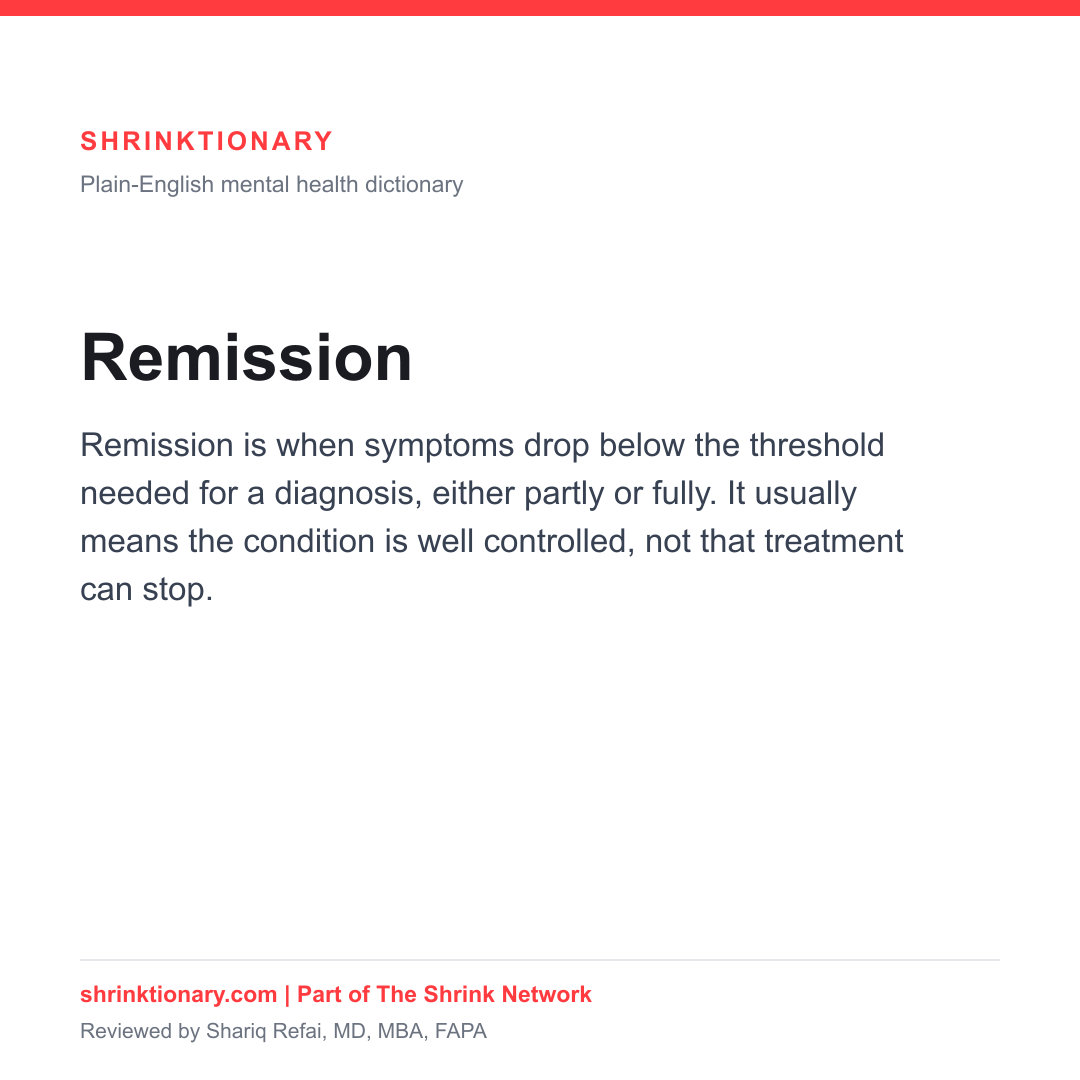
Remission is the point where a person’s symptoms have eased enough that they no longer meet the full criteria for a condition. Someone in remission from depression, for example, might no longer have the cluster of symptoms that defined the diagnosis. The condition is under control, even if some traces remain.
Clinicians often split remission into two kinds. Partial remission means symptoms have improved a lot but some are still present. Full remission means symptoms are gone or nearly gone for a sustained stretch of time. The exact definitions can vary by condition, but the core idea is the same. Things are markedly better than they were.
Why remission matters
Remission is usually the goal of treatment. It marks real, measurable improvement rather than just feeling a little better. Reaching full remission, rather than stopping at partial, tends to lower the chance that symptoms come back and gives a person a steadier base to build on.
Remission also shapes what happens next. Many conditions are treated for a while even after symptoms fade, because stopping too soon raises the risk of a return. So remission often signals a shift in care, from getting symptoms down to keeping them down, rather than an end to treatment. A prescriber decides how long to continue any medication after remission, and that decision depends on the condition and the person’s history.
What remission isn’t
Remission isn’t the same as being cured. A cure implies the condition is gone for good. Remission means it’s controlled right now, with the possibility that symptoms could return. That’s why care often continues even when someone feels well.
It also isn’t a sign that treatment was unnecessary. Reaching remission usually reflects that treatment is working, not that it can be dropped. Stopping abruptly is one of the more common reasons symptoms come back.
Related terms you’ll see next
Relapse is the return of symptoms after a period of improvement like remission. Prognosis describes the likely course of a condition, including the odds of reaching and holding remission. Antidepressants are one class of medication often continued after remission to help maintain it.
Where you’ll see it
You’ll hear about remission when a clinician reviews how treatment is going, often as the marker that things are working. If you reach remission, it’s worth asking how long to stay on any treatment and what the plan is for tapering, since stopping on your own can undo the gains. Think of remission as a milestone to protect, not a finish line.
When this word matters
The distinction matters because remission means symptoms have dropped below the threshold for a diagnosis, often the goal of treatment, but it usually doesn't mean care can stop. Reaching full remission rather than stopping at partial tends to lower the chance symptoms come back.
Commonly confused with
Frequently asked questions
Is remission the same as being cured?
No. A cure means the condition is gone for good, while remission means it's controlled right now with the possibility that symptoms could return. That's why care often continues even when someone feels well.
What is the difference between partial and full remission?
Partial remission means symptoms have improved a lot but some are still present, while full remission means symptoms are gone or nearly gone for a sustained stretch of time. Reaching full remission tends to lower the chance that symptoms come back.
Should I stop treatment once I reach remission?
Not on your own. Many conditions are treated for a while even after symptoms fade, because stopping too soon raises the risk of return, so it's worth asking your prescriber how long to continue and what the plan is for tapering.
Related terms
Sources
- Mental Health Topics , National Institute of Mental Health
- Mental Health Medications , National Institute of Mental Health
Use or cite this definition
Free to reuse with attribution. Paste the block into your own page, or grab a citation.
Embed on your site
<blockquote>
<p><strong>Remission:</strong> Remission is when symptoms drop below the threshold needed for a diagnosis, either partly or fully. It usually means the condition is well controlled, not that treatment can stop.</p>
<p>— <a href="https://shrinktionary.com/terms/remission/">Shrinktionary</a>, a plain-English mental health dictionary, medically reviewed by a board certified psychiatrist.</p>
</blockquote>Cite (APA)
Refai, S. (2026). Remission. Shrinktionary. https://shrinktionary.com/terms/remission/
Cite (MLA)
"Remission." Shrinktionary, https://shrinktionary.com/terms/remission/. Accessed September 26, 2026.
Your next step in The Shrink Network
You are here: Shrinktionary, the language layer of The Shrink Network.
Each site in the network has one job. No matter where you enter, we help you find the next step that makes sense.
Want to understand more first?
See how this connects to everything else in the Term Web →
Take it with you
Free printable references you can save or share. For education, not medical advice.