What clinically significant actually is
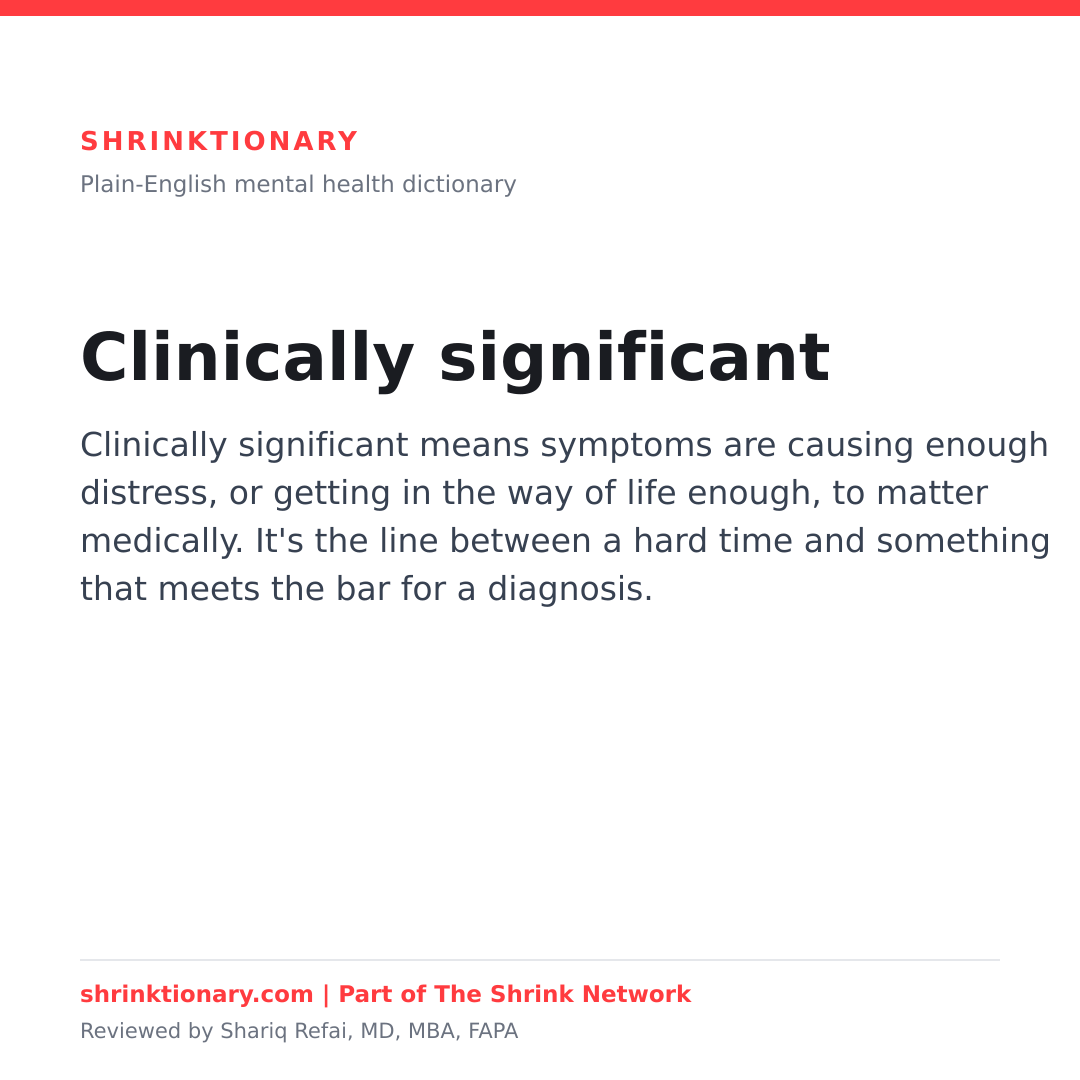
Clinically significant is a threshold. Most diagnostic definitions require that symptoms cause meaningful distress, meaningful interference with daily life, or both, before the condition can be diagnosed at all. Symptoms alone aren’t enough. They have to be doing something.
The test is usually some version of two questions. Is this causing real distress? Is it getting in the way of work, school, relationships, or taking care of yourself? If the answer to both is no, most definitions say the bar hasn’t been met, even if some symptoms are present.
Why it matters
This threshold is what keeps ordinary human experience from being labeled as illness. Plenty of people have a few symptoms of something without being unwell. Nervousness before a presentation is not an anxiety disorder. Sadness after a loss is not automatically depression. The clinical significance bar is where that line gets drawn.
It also explains a question that can feel strangely off-topic in an evaluation. When a clinician asks how work is going, or whether you’re keeping up with things at home, they’re often testing this threshold rather than making conversation.
What it isn’t
Clinically significant isn’t a measure of whether your distress is real or whether it deserves attention. Falling below the threshold doesn’t mean nothing is wrong. It means the picture doesn’t meet the definition of a specific diagnosis, and help can still be appropriate.
It’s also not the same as severe. Something can clear the bar for clinical significance and still be mild. This is a floor, not a rating.
Related terms you’ll see next
Diagnostic criteria are the full requirements, and clinical significance is usually one of them. Functional impairment is the daily-life half of the test. Severity is how intense things are once the bar is cleared.
Where you’ll see it
You’ll see this phrase in criteria and in evaluation notes. If you’re told your symptoms aren’t clinically significant, that isn’t a dismissal, and it’s worth asking what it means for what happens next. Distress that falls below a diagnostic bar can still be worth treating.
When this word matters
It matters because this threshold is what separates ordinary human distress from a diagnosable condition. It's also why a clinician asks how work and relationships are going, since that's how the bar gets tested.
Commonly confused with
Frequently asked questions
What makes something clinically significant?
Generally, that symptoms cause meaningful distress, meaningfully interfere with daily life like work, school, relationships, or self-care, or both. Symptoms on their own aren't enough.
If my symptoms aren't clinically significant, does that mean nothing's wrong?
No. It means the picture doesn't meet the definition of a specific diagnosis. Real distress can fall below that bar and still be worth attention and treatment.
Is clinically significant the same as severe?
No. Clinical significance is a floor that symptoms have to clear to count at all. Severity is how intense things are once that floor is cleared, so something can be clinically significant and still mild.
Related terms
Sources
- Diagnostic and Statistical Manual of Mental Disorders (DSM-5-TR) , American Psychiatric Association
- Mental Health Topics , National Institute of Mental Health
Use or cite this definition
Free to reuse with attribution. Paste the block into your own page, or grab a citation.
Embed on your site
<blockquote>
<p><strong>Clinically significant:</strong> Clinically significant means symptoms are causing enough distress, or getting in the way of life enough, to matter medically. It's the line between a hard time and something that meets the bar for a diagnosis.</p>
<p>— <a href="https://shrinktionary.com/terms/clinically-significant/">Shrinktionary</a>, a plain-English mental health dictionary, medically reviewed by a board certified psychiatrist.</p>
</blockquote>Cite (APA)
Refai, S. (2026). Clinically significant. Shrinktionary. https://shrinktionary.com/terms/clinically-significant/
Cite (MLA)
"Clinically significant." Shrinktionary, https://shrinktionary.com/terms/clinically-significant/. Accessed September 29, 2026.
Your next step in The Shrink Network
You are here: Shrinktionary, the language layer of The Shrink Network.
Each site in the network has one job. No matter where you enter, we help you find the next step that makes sense.
Want to understand more first?
See how this connects to everything else in the Term Web →
Take it with you
Free printable references you can save or share. For education, not medical advice.