What functional impairment actually is
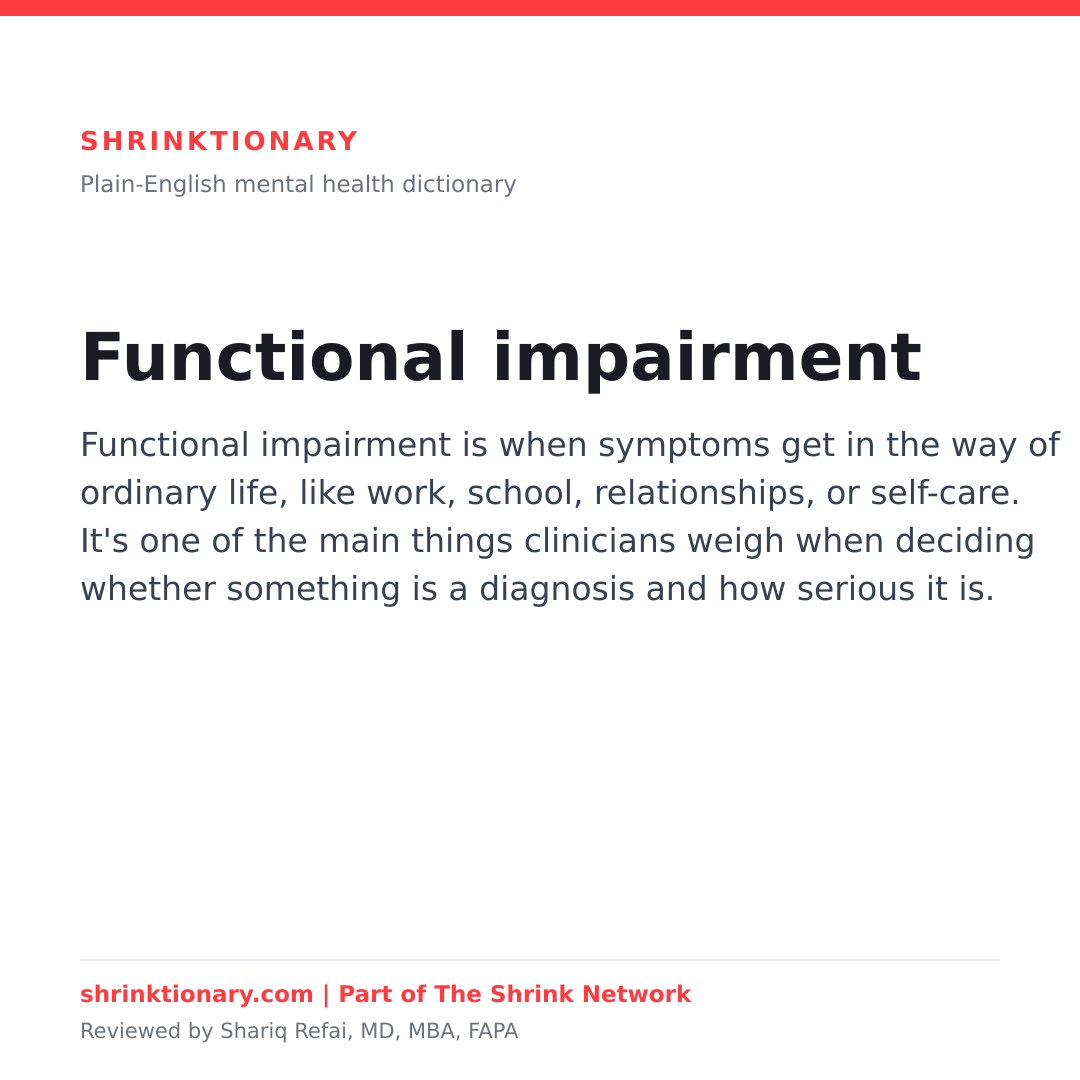
Functional impairment is the practical damage. Not how bad you feel, but what the symptoms are stopping you from doing.
Clinicians usually look at a few domains. Work or school, meaning whether you’re keeping up, missing time, or slipping. Relationships, meaning whether you’re withdrawing or in more conflict. Self-care, meaning eating, sleeping, hygiene, and managing basics like bills or appointments. And independence, meaning whether you can manage day to day without more support than usual.
Why impairment matters
Impairment does a lot of work in psychiatry. It’s often part of what makes symptoms count as a diagnosis at all, it’s a big part of how severity gets rated, and it’s one of the clearest signals about what level of care someone needs. A person who can’t get to work is in a different situation from a person who’s suffering but still managing, even with the same diagnosis.
It’s also one of the most useful things to track. Feelings are hard to compare week to week. Whether you made it to work, answered your messages, and ate real meals is concrete, and it tends to be a more honest measure of whether treatment is helping.
What impairment isn’t
Impairment isn’t a measure of effort or character. People often push through and keep functioning at enormous cost, and that doesn’t mean they’re less unwell. It can mean the impairment is hidden, which is worth saying out loud to a clinician rather than hiding.
It also isn’t the same as suffering. You can be in a lot of pain and still functioning, or functioning poorly without feeling especially distressed. Clinicians ask about both because they’re genuinely different things.
Related terms you’ll see next
Clinically significant is the threshold that impairment helps establish. Severity rests partly on how much impairment there is. Levels of care is the ladder of treatment intensity that impairment helps decide.
Where you’ll see it
You’ll be asked about function in almost any evaluation, often in questions that sound mundane. How’s work. Are you sleeping. Are you eating. Those questions are measuring impairment. Answering them accurately, including the parts you’re pushing through, gives a clinician a far better picture than describing your mood alone.
When this word matters
It matters because impairment often decides whether symptoms count as a diagnosis, how severe it's rated, and what level of care is recommended. It's also a more concrete way to track whether treatment is working than mood alone.
Commonly confused with
Frequently asked questions
What counts as functional impairment?
Trouble keeping up at work or school, withdrawal or increased conflict in relationships, slipping self-care like sleep, eating, or hygiene, and difficulty managing daily basics like bills and appointments.
What if I'm still functioning but feel terrible?
That's worth saying plainly. People often push through at real cost, which can hide the impairment. Clinicians ask about both distress and function because they're genuinely different things.
Why does impairment matter so much?
It often helps decide whether symptoms count as a diagnosis at all, it drives how severity is rated, and it's one of the clearest signals about what level of care someone needs.
Related terms
Sources
- Diagnostic and Statistical Manual of Mental Disorders (DSM-5-TR) , American Psychiatric Association
- Mental Health Topics , National Institute of Mental Health
Use or cite this definition
Free to reuse with attribution. Paste the block into your own page, or grab a citation.
Embed on your site
<blockquote>
<p><strong>Functional impairment:</strong> Functional impairment is when symptoms get in the way of ordinary life, like work, school, relationships, or self-care. It's one of the main things clinicians weigh when deciding whether something is a diagnosis and how serious it is.</p>
<p>— <a href="https://shrinktionary.com/terms/functional-impairment/">Shrinktionary</a>, a plain-English mental health dictionary, medically reviewed by a board certified psychiatrist.</p>
</blockquote>Cite (APA)
Refai, S. (2026). Functional impairment. Shrinktionary. https://shrinktionary.com/terms/functional-impairment/
Cite (MLA)
"Functional impairment." Shrinktionary, https://shrinktionary.com/terms/functional-impairment/. Accessed September 29, 2026.
Your next step in The Shrink Network
You are here: Shrinktionary, the language layer of The Shrink Network.
Each site in the network has one job. No matter where you enter, we help you find the next step that makes sense.
Want to understand more first?
See how this connects to everything else in the Term Web →
Take it with you
Free printable references you can save or share. For education, not medical advice.