What severity actually is
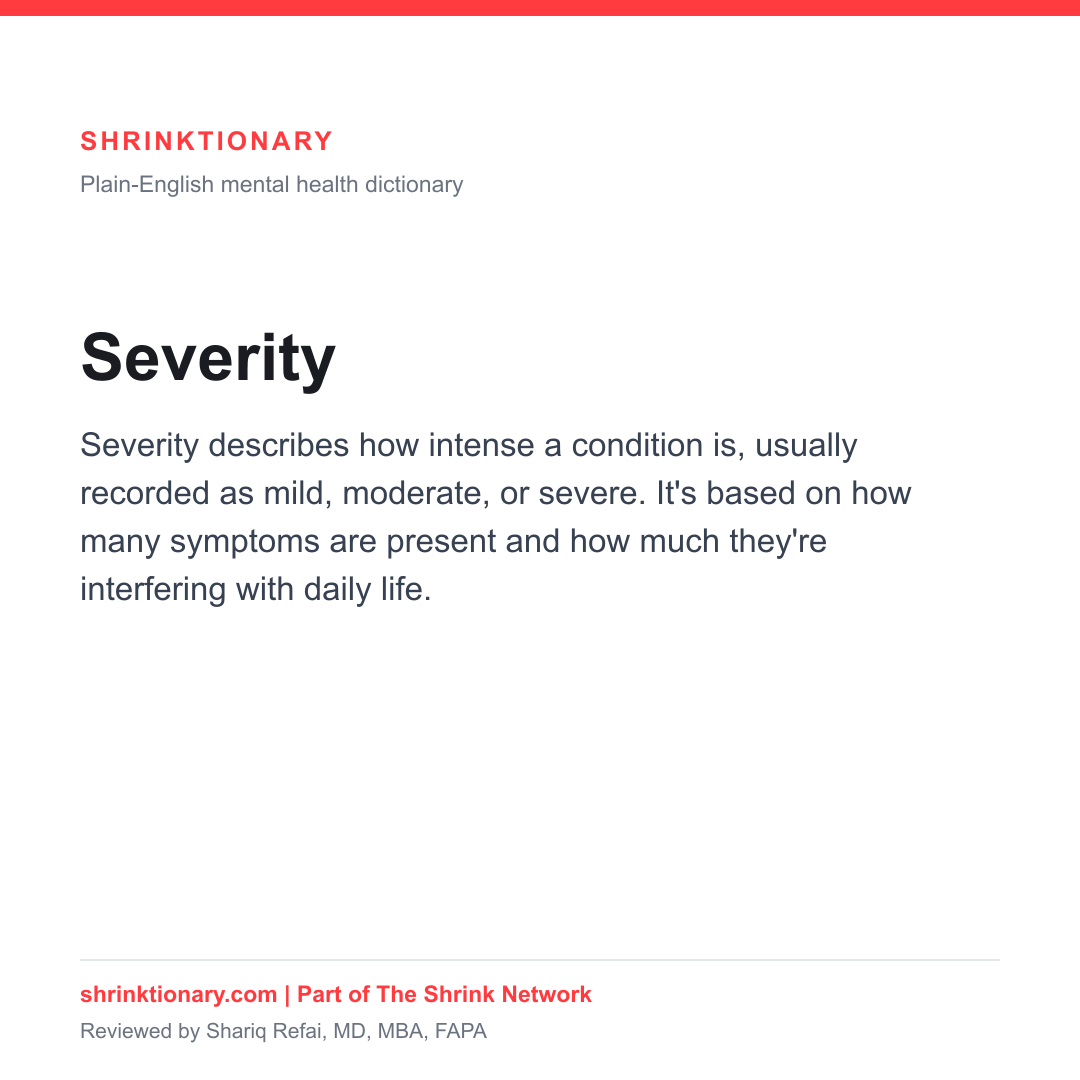
Severity is a rating of how much a condition is doing to a person right now. In most diagnoses it’s recorded as mild, moderate, or severe, and it’s based on two things: how many symptoms are present, and how much those symptoms are getting in the way of ordinary life.
It’s a snapshot, not a permanent setting. Severity can change over weeks or months, and a good record updates it as things move. Someone can be severe during an episode and mild once treatment takes hold.
Why severity matters
Severity is one of the biggest drivers of what happens next. It influences which treatment is offered first, how quickly, how closely someone is followed, and whether a higher level of care is worth considering. A mild presentation and a severe one can lead to genuinely different plans even under the same diagnosis.
It also matters for tracking. If a clinician can say the picture has moved from severe to moderate, that’s evidence the plan is working, and it’s more useful than asking whether someone feels a bit better.
What severity isn’t
Severity isn’t a measure of how much a person is suffering, and it isn’t a comment on strength or effort. Someone rated mild can be having a genuinely hard time, and someone rated severe isn’t failing at anything. The rating describes symptoms and their effect on daily life, not character.
It also isn’t fixed. People often hear severe and take it as a permanent label. It’s a description of where things stand now, and it’s expected to change.
Related terms you’ll see next
A specifier is the add-on label that severity is usually recorded as. Functional impairment is the daily-life piece that severity partly rests on. Clinically significant is the threshold symptoms have to clear before they count at all.
Where you’ll see it
You’ll see severity attached to a diagnosis in notes and paperwork, and it often comes up when treatment options are being discussed. If a rating surprises you, ask what it’s based on. It’s a clinical description, and it should be something you can talk through.
When this word matters
It matters because severity is one of the biggest drivers of what treatment gets offered and how closely you're followed. It's also a snapshot that should change over time, not a permanent label.
Commonly confused with
Frequently asked questions
How is severity decided?
It generally rests on how many symptoms are present and how much they're interfering with daily life, like work, school, relationships, and self-care. It's a clinical judgment, not a score you calculate.
Does severe mean my condition is permanent?
No. Severity is a snapshot of where things stand now, and it's expected to change with treatment and time. Someone can be severe during an episode and mild afterward.
Can I be mild and still feel awful?
Yes. Severity describes symptoms and their effect on functioning, not how much a person is suffering inside. A mild rating doesn't mean your distress isn't real or doesn't deserve care.
Related terms
Sources
- Diagnostic and Statistical Manual of Mental Disorders (DSM-5-TR) , American Psychiatric Association
- Mental Health Topics , National Institute of Mental Health
Use or cite this definition
Free to reuse with attribution. Paste the block into your own page, or grab a citation.
Embed on your site
<blockquote>
<p><strong>Severity:</strong> Severity describes how intense a condition is, usually recorded as mild, moderate, or severe. It's based on how many symptoms are present and how much they're interfering with daily life.</p>
<p>— <a href="https://shrinktionary.com/terms/severity/">Shrinktionary</a>, a plain-English mental health dictionary, medically reviewed by a board certified psychiatrist.</p>
</blockquote>Cite (APA)
Refai, S. (2026). Severity. Shrinktionary. https://shrinktionary.com/terms/severity/
Cite (MLA)
"Severity." Shrinktionary, https://shrinktionary.com/terms/severity/. Accessed September 29, 2026.
Your next step in The Shrink Network
You are here: Shrinktionary, the language layer of The Shrink Network.
Each site in the network has one job. No matter where you enter, we help you find the next step that makes sense.
Want to understand more first?
See how this connects to everything else in the Term Web →
Take it with you
Free printable references you can save or share. For education, not medical advice.