What an episode actually is
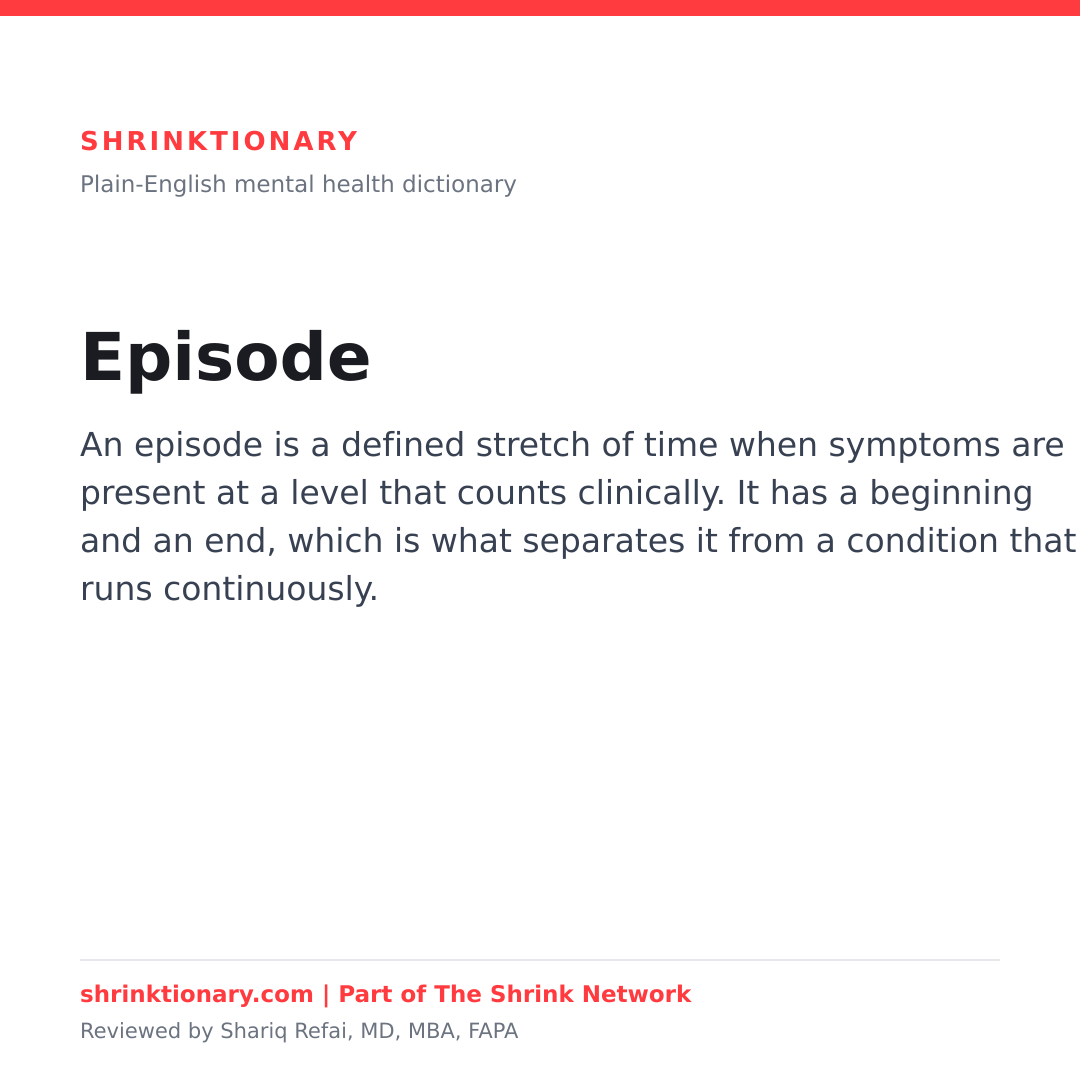
An episode is a period of illness with edges. Symptoms rise to a level that meets a clinical threshold, they stay there for some minimum length of time, and then they ease. That shape, a start and a finish, is what makes it an episode rather than an ongoing state.
The minimum length matters. Definitions usually require symptoms to persist for a set stretch, often a couple of weeks or more depending on the condition, so that an ordinary bad patch isn’t counted as an episode. A rough few days is not the same thing.
Why episodes matter
Thinking in episodes changes how care is planned. If a condition runs in episodes, then treatment has two jobs: get the current episode to end, and reduce the chance the next one starts. Those are different goals, and they sometimes call for different lengths of treatment.
Counting episodes also carries information. A first episode and a fourth episode often get handled differently, because a history of repeated episodes tends to change what’s recommended about staying on treatment. It’s one of the reasons a clinician asks whether this has happened before.
What an episode isn’t
An episode isn’t the same as the condition. Someone can have a condition that shows up in episodes and be entirely well between them. Having had an episode doesn’t mean symptoms are always present.
It also isn’t a mood that passed. A hard week is not an episode. The clinical meaning requires that symptoms reach a defined level and hold there for a defined stretch of time.
Related terms you’ll see next
Onset is when an episode begins. Course of illness is the larger pattern that episodes fit into. Remission is what it’s called when an episode’s symptoms fall below the diagnostic threshold, and relapse is when they come back.
Where you’ll see it
You’ll hear about episodes when a clinician takes a history, because how many you’ve had and how long they lasted shapes the plan. If you’re asked whether this has happened before, that question is doing real work, and a careful answer is worth the effort.
When this word matters
It matters because thinking in episodes gives treatment two jobs: ending the current one and lowering the odds of the next. How many episodes you've had is one of the things that most changes what's recommended.
Commonly confused with
Frequently asked questions
How long does something have to last to be an episode?
It depends on the condition, but definitions generally require symptoms to persist for a set minimum stretch, often a couple of weeks or more, so that an ordinary bad patch isn't counted.
Does having an episode mean I'll have another one?
Not necessarily, but a history of repeated episodes does tend to change what's recommended about how long to stay on treatment. That's one reason a clinician asks whether this has happened before.
Is a bad week an episode?
No. A hard stretch is real, but the clinical meaning requires symptoms to reach a defined level and hold there for a defined length of time.
Related terms
Sources
- Diagnostic and Statistical Manual of Mental Disorders (DSM-5-TR) , American Psychiatric Association
- Mental Health Topics , National Institute of Mental Health
Use or cite this definition
Free to reuse with attribution. Paste the block into your own page, or grab a citation.
Embed on your site
<blockquote>
<p><strong>Episode:</strong> An episode is a defined stretch of time when symptoms are present at a level that counts clinically. It has a beginning and an end, which is what separates it from a condition that runs continuously.</p>
<p>— <a href="https://shrinktionary.com/terms/episode/">Shrinktionary</a>, a plain-English mental health dictionary, medically reviewed by a board certified psychiatrist.</p>
</blockquote>Cite (APA)
Refai, S. (2026). Episode. Shrinktionary. https://shrinktionary.com/terms/episode/
Cite (MLA)
"Episode." Shrinktionary, https://shrinktionary.com/terms/episode/. Accessed September 29, 2026.
Your next step in The Shrink Network
You are here: Shrinktionary, the language layer of The Shrink Network.
Each site in the network has one job. No matter where you enter, we help you find the next step that makes sense.
Want to understand more first?
See how this connects to everything else in the Term Web →
Take it with you
Free printable references you can save or share. For education, not medical advice.