What onset actually is
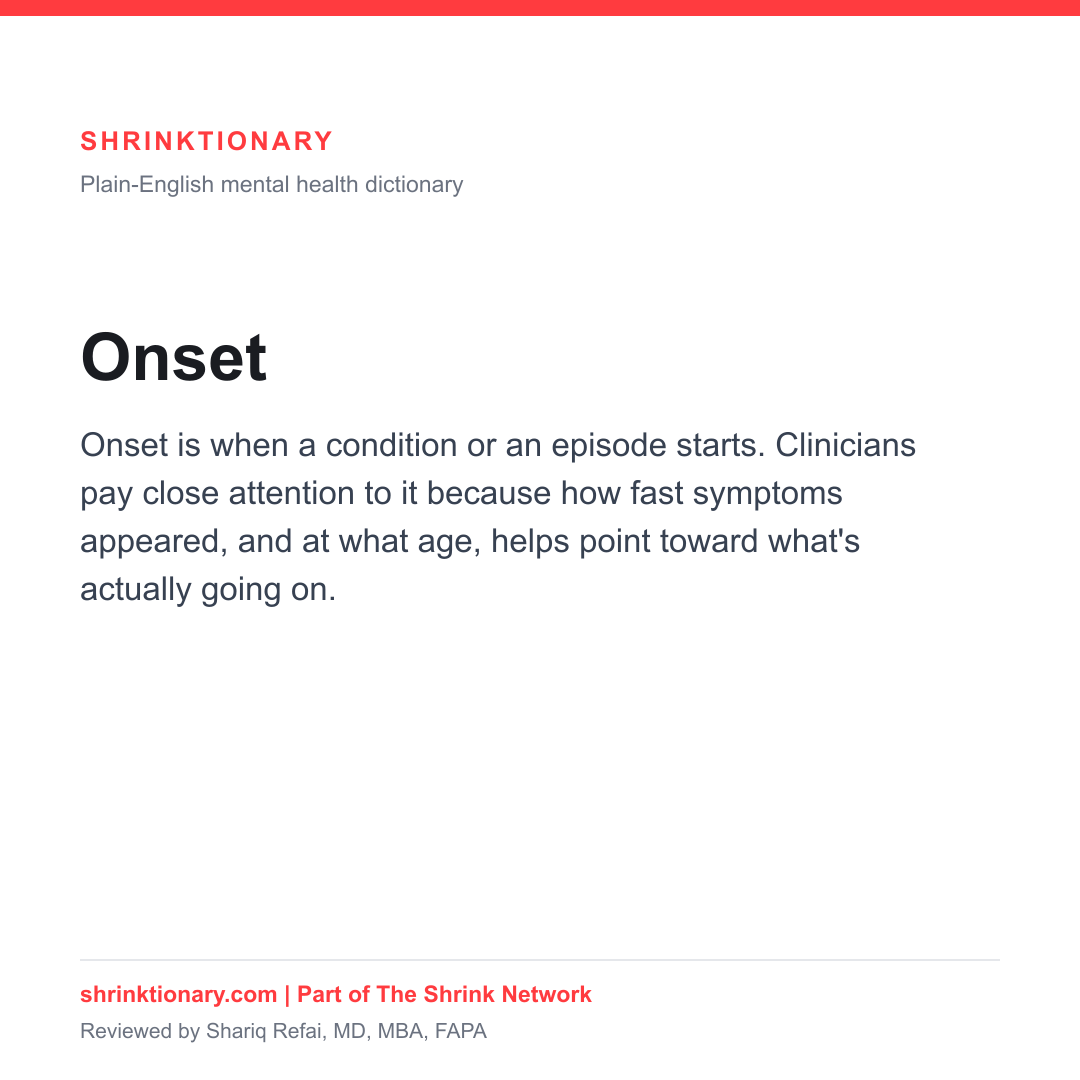
Onset is the beginning. It covers two questions that clinicians ask separately: how old someone was when this first showed up, and how quickly it came on.
Speed gets described in rough terms. Acute onset means symptoms appeared over hours or days. Gradual or insidious onset means they crept in over weeks, months, or longer, often so slowly that nobody can name a starting point. Both are informative, and they point in different directions.
Why onset matters
Onset is one of the strongest clues in a psychiatric history. Conditions tend to have typical ages when they first appear, so an unusual age raises the question of whether something else is going on. Sudden onset in particular can be a signal to look for a medical cause, a substance, or a medication effect rather than assuming a primary psychiatric condition.
It also shapes urgency. Something that appeared over two days is a different problem from something that’s been building for two years, even if the symptoms look similar today.
What onset isn’t
Onset isn’t the same as diagnosis. People often have symptoms long before anyone names them, so the date someone was diagnosed can be years after the actual onset.
It also isn’t a cause. Knowing when something started doesn’t explain why it started. Onset is a clue that helps narrow the possibilities, not an answer.
Related terms you’ll see next
Prodrome is the early, vague phase that can precede a full onset. Episode is a defined stretch of symptoms, and it has its own onset. Course of illness is the pattern that follows. Etiology is the question of cause, which onset only hints at.
Where you’ll see it
You’ll be asked about onset in almost any evaluation, usually as some version of “when did this start, and how fast?” It’s worth thinking about before you go in, because a vague answer costs a clinician one of their better clues. If symptoms came on suddenly and you’re not sure why, that’s worth saying plainly.
When this word matters
It matters because onset is one of the strongest clues in a psychiatric history. Sudden onset in particular can be a signal to look for a medical cause, a substance, or a medication effect rather than assuming a primary psychiatric condition.
Commonly confused with
Frequently asked questions
What's the difference between acute and gradual onset?
Acute onset means symptoms appeared over hours or days. Gradual onset means they built up over weeks or months, often so slowly that no clear starting point stands out. The two point clinicians in different directions.
Why does a clinician care how old I was when it started?
Conditions tend to first appear at typical ages, so an unusual age of onset raises the question of whether something else explains the picture, like a medical cause, a substance, or a medication.
Is onset the same as when I was diagnosed?
No. People often have symptoms long before anyone names them, so a diagnosis date can come years after the actual onset.
Related terms
Sources
- Diagnostic and Statistical Manual of Mental Disorders (DSM-5-TR) , American Psychiatric Association
- Mental Health Topics , National Institute of Mental Health
Use or cite this definition
Free to reuse with attribution. Paste the block into your own page, or grab a citation.
Embed on your site
<blockquote>
<p><strong>Onset:</strong> Onset is when a condition or an episode starts. Clinicians pay close attention to it because how fast symptoms appeared, and at what age, helps point toward what's actually going on.</p>
<p>— <a href="https://shrinktionary.com/terms/onset/">Shrinktionary</a>, a plain-English mental health dictionary, medically reviewed by a board certified psychiatrist.</p>
</blockquote>Cite (APA)
Refai, S. (2026). Onset. Shrinktionary. https://shrinktionary.com/terms/onset/
Cite (MLA)
"Onset." Shrinktionary, https://shrinktionary.com/terms/onset/. Accessed September 29, 2026.
Your next step in The Shrink Network
You are here: Shrinktionary, the language layer of The Shrink Network.
Each site in the network has one job. No matter where you enter, we help you find the next step that makes sense.
Want to understand more first?
See how this connects to everything else in the Term Web →
Take it with you
Free printable references you can save or share. For education, not medical advice.