What persistent depressive disorder actually is
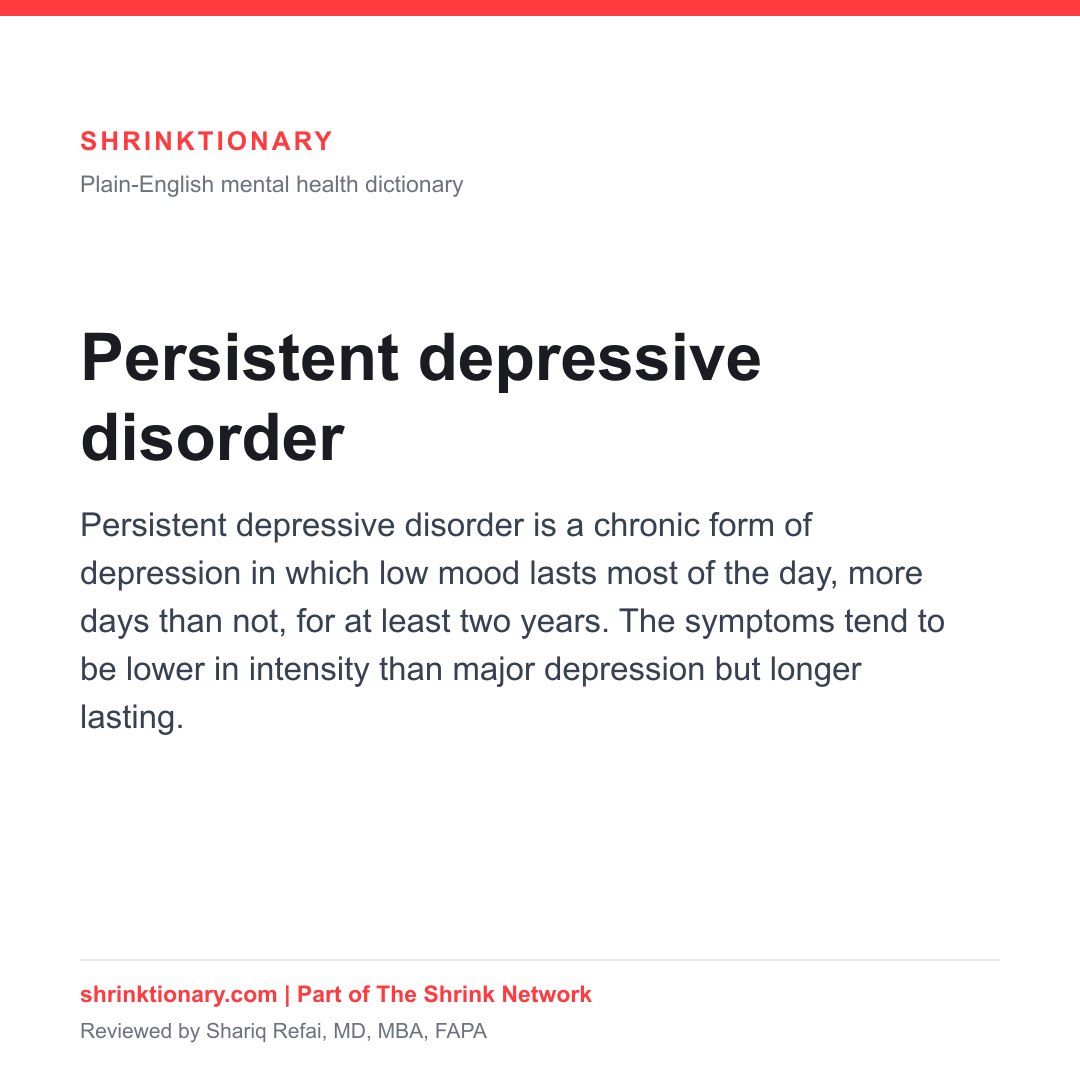
Persistent depressive disorder is a long-lasting form of depression. The defining feature is depressed mood that’s present most of the day, more days than not, for at least two years in adults, or one year in children and teens. The older name for this condition was dysthymia.
Along with the low mood, people usually have several other symptoms, such as low energy, poor appetite or overeating, trouble sleeping or sleeping too much, low self-esteem, difficulty concentrating, and a sense of hopelessness. The symptoms are often less intense than those of a major depressive episode, but they stick around far longer, which is what gives the condition its name.
Because it lasts so long, some people come to see the low mood as just part of who they are rather than as a treatable condition. It’s also possible to have episodes of major depression layered on top of persistent depressive disorder, sometimes called double depression.
What persistent depressive disorder can feel like
Living with persistent depressive disorder is often described as a gray, low-grade heaviness that never fully lifts. Rather than dramatic crashes, it can feel like a steady absence of joy, energy, or motivation that has been present for so long it feels normal.
People may push through work and responsibilities while feeling like they’re running on empty. They might assume they’re simply a pessimistic or tired person, not realizing that the persistent low mood is something that can change with treatment.
What persistent depressive disorder isn’t
Persistent depressive disorder isn’t a personality flaw or simply a gloomy disposition. It’s a recognized mood disorder, and the chronic nature of it can make it easy to mistake for an unchangeable trait.
It also isn’t the same as major depressive disorder, though the two overlap and can occur together. Major depression tends to come in distinct episodes that may be more severe, while persistent depressive disorder is defined by its long, continuous duration. Telling them apart helps guide the right approach to care.
Related terms you’ll see next
Depression is the broader category this condition belongs to. Major depressive disorder can occur on top of persistent depressive disorder. Anhedonia describes the loss of pleasure that often comes with it. Behavioral activation is a treatment approach used for chronic low mood.
When to seek professional care
If low mood and low energy have been with you for years and feel like part of the background, it’s worth an evaluation, even if you’ve learned to function around it. A clinician can sort out whether the pattern fits persistent depressive disorder and what treatments could help. Long-standing depression can improve with care, even after many years. If you’re having thoughts of suicide or self-harm, seek help right away. If you’re in crisis, call or text 988 in the United States.
When evaluation may help
Not everyone reading about persistent depressive disorder needs treatment. If it's getting in the way of your day, your sleep, your work, or your relationships, or if it isn't easing on its own, a professional evaluation is a reasonable next step. Most people start with their primary care doctor or a therapist. A psychiatrist is the right call when medication may be involved or the picture is complicated, though waits can be long.
We keep an honest, no-commission rundown of the options, from primary care to telepsychiatry to crisis lines, on one page.
If you're in crisis or thinking about suicide, call or text 988 in the US, or go to the nearest emergency room.
When this word matters
The distinction matters because PDD is a chronic, lower-intensity low mood lasting at least two years, which is different from major depression's more intense but often shorter episodes, and the two can overlap.
Commonly confused with
Frequently asked questions
What's the difference between persistent depressive disorder and major depression?
Major depression tends to come in distinct episodes that may be more severe, while persistent depressive disorder is defined by its long, continuous duration. The two overlap and can occur together, but telling them apart helps guide the right care.
Is persistent depressive disorder the same as dysthymia?
Yes. Dysthymia is the older name for this condition, sometimes also called chronic depression. The defining feature is depressed mood present most of the day, more days than not, for at least two years in adults.
What is double depression?
Double depression is when episodes of major depression layer on top of persistent depressive disorder. Even long-standing depression can improve with care, so an evaluation is worthwhile even if the low mood has felt like part of the background for years.
Related terms
In these language clusters
Compare
Sources
- Depression , National Institute of Mental Health
- Depression , MedlinePlus
- Diagnostic and Statistical Manual of Mental Disorders, Fifth Edition, Text Revision (DSM-5-TR) , American Psychiatric Association
Use or cite this definition
Free to reuse with attribution. Paste the block into your own page, or grab a citation.
Embed on your site
<blockquote>
<p><strong>Persistent depressive disorder:</strong> Persistent depressive disorder is a chronic form of depression in which low mood lasts most of the day, more days than not, for at least two years. The symptoms tend to be lower in intensity than major depression but longer lasting.</p>
<p>— <a href="https://shrinktionary.com/terms/persistent-depressive-disorder/">Shrinktionary</a>, a plain-English mental health dictionary, medically reviewed by a board certified psychiatrist.</p>
</blockquote>Cite (APA)
Refai, S. (2026). Persistent depressive disorder. Shrinktionary. https://shrinktionary.com/terms/persistent-depressive-disorder/
Cite (MLA)
"Persistent depressive disorder." Shrinktionary, https://shrinktionary.com/terms/persistent-depressive-disorder/. Accessed September 26, 2026.
Your next step in The Shrink Network
You are here: Shrinktionary, the language layer of The Shrink Network.
Each site in the network has one job. No matter where you enter, we help you find the next step that makes sense.
Want to understand more first?
See how this connects to everything else in the Term Web →
Take it with you
Free printable references you can save or share. For education, not medical advice.