What cyclothymia actually is
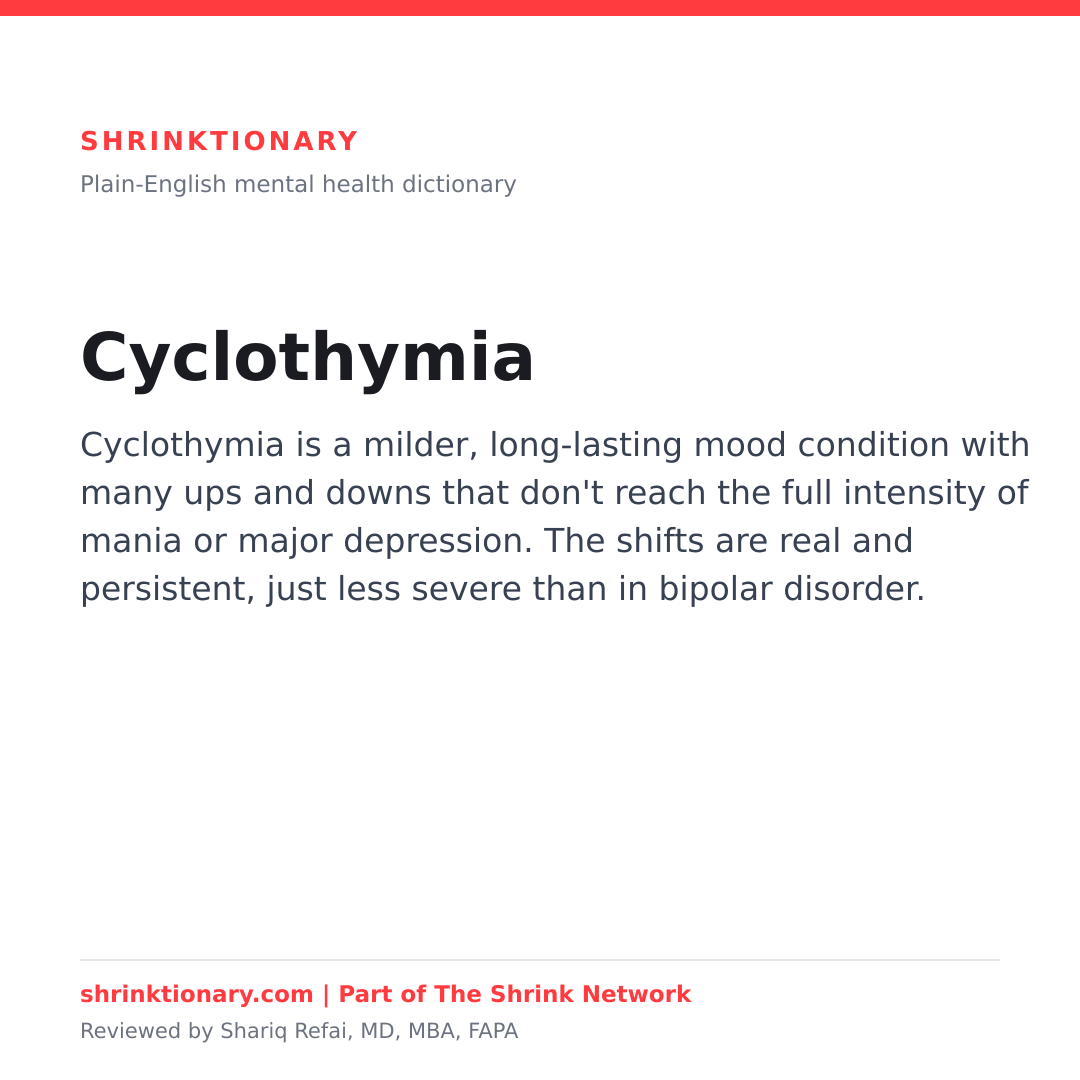
Cyclothymia is a long-lasting mood condition that involves many shifts between mild highs and mild lows. The highs resemble hypomania, where a person feels more energized or upbeat, and the lows resemble depression, but neither reaches the full severity seen in bipolar disorder. For the diagnosis, these ups and downs continue over a long stretch of time, usually at least two years in adults, without a long break.
It sits on the bipolar spectrum as a milder, chronic form. Because the swings are less dramatic, cyclothymia can go unrecognized for years, with people assuming the shifts are just part of their temperament. Over time, some people with cyclothymia go on to develop fuller bipolar episodes.
How cyclothymia shows up
The pattern often feels like riding gentle but unpredictable waves. During an up phase, a person might feel productive, sociable, and full of ideas, sleeping less and feeling confident. During a down phase, they might feel tired, low, and uninterested in things they usually enjoy.
These phases can come and go fairly quickly, and stretches of steady mood are usually short. The instability can wear on relationships, work, and self-image, partly because it’s hard to predict how a given week will go. Many people describe feeling like they never quite settle.
What cyclothymia isn’t
It isn’t ordinary moodiness or having a good week followed by a rough one. The shifts in cyclothymia are persistent and last over years, and they cause real disruption. It also isn’t the same as full bipolar disorder, where the highs and lows reach the level of mania or major depression.
And it isn’t a sign of being unstable as a person or simply needing to “even out.” It’s a recognized condition that can be understood and managed with the right support.
Related terms you’ll see next
When to seek professional care
It’s worth talking with a professional when mood swings feel persistent, hard to predict, or disruptive to daily life, even if they seem mild. A clinician can tell cyclothymia apart from related mood conditions and help with treatment, which often includes mood-stabilizing approaches and therapy. If lows ever bring thoughts of suicide, reach out for urgent help through a crisis line or emergency services.
When evaluation may help
Not everyone reading about cyclothymia needs treatment. If it's getting in the way of your day, your sleep, your work, or your relationships, or if it isn't easing on its own, a professional evaluation is a reasonable next step. Most people start with their primary care doctor or a therapist. A psychiatrist is the right call when medication may be involved or the picture is complicated, though waits can be long.
We keep an honest, no-commission rundown of the options, from primary care to telepsychiatry to crisis lines, on one page.
If you're in crisis or thinking about suicide, call or text 988 in the US, or go to the nearest emergency room.
When this word matters
It becomes a diagnosis when many ups and downs persist over a long stretch but never reach the full intensity of mania or major depression. Telling it apart from bipolar disorder matters because the shifts are real and lasting, just less severe.
Commonly confused with
Frequently asked questions
What is cyclothymia?
Cyclothymia is a long-lasting mood condition with many shifts between mild highs and mild lows that don't reach the full intensity of mania or major depression. The diagnosis involves these ups and downs continuing over a long stretch, usually at least two years in adults.
How is cyclothymia different from bipolar disorder?
Cyclothymia sits on the bipolar spectrum as a milder, chronic form, where the highs and lows don't reach the level of mania or major depression. Over time, some people with cyclothymia go on to develop fuller bipolar episodes.
Is cyclothymia just ordinary moodiness?
No. The shifts in cyclothymia are persistent and last over years, and they cause real disruption to relationships, work, and self-image. It's a recognized condition that can be understood and managed with the right support.
Related terms
In these language clusters
Compare
Sources
- Bipolar Disorder , National Institute of Mental Health
- Cyclothymic Disorder , MedlinePlus
Use or cite this definition
Free to reuse with attribution. Paste the block into your own page, or grab a citation.
Embed on your site
<blockquote>
<p><strong>Cyclothymia:</strong> Cyclothymia is a milder, long-lasting mood condition with many ups and downs that don't reach the full intensity of mania or major depression. The shifts are real and persistent, just less severe than in bipolar disorder.</p>
<p>— <a href="https://shrinktionary.com/terms/cyclothymia/">Shrinktionary</a>, a plain-English mental health dictionary, medically reviewed by a board certified psychiatrist.</p>
</blockquote>Cite (APA)
Refai, S. (2026). Cyclothymia. Shrinktionary. https://shrinktionary.com/terms/cyclothymia/
Cite (MLA)
"Cyclothymia." Shrinktionary, https://shrinktionary.com/terms/cyclothymia/. Accessed September 26, 2026.
Your next step in The Shrink Network
You are here: Shrinktionary, the language layer of The Shrink Network.
Each site in the network has one job. No matter where you enter, we help you find the next step that makes sense.
Want to understand more first?
See how this connects to everything else in the Term Web →
Take it with you
Free printable references you can save or share. For education, not medical advice.