What psychotropic actually means
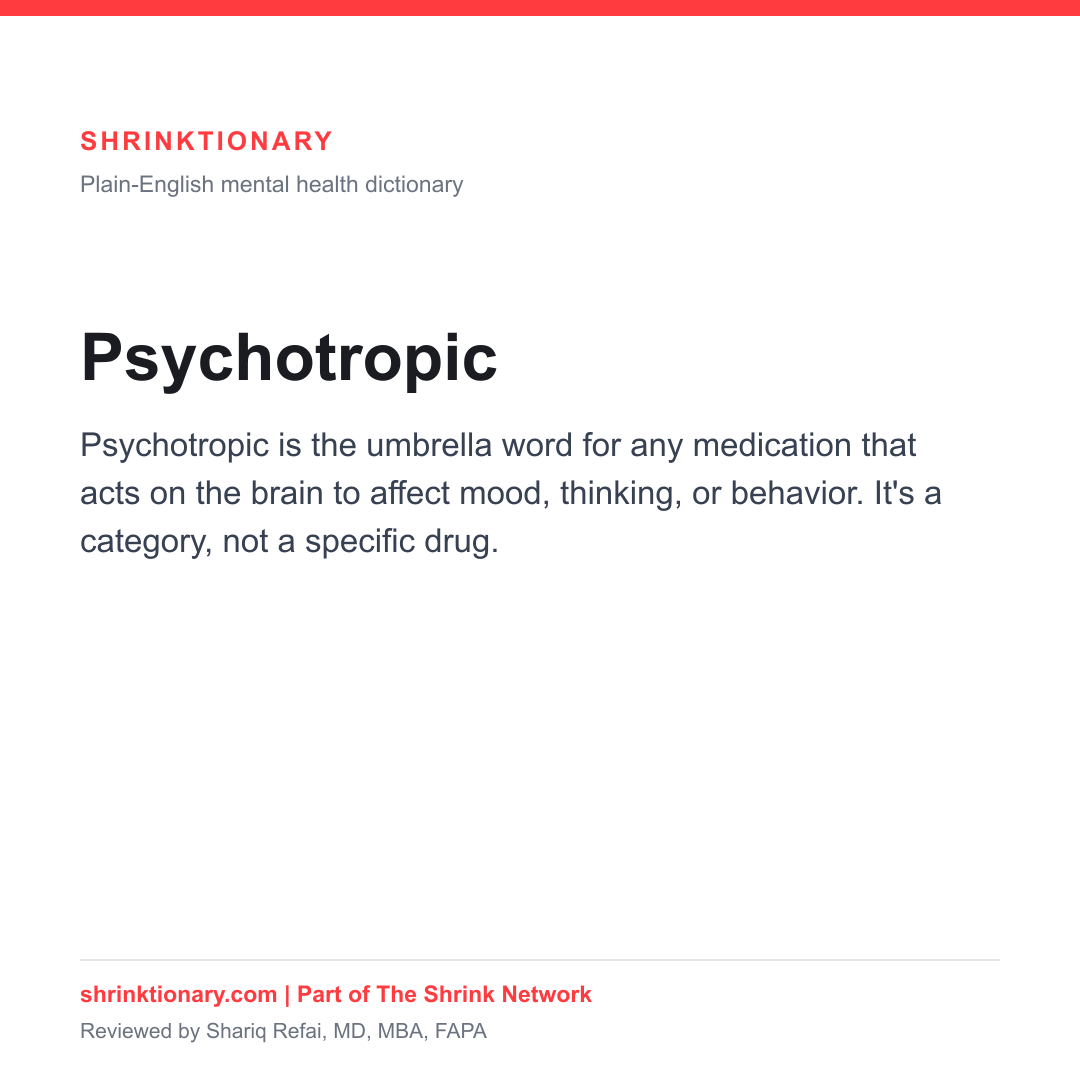
Psychotropic is the umbrella. It covers any medication that acts on the brain in a way that changes mood, thinking, perception, or behavior. Antidepressants are psychotropic. So are antipsychotics, mood stabilizers, anti-anxiety medications, stimulants, and sleep medications.
The word tells you the category, not the drug, and not what it does. It’s the level of language a form uses when it asks “are you taking any psychotropic medications,” meaning: anything in this whole territory.
Where you’ll hear it
Mostly in clinical writing, on intake paperwork, in insurance documents, and in research papers. It’s not a word people use about their own treatment. Nobody says they’re on a psychotropic. They say they’re on Zoloft.
That’s worth knowing because the gap between the two vocabularies is exactly where confusion lives. A form asks about psychotropics, someone reads it, doesn’t recognize the word, and answers no while holding a prescription for one.
What psychotropic isn’t
It isn’t a comment on how strong a drug is or how serious a condition must be to warrant it. A low dose of something for sleep and a medication for schizophrenia are both psychotropic, and the word flattens them into the same bucket.
It also isn’t the same as psychoactive in everyday use, though the two words overlap. Psychoactive gets applied broadly to anything that affects the mind, including caffeine, alcohol, and recreational drugs. Psychotropic usually, though not always, points at prescribed medication.
And it isn’t a scary word, despite sounding like one. It’s just a filing category.
Related terms you’ll see next
When to seek professional care
When a form or a clinician asks about psychotropic medications, the safest thing is to list everything you take that affects mood, sleep, anxiety, focus, or thinking, and let them sort out what counts. Include supplements and over-the-counter sleep aids, since those can interact even when they don’t feel like medication. If you have thoughts of harming yourself, get help right away by calling 911, or call or text 988 in the US to reach the Suicide and Crisis Lifeline.
When this word matters
It matters on intake forms. Someone reads "are you taking any psychotropic medications," doesn't recognize the word, and answers no while holding a prescription for one.
Commonly confused with
Frequently asked questions
What counts as a psychotropic medication?
Any medication that acts on the brain to change mood, thinking, perception, or behavior. Antidepressants, antipsychotics, mood stabilizers, anti-anxiety medications, stimulants, and sleep medications are all psychotropic.
Is psychotropic the same as psychoactive?
They overlap. Psychoactive gets applied broadly to anything that affects the mind, including caffeine, alcohol, and recreational drugs. Psychotropic usually, though not always, points at prescribed medication.
A form asked if I take psychotropic medication. What should I say?
List everything you take that affects mood, sleep, anxiety, focus, or thinking, and let the clinician sort out what counts. Include supplements and over-the-counter sleep aids, since those can interact even when they don't feel like medication.
Related terms
In these language clusters
Sources
- Mental Health Medications , National Institute of Mental Health
- Mental Health , MedlinePlus
Use or cite this definition
Free to reuse with attribution. Paste the block into your own page, or grab a citation.
Embed on your site
<blockquote>
<p><strong>Psychotropic:</strong> Psychotropic is the umbrella word for any medication that acts on the brain to affect mood, thinking, or behavior. It's a category, not a specific drug.</p>
<p>— <a href="https://shrinktionary.com/terms/psychotropic/">Shrinktionary</a>, a plain-English mental health dictionary, medically reviewed by a board certified psychiatrist.</p>
</blockquote>Cite (APA)
Refai, S. (2026). Psychotropic. Shrinktionary. https://shrinktionary.com/terms/psychotropic/
Cite (MLA)
"Psychotropic." Shrinktionary, https://shrinktionary.com/terms/psychotropic/. Accessed September 29, 2026.
Your next step in The Shrink Network
You are here: Shrinktionary, the language layer of The Shrink Network.
Each site in the network has one job. No matter where you enter, we help you find the next step that makes sense.
Want to understand more first?
See how this connects to everything else in the Term Web →
Take it with you
Free printable references you can save or share. For education, not medical advice.