What a generic drug actually is
Every medication has two names. One is the chemical name of the active ingredient, and one is the brand name a company gave it when it was the only version on the market. Sertraline is the drug. Zoloft is the brand. Fluoxetine is the drug. Prozac is the brand.
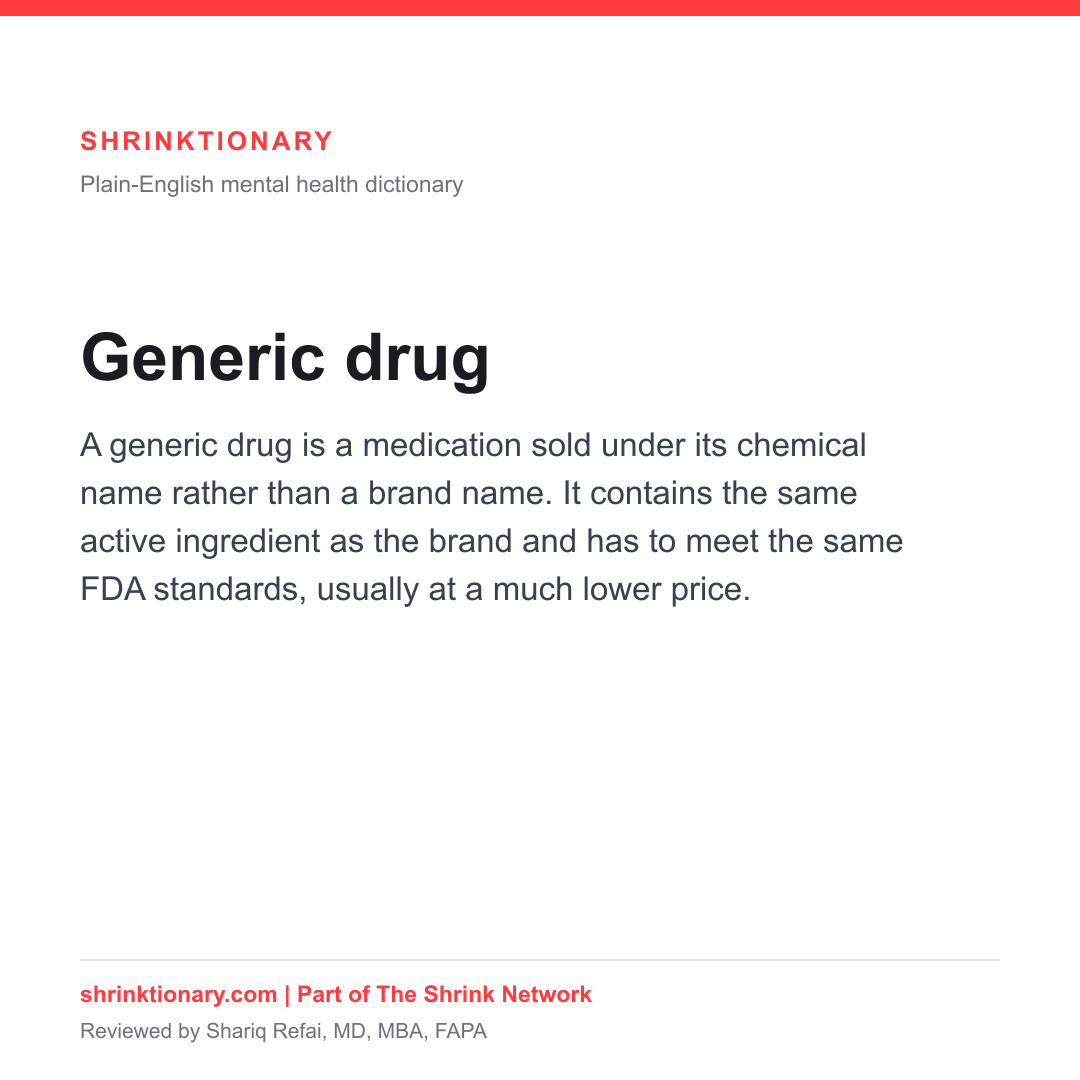
When a brand’s patent runs out, other manufacturers can make the same medication and sell it under its chemical name. That’s a generic. It has the same active ingredient, in the same amount, and it has to meet the FDA’s standards for being equivalent to the original.
Why the word comes up
Mostly, price. Generics typically cost a fraction of the brand, which is a large part of why people can afford to stay on treatment at all. Cost is one of the most common reasons people quietly stop taking a medication, so this is not a trivial detail.
It also comes up because the two names create genuine confusion. People end up believing they’re on two medications when they’re on one, or they don’t recognize their own prescription because the pharmacy label says a different word than the one their doctor used. If you’re ever unsure whether two names are the same drug, ask the pharmacist. It’s a common question and it’s exactly what they’re there for.
What a generic isn’t
A generic isn’t a weaker or lesser version. The active ingredient is the same, and the manufacturer has to show it behaves the same way in the body.
That said, generics can differ in the inactive parts: the fillers, dyes, and coatings. For most people that changes nothing. A small number of people report that a switch felt different, and while some of that is expectation, it isn’t automatically imaginary either, and it’s a reasonable thing to mention to your prescriber rather than something to feel silly about.
And a generic isn’t always available. Newer medications still under patent have no generic version yet, which is part of why they cost what they do.
Related terms you’ll see next
When to seek professional care
If cost is why you’re skipping doses or stretching a prescription, say so to your prescriber. That’s a solvable problem far more often than people expect, and it’s a much better conversation than the one that follows a relapse. If a switch between a brand and a generic seems to have changed how you feel, bring it up rather than sitting with it. If you have thoughts of harming yourself, get help right away by calling 911, or call or text 988 in the US to reach the Suicide and Crisis Lifeline.
When this word matters
It matters at the pharmacy counter, when the label says a word your doctor never used and you're not sure you were handed the right thing. It also matters because cost is one of the most common reasons people quietly stop treatment.
Commonly confused with
Frequently asked questions
Are generic drugs as good as the brand?
A generic contains the same active ingredient, in the same amount, and has to meet the FDA's standards for behaving equivalently in the body. It isn't a weaker or lesser version. Generics can differ in inactive parts like fillers and dyes, which for most people changes nothing.
Why does my prescription have two different names?
Every medication has a chemical name and, often, a brand name. Sertraline is the drug and Zoloft is the brand. They're the same medication. If you're ever unsure whether two names refer to one drug, ask the pharmacist. It's a common question.
Why is there no generic version of my medication?
Newer medications still under patent have no generic yet. Once the patent expires, other manufacturers can make the same drug and sell it under its chemical name, which is usually when the price drops sharply.
Related terms
In these language clusters
Sources
- Drugs , U.S. Food and Drug Administration
- Drugs, Herbs and Supplements , MedlinePlus (U.S. National Library of Medicine)
Use or cite this definition
Free to reuse with attribution. Paste the block into your own page, or grab a citation.
Embed on your site
<blockquote>
<p><strong>Generic drug:</strong> A generic drug is a medication sold under its chemical name rather than a brand name. It contains the same active ingredient as the brand and has to meet the same FDA standards, usually at a much lower price.</p>
<p>— <a href="https://shrinktionary.com/terms/generic-drug/">Shrinktionary</a>, a plain-English mental health dictionary, medically reviewed by a board certified psychiatrist.</p>
</blockquote>Cite (APA)
Refai, S. (2026). Generic drug. Shrinktionary. https://shrinktionary.com/terms/generic-drug/
Cite (MLA)
"Generic drug." Shrinktionary, https://shrinktionary.com/terms/generic-drug/. Accessed September 29, 2026.
Your next step in The Shrink Network
You are here: Shrinktionary, the language layer of The Shrink Network.
Each site in the network has one job. No matter where you enter, we help you find the next step that makes sense.
Want to understand more first?
See how this connects to everything else in the Term Web →
Take it with you
Free printable references you can save or share. For education, not medical advice.