What medication adherence actually is
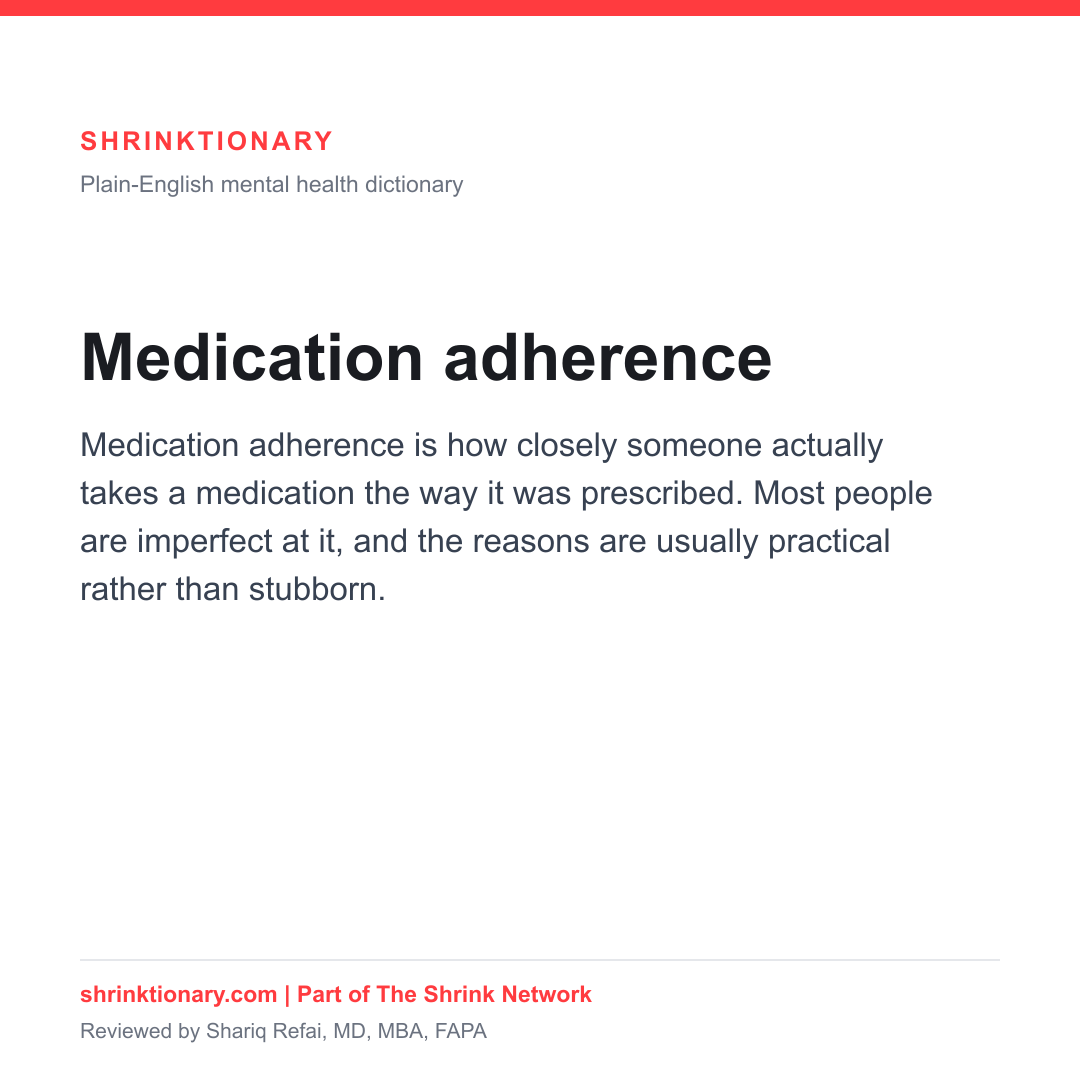
Adherence is the gap between the prescription and reality. It covers taking the right dose, at roughly the right time, for as long as it was meant to be taken, and it’s the quiet variable behind an enormous amount of treatment that appears not to be working.
It’s worth saying plainly: almost nobody is perfect at this. Missing doses is normal human behavior, not a character defect, and a clinician who has been doing this a while assumes some of it is happening.
Why the word matters
Because “the medication isn’t working” and “the medication isn’t being taken” look identical from the outside, and they lead to completely different next steps. If a prescriber doesn’t know that half the doses were missed, the logical move is to raise the dose or switch drugs, and both of those are the wrong move.
The reasons people don’t take medication are almost always practical, and almost always fixable. Side effects nobody warned them about. Cost. Feeling better and assuming they’re done. Too many pills at too many times of day. Not really believing the diagnosis. Nobody ever explaining why it would take six weeks to feel anything. Every one of those has an answer, but only if it gets said out loud.
What adherence isn’t
It isn’t obedience. The older word for this was “compliance,” and it fell out of use for good reason, because it framed the patient as someone who follows orders rather than someone making decisions about their own body.
It also isn’t a moral test. If you’ve stopped taking something, the useful question is what made it hard, not whether you tried hard enough.
And low adherence isn’t always a mistake. Sometimes people stop a medication because it was genuinely making their life worse, and the problem isn’t that they stopped, it’s that nobody was told.
Related terms you’ll see next
When to seek professional care
Tell your prescriber the truth about what you’re actually taking, including the doses you’ve skipped. It isn’t a confession, it’s the single most useful piece of information you can hand them, and treatment decisions get made badly without it. If a medication is hard to keep taking, say why, because dosing schedules, formulations, and costs can often be changed. If you have thoughts of harming yourself, get help right away by calling 911, or call or text 988 in the US to reach the Suicide and Crisis Lifeline.
When this word matters
It matters at the appointment where you're asked how it's going and you round up. That small, understandable edit is how a dose gets raised that didn't need raising, or a working medication gets abandoned.
Commonly confused with
Frequently asked questions
Why does it matter if I miss doses?
Because "the medication isn't working" and "the medication isn't being taken" look identical from the outside, and they lead to opposite next steps. If your prescriber doesn't know doses were missed, the logical move is to raise the dose or switch drugs, and both of those would be wrong.
Should I tell my doctor I've been skipping doses?
Yes. It isn't a confession, it's the single most useful piece of information you can hand them. Treatment decisions get made badly without it, and a clinician who has been doing this a while already assumes some doses get missed.
Why is it called adherence and not compliance?
Compliance fell out of use because it framed the patient as someone who follows orders. Adherence reflects that you're making decisions about your own body. The reasons people don't take medication are almost always practical, and almost always fixable.
Related terms
In these language clusters
Sources
- Mental Health Medications , National Institute of Mental Health
- Drugs, Herbs and Supplements , MedlinePlus (U.S. National Library of Medicine)
Use or cite this definition
Free to reuse with attribution. Paste the block into your own page, or grab a citation.
Embed on your site
<blockquote>
<p><strong>Medication adherence:</strong> Medication adherence is how closely someone actually takes a medication the way it was prescribed. Most people are imperfect at it, and the reasons are usually practical rather than stubborn.</p>
<p>— <a href="https://shrinktionary.com/terms/medication-adherence/">Shrinktionary</a>, a plain-English mental health dictionary, medically reviewed by a board certified psychiatrist.</p>
</blockquote>Cite (APA)
Refai, S. (2026). Medication adherence. Shrinktionary. https://shrinktionary.com/terms/medication-adherence/
Cite (MLA)
"Medication adherence." Shrinktionary, https://shrinktionary.com/terms/medication-adherence/. Accessed September 29, 2026.
Your next step in The Shrink Network
You are here: Shrinktionary, the language layer of The Shrink Network.
Each site in the network has one job. No matter where you enter, we help you find the next step that makes sense.
Want to understand more first?
See how this connects to everything else in the Term Web →
Take it with you
Free printable references you can save or share. For education, not medical advice.