What maintenance treatment actually is
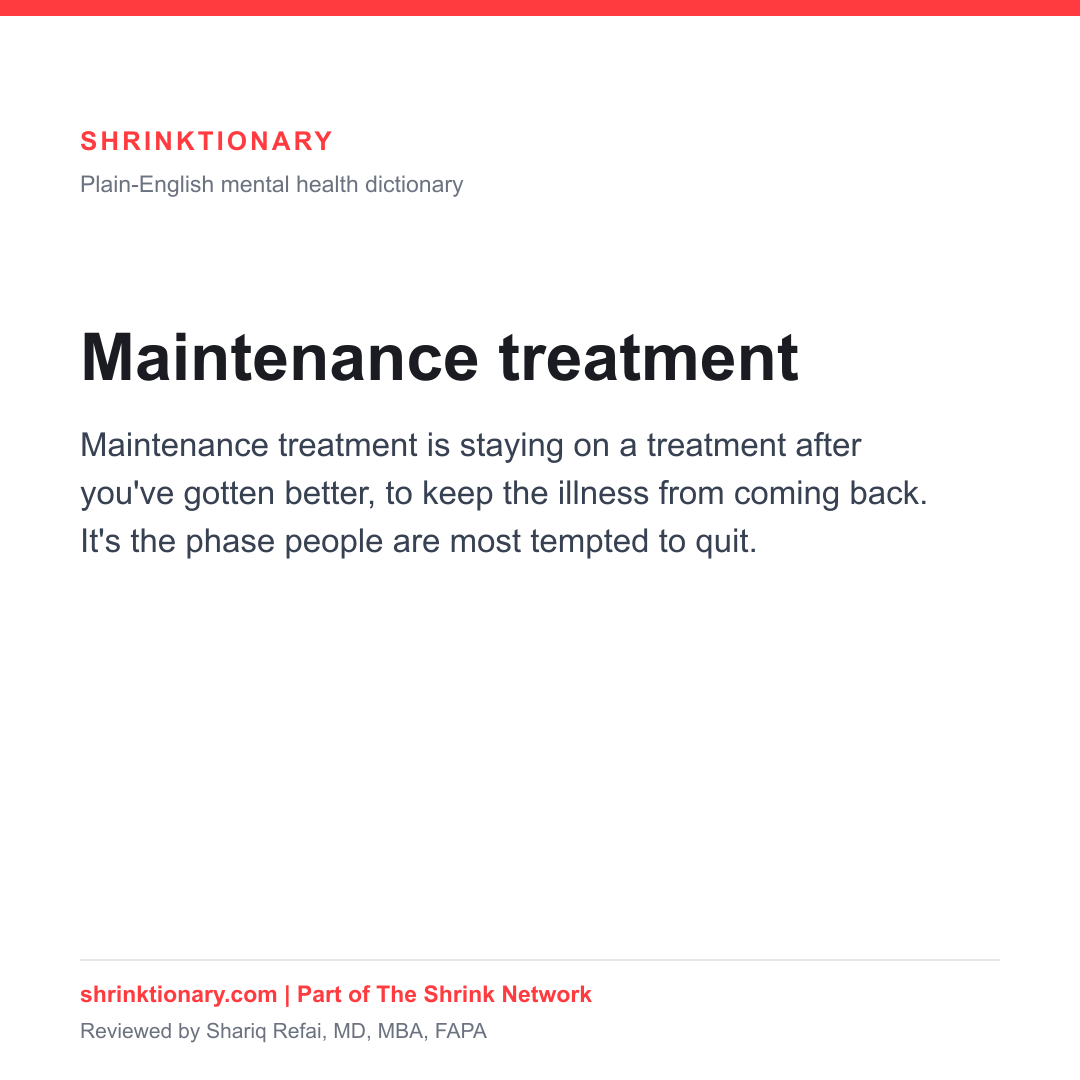
Treatment usually has two jobs. The first is getting you out of an episode. The second is keeping you out of the next one. Maintenance treatment is that second job.
It’s the stretch that begins after you feel better. The symptoms have lifted, life has resumed, and you’re still taking the medication anyway, because stopping the moment you recover is one of the most reliable ways to end up back where you started.
Why the word matters
Because it explains something that otherwise feels absurd. People routinely ask why they’re still on a medication when they feel fine. The answer is that feeling fine is often the medication working, not evidence that it’s no longer needed.
How long maintenance lasts depends on the condition and on your history. After a first episode of depression it’s often months rather than forever. After several episodes, the calculation changes, because each one raises the odds of another. In bipolar disorder, maintenance is frequently long-term, and preventing episodes is much of the point of the treatment.
The tension here is real and worth naming honestly. There’s a genuine cost to staying on a medication, and a genuine risk in stopping it. That’s a trade-off to weigh with a prescriber, not a lecture to be given.
What maintenance treatment isn’t
It isn’t a life sentence, and it isn’t a sign of weakness or dependence. Staying on a medication that prevents episodes is closer to how the rest of medicine works than to anything unusual.
It also isn’t the same as remission. Remission is the state of being well. Maintenance is what you do to protect it.
And it isn’t a decision to make alone at the point where you feel best. That’s precisely the moment when stopping seems most obviously reasonable, and it’s precisely the moment when a relapse is easiest to cause.
Related terms you’ll see next
When to seek professional care
If you want to come off a medication because you feel better, that’s a legitimate goal and worth raising, not hiding. Ask your prescriber how long maintenance is meant to last in your case and what the odds of relapse look like if you stop, because those numbers exist and they’ll make the decision yours instead of a guess. If you do stop, do it as a planned taper with someone watching. If you have thoughts of harming yourself, get help right away by calling 911, or call or text 988 in the US to reach the Suicide and Crisis Lifeline.
When this word matters
It matters at the exact moment you feel best, because that's when stopping seems most obviously reasonable and when a relapse is easiest to cause. Feeling well is often the medication working, not proof it's finished.
Commonly confused with
Frequently asked questions
Why am I still on medication if I feel fine?
Because feeling fine is often the medication working, not evidence that it's no longer needed. Maintenance treatment is the phase that keeps the next episode from arriving, and stopping the moment you recover is one of the most reliable ways to end up back where you started.
How long does maintenance treatment last?
It depends on the condition and your history. After a first episode of depression it's often months rather than forever. After several episodes the calculation changes, because each one raises the odds of another. In bipolar disorder, maintenance is frequently long-term.
Can I stop maintenance treatment?
It's a legitimate goal and worth raising with your prescriber rather than acting on alone. Ask what the odds of relapse look like if you stop, then taper with someone watching rather than stopping outright.
Related terms
In these language clusters
Sources
- Depression , National Institute of Mental Health
- Mental Health Medications , National Institute of Mental Health
Use or cite this definition
Free to reuse with attribution. Paste the block into your own page, or grab a citation.
Embed on your site
<blockquote>
<p><strong>Maintenance treatment:</strong> Maintenance treatment is staying on a treatment after you've gotten better, to keep the illness from coming back. It's the phase people are most tempted to quit.</p>
<p>— <a href="https://shrinktionary.com/terms/maintenance-treatment/">Shrinktionary</a>, a plain-English mental health dictionary, medically reviewed by a board certified psychiatrist.</p>
</blockquote>Cite (APA)
Refai, S. (2026). Maintenance treatment. Shrinktionary. https://shrinktionary.com/terms/maintenance-treatment/
Cite (MLA)
"Maintenance treatment." Shrinktionary, https://shrinktionary.com/terms/maintenance-treatment/. Accessed September 29, 2026.
Your next step in The Shrink Network
You are here: Shrinktionary, the language layer of The Shrink Network.
Each site in the network has one job. No matter where you enter, we help you find the next step that makes sense.
Want to understand more first?
See how this connects to everything else in the Term Web →
Take it with you
Free printable references you can save or share. For education, not medical advice.