What nervous breakdown actually is
“Nervous breakdown” is a phrase people reach for when someone hits a wall. The pressure has built up, and they can’t keep going. They might stop showing up to work, stop answering the phone, or feel like they’ve simply run out of whatever it takes to cope.
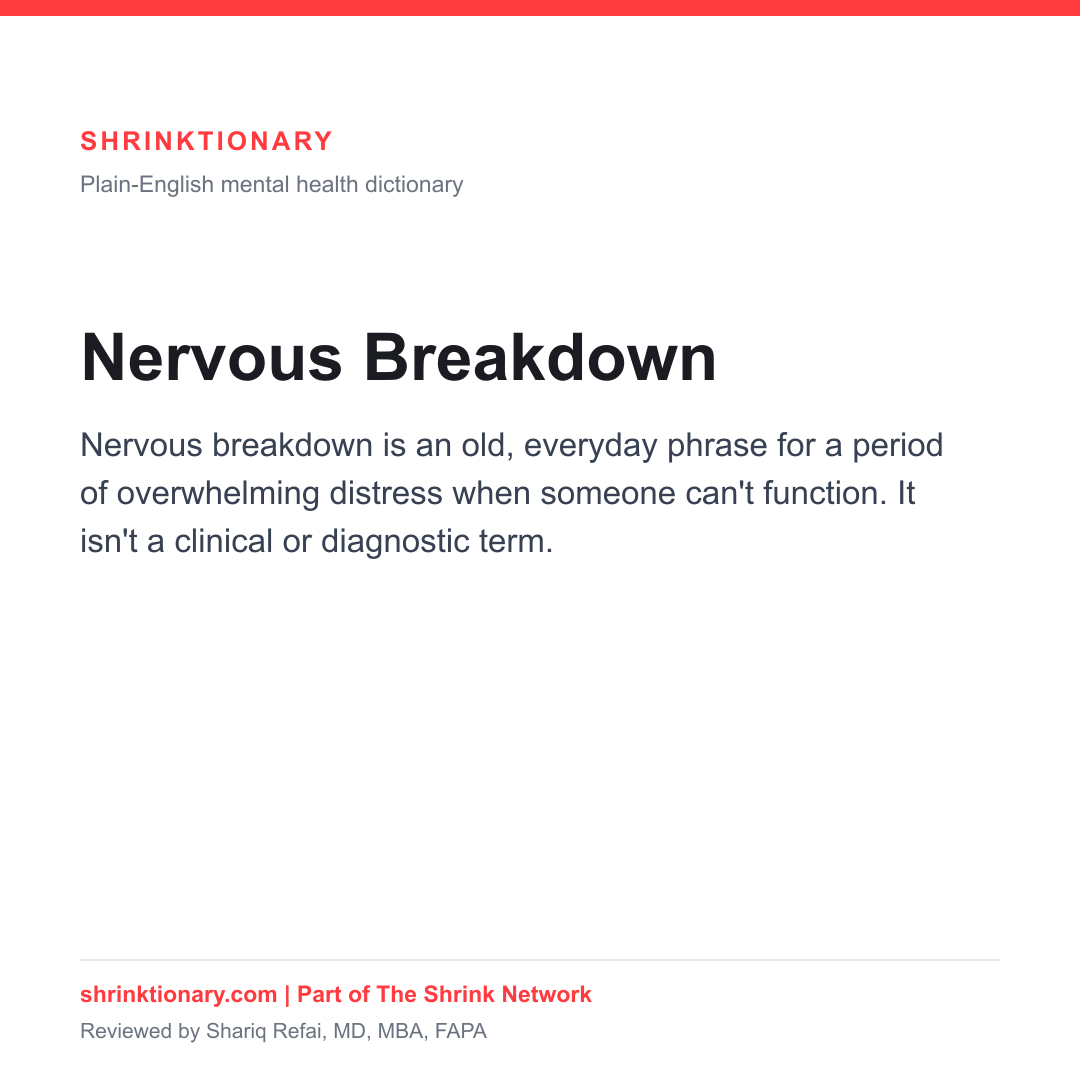
It’s worth being clear about one thing right away. Nervous breakdown isn’t a medical diagnosis. You won’t find it in the manuals clinicians use. It’s an everyday term, not a clinical one, and it describes a situation rather than a specific condition.
What people usually mean
When someone says they had a nervous breakdown, they’re usually describing a stretch of time when distress got so intense that normal life ground to a halt. That can look like uncontrollable crying, panic, exhaustion, trouble sleeping or eating, or feeling detached from everything around them.
Underneath the phrase there’s often something a clinician can name and treat. That might be severe depression, an anxiety condition, a panic episode, or the tail end of long, unrelenting stress. The phrase points at a real experience. It just doesn’t tell you what’s driving it.
What it isn’t
A nervous breakdown isn’t a sign of weakness, and it isn’t a permanent state. People recover. It also isn’t a precise label, so it doesn’t tell a doctor much on its own. Two people who both say they “had a breakdown” might be dealing with very different things.
It’s also not the same as “going crazy.” That framing adds shame to something that’s already hard, and it gets in the way of people asking for help.
Related terms you’ll see next
Burnout describes the depletion that comes from prolonged stress, often at work. Stress is the body’s response to ongoing demand. Depression and anxiety are two of the conditions that often sit underneath what people call a breakdown.
Why the distinction matters
The phrase can be a useful flag that someone is in real trouble. But because it isn’t a diagnosis, the helpful next step is to figure out what’s actually going on. If you or someone you know has reached this point, a licensed clinician can identify what’s driving it and start treatment that fits. If there are thoughts of suicide, that’s an emergency, and reaching out for immediate help is the right move.
When this word matters
Because it isn't a real diagnosis, the phrase matters mainly as a signal that someone is overwhelmed and unable to function, which can reflect conditions like a depressive episode, severe anxiety, or burnout that deserve a closer look.
Commonly confused with
Frequently asked questions
Is a nervous breakdown a medical diagnosis?
No. It's an everyday phrase, not a clinical term, and you won't find it in the manuals clinicians use. It describes a situation rather than a specific condition.
What do people usually mean by a nervous breakdown?
They usually mean a stretch of time when distress got so intense that normal life ground to a halt, with things like uncontrollable crying, panic, exhaustion, or feeling detached. Underneath it there's often something a clinician can name and treat.
What can be behind what people call a nervous breakdown?
It might be severe depression, an anxiety condition, a panic episode, or the tail end of long, unrelenting stress. Because the phrase isn't a diagnosis, a clinician can help identify what's actually driving it.
Related terms
Sources
- Caring for Your Mental Health , National Institute of Mental Health
- Mental Health , MedlinePlus
Use or cite this definition
Free to reuse with attribution. Paste the block into your own page, or grab a citation.
Embed on your site
<blockquote>
<p><strong>Nervous Breakdown:</strong> Nervous breakdown is an old, everyday phrase for a period of overwhelming distress when someone can't function. It isn't a clinical or diagnostic term.</p>
<p>— <a href="https://shrinktionary.com/terms/nervous-breakdown/">Shrinktionary</a>, a plain-English mental health dictionary, medically reviewed by a board certified psychiatrist.</p>
</blockquote>Cite (APA)
Refai, S. (2026). Nervous Breakdown. Shrinktionary. https://shrinktionary.com/terms/nervous-breakdown/
Cite (MLA)
"Nervous Breakdown." Shrinktionary, https://shrinktionary.com/terms/nervous-breakdown/. Accessed September 26, 2026.
Your next step in The Shrink Network
You are here: Shrinktionary, the language layer of The Shrink Network.
Each site in the network has one job. No matter where you enter, we help you find the next step that makes sense.
Want to understand more first?
See how this connects to everything else in the Term Web →
Take it with you
Free printable references you can save or share. For education, not medical advice.