What histrionic personality disorder actually is
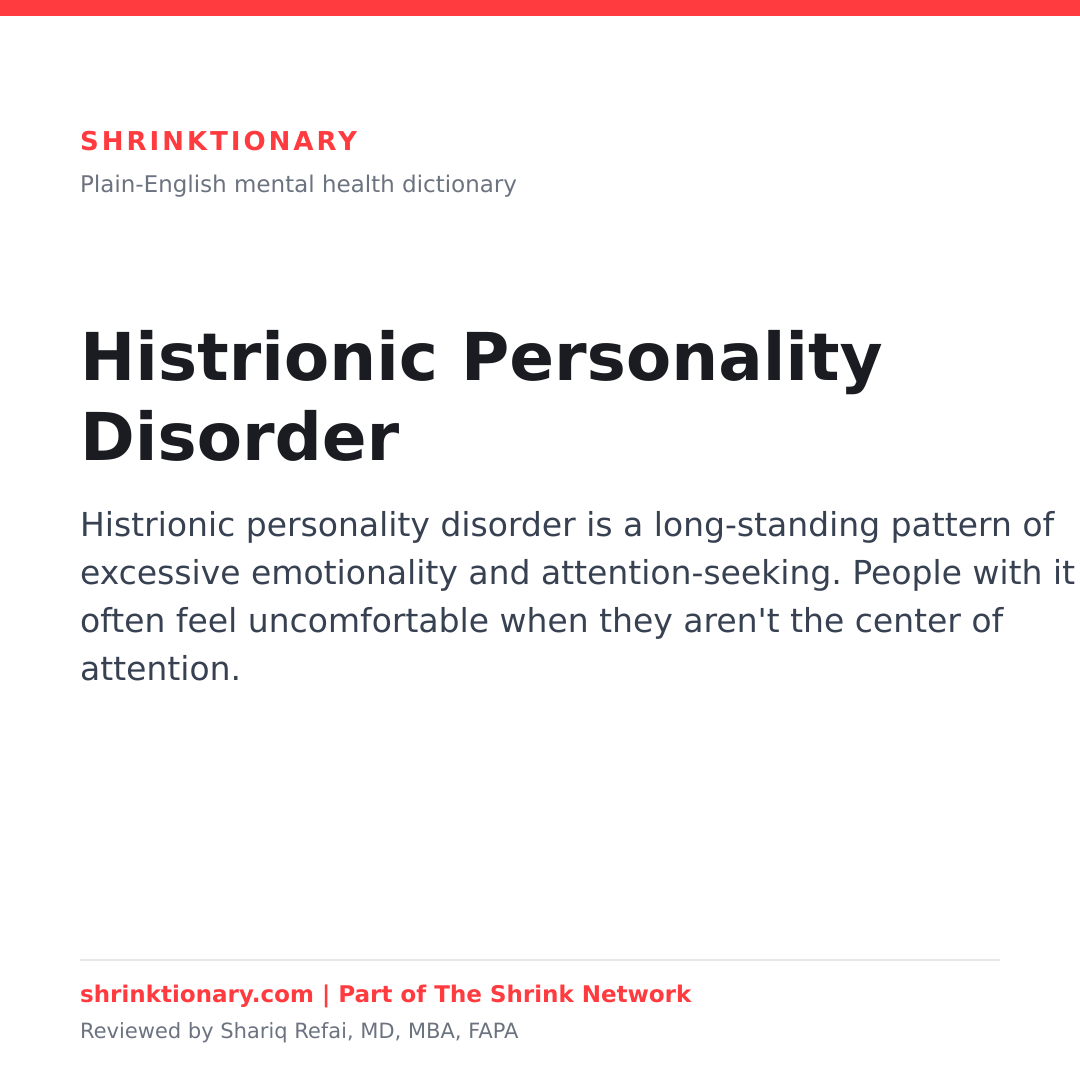
Histrionic personality disorder is one of the personality disorders described in the DSM-5-TR. It’s a stable, long-running pattern of excessive emotionality and attention-seeking that starts by early adulthood and shows up across many situations. The word histrionic comes from a root meaning theatrical, and that’s part of the picture. Emotions tend to run big, shift quickly, and get expressed in ways that pull other people’s eyes toward the person.
Clinicians look for a cluster of features, not a single trait. These can include discomfort when not the center of attention, interactions that come across as seductive or provocative, rapidly shifting and shallow emotions, using physical appearance to draw attention, speech that’s impressionistic and short on detail, dramatic or exaggerated expression, being easily influenced by others, and treating relationships as closer than they really are. A pattern this broad and this lasting is what separates a personality disorder from a passing mood or a single dramatic moment.
What histrionic personality disorder can feel like
From the inside, it often doesn’t feel like a disorder at all. Many people experience a strong, almost physical need for connection and approval, and a sinking feeling when attention drifts elsewhere. Praise can feel essential rather than nice. A quiet room can feel like rejection.
Relationships frequently start fast and warm and then strain, because the need for reassurance is hard to fully satisfy and feelings can swing. People around the person sometimes describe feeling pulled in, then confused when the emotional weather changes. The person themselves may feel misunderstood, as if their genuine feelings are being dismissed as performance.
What histrionic personality disorder isn’t
It isn’t simply being outgoing, expressive, or comfortable on a stage. Plenty of warm, dramatic, attention-loving people have no disorder at all. The diagnosis applies only when the pattern is rigid, long-standing, and causes real distress or problems in work and relationships.
It also isn’t the same as narcissistic personality disorder, even though both involve attention. It isn’t borderline personality disorder, though the two can look similar and sometimes overlap. And it isn’t a character flaw or a choice to be difficult. A personality disorder is a way of relating to the world that formed over years and feels like simply being oneself.
Related terms you’ll see next
Narcissistic personality disorder and borderline personality disorder are the conditions most often compared with this one. Validation and people-pleasing describe relationship patterns that frequently come up in the same conversations.
When to seek professional care
If patterns of attention-seeking, rapidly shifting emotions, or unstable relationships are causing ongoing distress or getting in the way of work, friendships, or family life, a mental health evaluation is a reasonable step. Personality disorders are diagnosed by a qualified clinician, never from a checklist alone. Psychotherapy is the main treatment, and many people make meaningful progress over time.
When evaluation may help
Not everyone reading about histrionic personality disorder needs treatment. If it's getting in the way of your day, your sleep, your work, or your relationships, or if it isn't easing on its own, a professional evaluation is a reasonable next step. Most people start with their primary care doctor or a therapist. A psychiatrist is the right call when medication may be involved or the picture is complicated, though waits can be long.
We keep an honest, no-commission rundown of the options, from primary care to telepsychiatry to crisis lines, on one page.
If you're in crisis or thinking about suicide, call or text 988 in the US, or go to the nearest emergency room.
When this word matters
It matters when attention-seeking, rapidly shifting emotions, or unstable relationships form a rigid, long-standing pattern that causes real distress or gets in the way of work, friendships, and family life. The pattern, not any single dramatic moment, is what separates a personality disorder from ordinary expressiveness, and it's diagnosed only by a qualified clinician.
Commonly confused with
Frequently asked questions
What is histrionic personality disorder?
Histrionic personality disorder is a long-standing pattern of excessive emotionality and attention-seeking that begins by early adulthood and shows up across many situations. People with it often feel uncomfortable when they aren't the center of attention. It's one of the personality disorders described in the DSM-5-TR.
How is it different from narcissistic personality disorder?
Both involve a strong pull toward attention, but they differ. Histrionic personality disorder centers on emotional expressiveness and a need to be noticed and approved of, while narcissistic personality disorder centers more on grandiosity and a sense of superiority. They're separate diagnoses, though they can overlap.
Can histrionic personality disorder be treated?
Yes. Psychotherapy is the main treatment, and many people make meaningful progress over time. A personality disorder is diagnosed by a qualified clinician, never from a checklist alone, so an evaluation is the right first step if the pattern is causing distress.
Related terms
Sources
- Personality Disorders , MedlinePlus (U.S. National Library of Medicine)
- Histrionic Personality Disorder (StatPearls) , National Center for Biotechnology Information
Use or cite this definition
Free to reuse with attribution. Paste the block into your own page, or grab a citation.
Embed on your site
<blockquote>
<p><strong>Histrionic Personality Disorder:</strong> Histrionic personality disorder is a long-standing pattern of excessive emotionality and attention-seeking. People with it often feel uncomfortable when they aren't the center of attention.</p>
<p>— <a href="https://shrinktionary.com/terms/histrionic-personality-disorder/">Shrinktionary</a>, a plain-English mental health dictionary, medically reviewed by a board certified psychiatrist.</p>
</blockquote>Cite (APA)
Refai, S. (2026). Histrionic Personality Disorder. Shrinktionary. https://shrinktionary.com/terms/histrionic-personality-disorder/
Cite (MLA)
"Histrionic Personality Disorder." Shrinktionary, https://shrinktionary.com/terms/histrionic-personality-disorder/. Accessed September 29, 2026.
Your next step in The Shrink Network
You are here: Shrinktionary, the language layer of The Shrink Network.
Each site in the network has one job. No matter where you enter, we help you find the next step that makes sense.
Want to understand more first?
See how this connects to everything else in the Term Web →
Take it with you
Free printable references you can save or share. For education, not medical advice.