What validation actually is
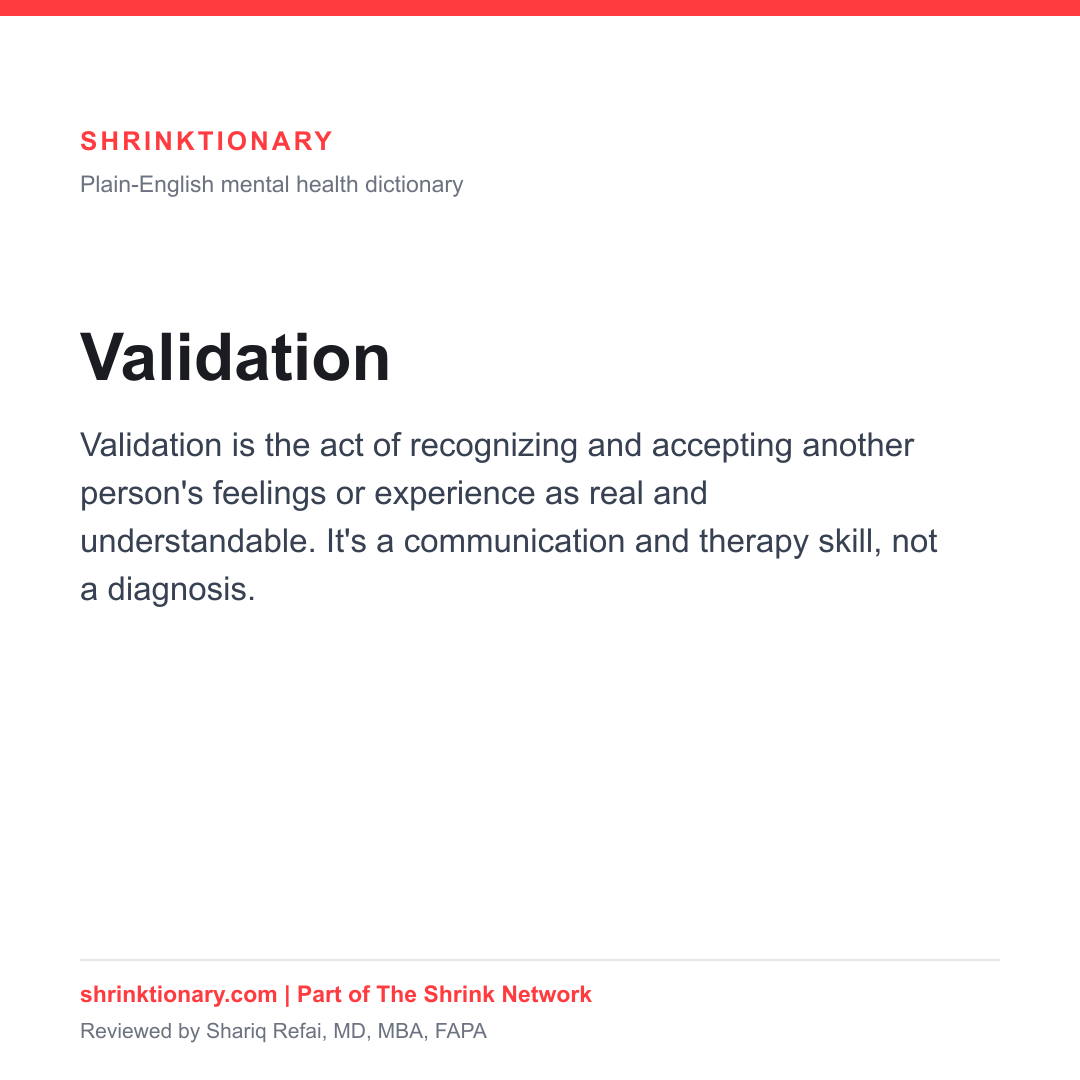
Validation is the act of letting someone know that their feelings or experience make sense and are taken seriously. It means recognizing what another person is going through without rushing to fix it, dismiss it, or argue them out of it. Saying something like that sounds really hard, or no wonder you’re upset, is validation in plain terms.
It’s a communication skill and a core part of several therapies, including dialectical behavior therapy, where it’s used deliberately alongside skills for change. Validation isn’t a diagnosis or a clinical condition. It’s a way of responding that helps people feel heard, which often lowers the emotional temperature and makes problem-solving possible. Importantly, validating a feeling doesn’t mean agreeing with every belief or endorsing every choice. It means acknowledging that the feeling is real.
How it tends to show up
In everyday life, validation can be as simple as reflecting back what you heard, naming the emotion someone seems to be feeling, or acknowledging that their reaction is understandable given their situation. It tends to show up in good listening, in steady friendships, and in conversations where someone feels safe enough to keep talking.
People also notice the absence of it. When a person shares something painful and gets met with that’s not a big deal or you’re overreacting, the result is often more distress, not less. In therapy, clinicians use validation on purpose to build trust and to help clients tolerate strong emotions long enough to work with them. There’s also self-validation, where a person learns to acknowledge their own feelings rather than dismissing them.
What validation isn’t
Validation isn’t agreement, approval, or praise. You can validate that someone feels furious without thinking their plan to act on that fury is wise. It also isn’t flattery or telling people only what they want to hear.
It isn’t the same as fixing the problem either. A lot of well-meaning advice skips validation and jumps straight to solutions, which can leave the other person feeling unheard. And it isn’t a diagnosis or a treatment on its own, but rather a building block used inside relationships and care.
Related terms you’ll see next
Emotional dysregulation often eases when feelings are validated rather than dismissed, which is part of why the skill matters in therapy. DBT is a treatment that uses validation as a core technique. Self-compassion overlaps with self-validation, where a person learns to treat their own feelings as worth acknowledging.
Why it matters
Validation matters because feeling understood is one of the most reliable ways to calm distress and keep a hard conversation from breaking down. In relationships, it builds trust and safety. In therapy, it’s part of what makes change possible, since people can usually work with an emotion more easily once it’s been acknowledged. Learning to validate others, and yourself, is a skill that tends to improve over time with practice rather than something you either have or don’t.
When this word matters
It matters because feeling understood is one of the most reliable ways to calm distress and keep a hard conversation from breaking down. In relationships it builds trust, and in therapy it's part of what makes change possible, since people can usually work with an emotion more easily once it's been acknowledged.
Commonly confused with
Frequently asked questions
Does validation mean agreeing with someone?
No. Validation means acknowledging that a person's feelings are real and understandable, not that you agree with every belief or endorse every choice. You can validate that someone feels furious without thinking their plan to act on that fury is wise.
What does validation sound like in practice?
It can be as simple as reflecting back what you heard, naming the emotion someone seems to be feeling, or saying that their reaction makes sense given their situation. Phrases like that sounds really hard are everyday examples.
Can you validate your own feelings?
Yes. Self-validation means acknowledging your own feelings rather than dismissing them. It overlaps with self-compassion and tends to improve with practice rather than being something you either have or don't.
Related terms
In these language clusters
Sources
- Dialectical Behavior Therapy , Cleveland Clinic
- Psychotherapies , National Institute of Mental Health
Use or cite this definition
Free to reuse with attribution. Paste the block into your own page, or grab a citation.
Embed on your site
<blockquote>
<p><strong>Validation:</strong> Validation is the act of recognizing and accepting another person's feelings or experience as real and understandable. It's a communication and therapy skill, not a diagnosis.</p>
<p>— <a href="https://shrinktionary.com/terms/validation/">Shrinktionary</a>, a plain-English mental health dictionary, medically reviewed by a board certified psychiatrist.</p>
</blockquote>Cite (APA)
Refai, S. (2026). Validation. Shrinktionary. https://shrinktionary.com/terms/validation/
Cite (MLA)
"Validation." Shrinktionary, https://shrinktionary.com/terms/validation/. Accessed September 26, 2026.
Your next step in The Shrink Network
You are here: Shrinktionary, the language layer of The Shrink Network.
Each site in the network has one job. No matter where you enter, we help you find the next step that makes sense.
Want to understand more first?
See how this connects to everything else in the Term Web →
Take it with you
Free printable references you can save or share. For education, not medical advice.