What dissociative identity disorder actually is
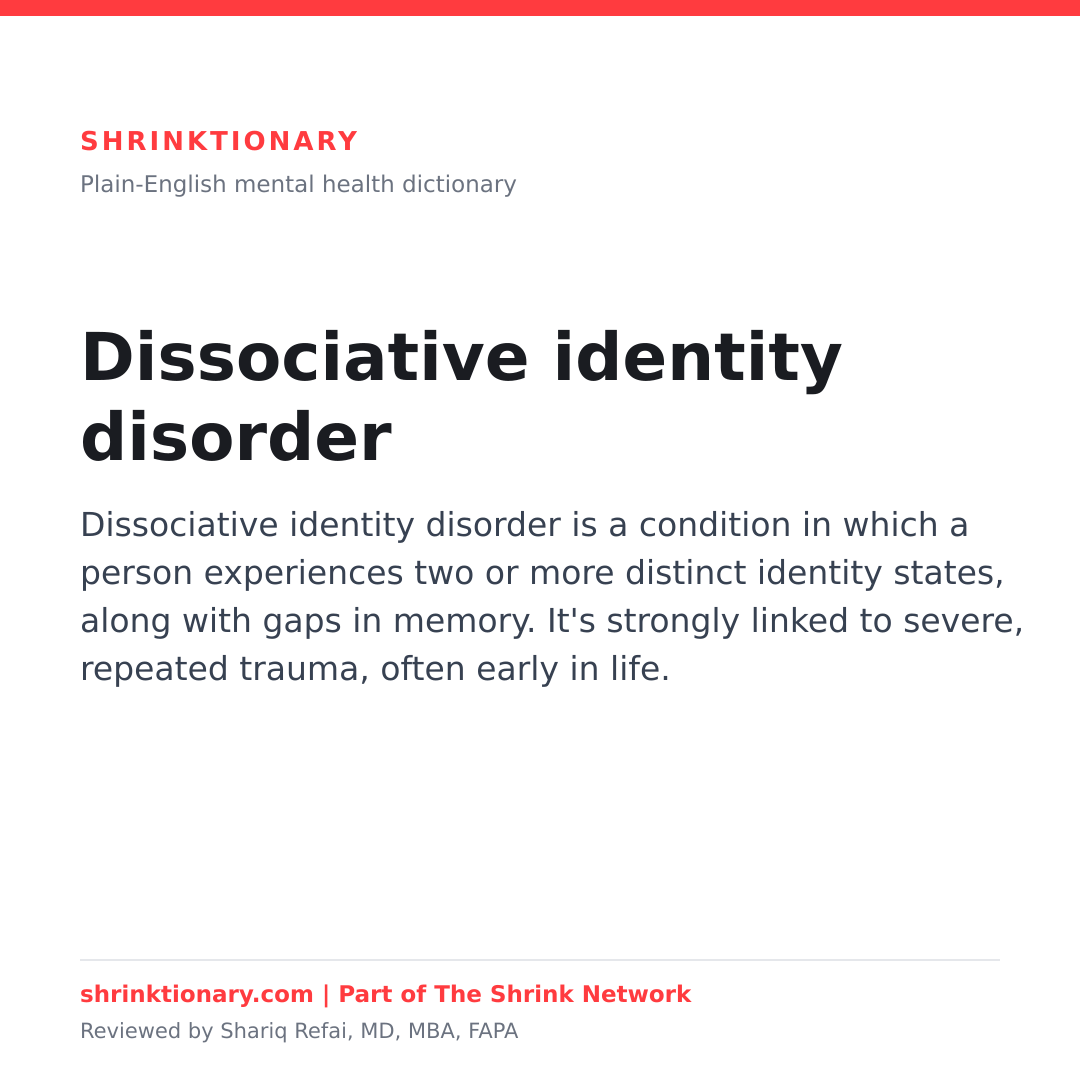
Dissociative identity disorder, or DID, is a condition in which a person’s sense of identity is split into two or more distinct states, sometimes called identities or parts. These states can have different ways of experiencing and relating to the world. Along with this, people have gaps in memory that go beyond ordinary forgetting, such as losing track of time or not recalling everyday events.
It’s understood as a way the mind copes with overwhelming, repeated trauma, very often during early childhood when a sense of self is still forming. Rather than holding everything in one continuous experience, the mind keeps painful material walled off. DID is one of several dissociative disorders, which all involve a disconnection between thoughts, memory, identity, or sense of reality.
How dissociative identity disorder shows up
People with DID may notice gaps in memory, find belongings they don’t remember acquiring, or be told about things they said or did that they can’t recall. There can be a sense of feeling detached from oneself, watching life from a distance, or feeling that thoughts and feelings don’t fully belong to them.
Shifts between identity states can be triggered by stress or reminders of trauma. Many people also live with depression, anxiety, flashbacks, and trouble with relationships and daily functioning. The condition often goes unrecognized for a long time, and people may feel confused or frightened by their own experiences.
What dissociative identity disorder isn’t
It isn’t the dramatic, dangerous portrayal often seen in films, where alternate identities are violent or sinister. That image is misleading and adds stigma. People with DID are far more likely to be harmed than to harm others.
It also isn’t the same as schizophrenia, despite the common mix-up. Schizophrenia involves psychosis like hallucinations and delusions, which is different from the identity and memory disruptions of DID. And it isn’t faking or attention-seeking. It’s a recognized response to serious trauma.
Related terms you’ll see next
When to seek professional care
Anyone noticing memory gaps, a sense of detachment from themselves, or distress connected to past trauma can benefit from talking with a mental health professional experienced in trauma. Treatment is usually long-term therapy focused on safety, processing trauma, and building a more integrated sense of self. If there are thoughts of suicide or self-harm, reach out for support right away. In the United States, you can call or text 988 any time to reach the Suicide and Crisis Lifeline.
When evaluation may help
Not everyone reading about dissociative identity disorder needs treatment. If it's getting in the way of your day, your sleep, your work, or your relationships, or if it isn't easing on its own, a professional evaluation is a reasonable next step. Most people start with their primary care doctor or a therapist. A psychiatrist is the right call when medication may be involved or the picture is complicated, though waits can be long.
We keep an honest, no-commission rundown of the options, from primary care to telepsychiatry to crisis lines, on one page.
If you're in crisis or thinking about suicide, call or text 988 in the US, or go to the nearest emergency room.
When this word matters
DID is strongly linked to severe, repeated trauma, often in early childhood, and it often goes unrecognized for years. The distinction from schizophrenia matters because DID involves identity and memory disruption, not the hallucinations and delusions of psychosis.
Commonly confused with
Frequently asked questions
What causes dissociative identity disorder?
It's strongly linked to severe, repeated trauma, very often during early childhood when a sense of self is still forming. The mind copes by keeping overwhelming material walled off rather than holding everything in one continuous experience.
Is dissociative identity disorder the same as schizophrenia?
No. Schizophrenia involves psychosis like hallucinations and delusions, which is different from the identity and memory disruptions of DID. The two are commonly confused but are distinct conditions.
Are people with dissociative identity disorder dangerous?
No. The violent or sinister portrayal often seen in films is misleading and adds stigma. People with DID are far more likely to be harmed than to harm others.
Related terms
Compare
Sources
- Mental Disorders , MedlinePlus
- What Are Dissociative Disorders? , American Psychiatric Association
Use or cite this definition
Free to reuse with attribution. Paste the block into your own page, or grab a citation.
Embed on your site
<blockquote>
<p><strong>Dissociative identity disorder:</strong> Dissociative identity disorder is a condition in which a person experiences two or more distinct identity states, along with gaps in memory. It's strongly linked to severe, repeated trauma, often early in life.</p>
<p>— <a href="https://shrinktionary.com/terms/dissociative-identity-disorder/">Shrinktionary</a>, a plain-English mental health dictionary, medically reviewed by a board certified psychiatrist.</p>
</blockquote>Cite (APA)
Refai, S. (2026). Dissociative identity disorder. Shrinktionary. https://shrinktionary.com/terms/dissociative-identity-disorder/
Cite (MLA)
"Dissociative identity disorder." Shrinktionary, https://shrinktionary.com/terms/dissociative-identity-disorder/. Accessed September 26, 2026.
Your next step in The Shrink Network
You are here: Shrinktionary, the language layer of The Shrink Network.
Each site in the network has one job. No matter where you enter, we help you find the next step that makes sense.
Want to understand more first?
See how this connects to everything else in the Term Web →
Take it with you
Free printable references you can save or share. For education, not medical advice.