What withdrawal actually is
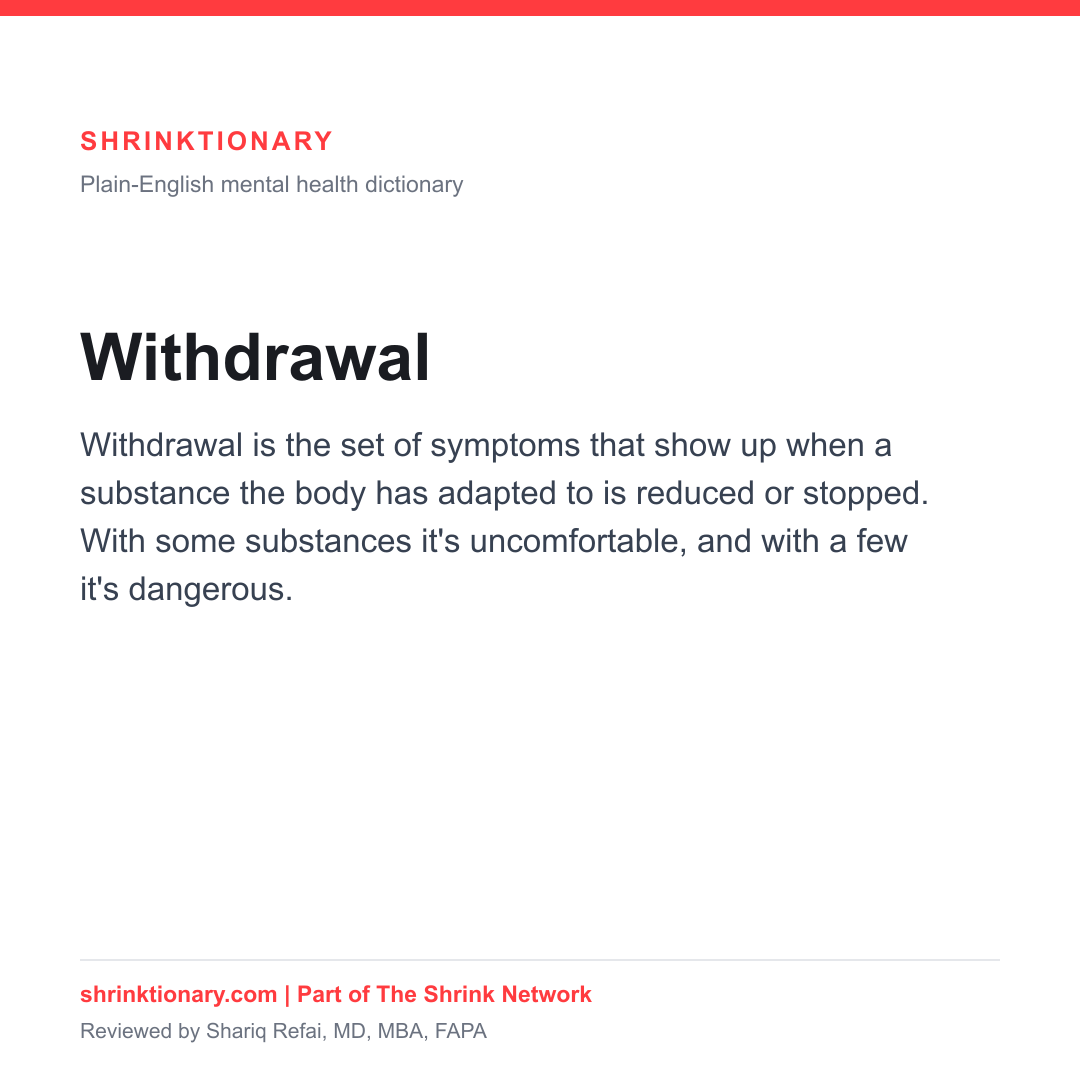
Withdrawal is what a body that has adapted to a substance does when the substance is taken away. The body has been compensating for the drug, and when the drug disappears, that compensation is suddenly exposed. What you feel is the mismatch.
The shape of withdrawal depends entirely on what’s being stopped. It can be a few days of feeling flu-like and irritable. It can be sleeplessness and anxiety that build over a week. With alcohol and benzodiazepines it can escalate to seizures, which is a medical emergency, and that’s why coming off those two is never something to do alone.
What to expect
Timing follows the drug. Substances that leave the body fast tend to produce withdrawal that starts sooner and hits harder. Ones that clear slowly produce a longer, flatter version that people sometimes don’t connect to stopping at all, because it shows up days later.
Withdrawal is also the reason tapering exists. Stepping a dose down gradually keeps the body from ever facing that sudden gap, which is why a planned taper usually turns a rough experience into a manageable one.
What withdrawal isn’t
Withdrawal isn’t proof of addiction. A body adapting is not a person losing control, and physical dependence can happen to anyone taking a medication as prescribed.
It also isn’t the same thing as the original condition coming back. If anxiety returns three days after stopping a medication, that’s more likely withdrawal. If it returns steadily over the following weeks and stays, that’s more likely relapse. They call for different responses, and telling them apart is a real clinical skill, not something to guess at.
And with antidepressants specifically, the accurate word is usually discontinuation syndrome rather than withdrawal, because antidepressants aren’t craved or misused.
Related terms you’ll see next
When to seek professional care
Never stop alcohol or a benzodiazepine abruptly on your own. Withdrawal from either can be life-threatening and needs medical supervision, sometimes in a hospital. For other medications, tell your prescriber before you stop so a taper can be planned. Get medical help right away for confusion, a seizure, a racing heart, a high fever, or severe agitation during withdrawal from anything. If you have thoughts of harming yourself, get help right away by calling 911, or call or text 988 in the US to reach the Suicide and Crisis Lifeline.
When this word matters
It matters most for alcohol and benzodiazepines, where stopping suddenly can cause seizures and can kill. Those two are the reason "just quit" is dangerous advice rather than merely unhelpful advice.
Commonly confused with
Frequently asked questions
Which withdrawals are dangerous?
Withdrawal from alcohol and from benzodiazepines can escalate to seizures and can be life-threatening. Neither should ever be stopped abruptly on your own. Both need medical supervision, sometimes in a hospital.
How do I tell withdrawal apart from my condition coming back?
Timing is the usual clue. Withdrawal tends to appear within days of stopping and then fades. A relapse tends to build more gradually over the following weeks and stays. Telling them apart is a real clinical skill, not something to guess at, because they call for different responses.
How long does withdrawal last?
It depends on the drug. Substances that leave the body fast produce withdrawal that starts sooner and hits harder. Ones that clear slowly produce a longer, flatter version that people sometimes don't even connect to stopping, because it shows up days later.
Related terms
In these language clusters
Sources
- Substance Use and Mental Health , National Institute of Mental Health
- Mental Health Medications , National Institute of Mental Health
Use or cite this definition
Free to reuse with attribution. Paste the block into your own page, or grab a citation.
Embed on your site
<blockquote>
<p><strong>Withdrawal:</strong> Withdrawal is the set of symptoms that show up when a substance the body has adapted to is reduced or stopped. With some substances it's uncomfortable, and with a few it's dangerous.</p>
<p>— <a href="https://shrinktionary.com/terms/withdrawal/">Shrinktionary</a>, a plain-English mental health dictionary, medically reviewed by a board certified psychiatrist.</p>
</blockquote>Cite (APA)
Refai, S. (2026). Withdrawal. Shrinktionary. https://shrinktionary.com/terms/withdrawal/
Cite (MLA)
"Withdrawal." Shrinktionary, https://shrinktionary.com/terms/withdrawal/. Accessed September 29, 2026.
Your next step in The Shrink Network
You are here: Shrinktionary, the language layer of The Shrink Network.
Each site in the network has one job. No matter where you enter, we help you find the next step that makes sense.
Want to understand more first?
See how this connects to everything else in the Term Web →
Take it with you
Free printable references you can save or share. For education, not medical advice.