What physical dependence actually is
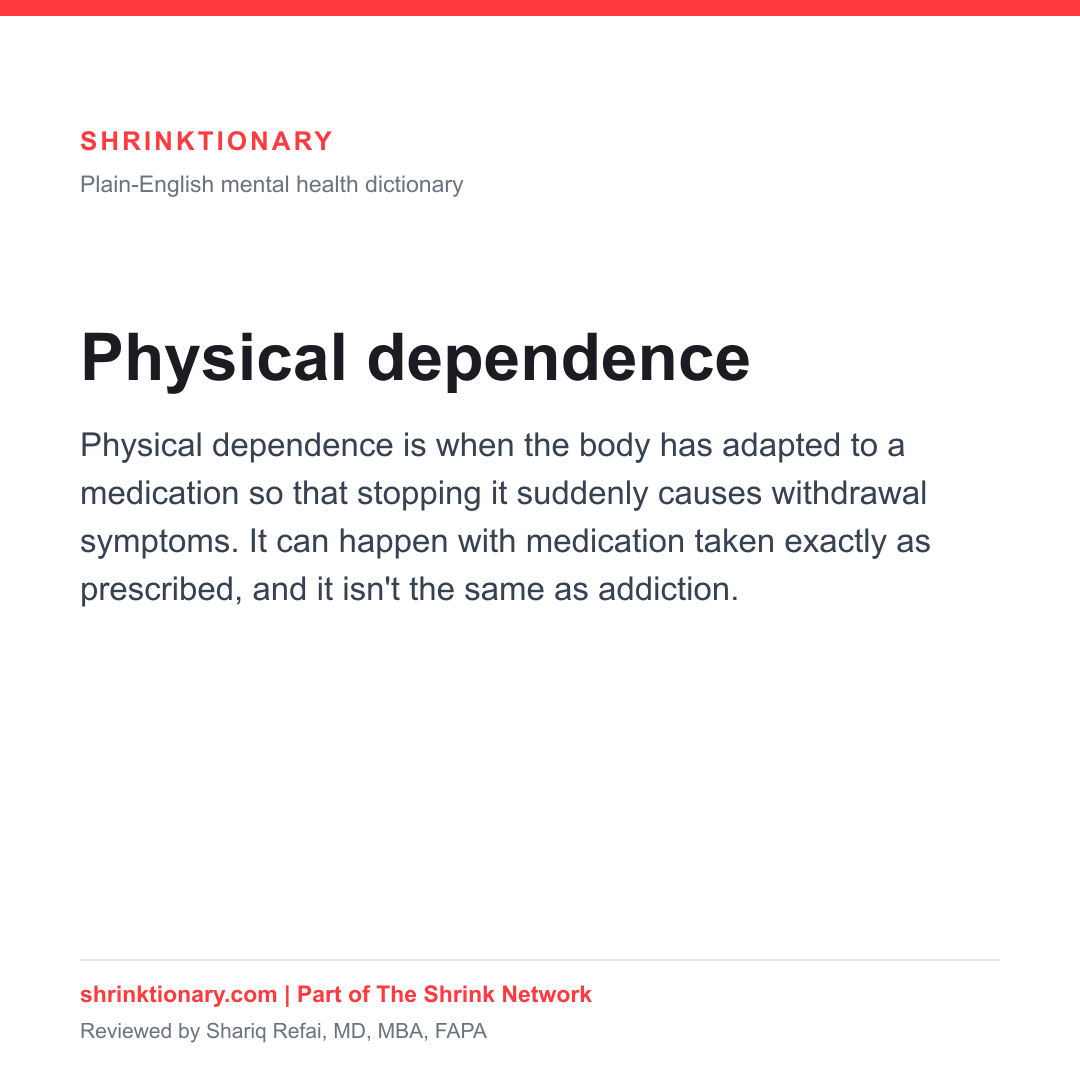
Physical dependence means your body has adjusted to having a drug around, and it notices when the drug goes away. Stop suddenly, and the body protests. That protest is withdrawal.
The important thing about this word, and the reason it causes so much unnecessary fear, is that physical dependence can develop in someone taking a medication exactly as prescribed, for exactly the right reason, with no misuse of any kind. It’s a property of how bodies adapt, not a verdict on the person.
Where it shows up
Physical dependence is expected with benzodiazepines taken regularly over time, which is a large part of why they’re generally used short-term. It’s part of the picture with several sleep medications. It happens with opioids, and it’s why coming off them is planned rather than abrupt.
Antidepressants sit in a slightly different place. Stopping them quickly can cause real and unpleasant symptoms, which is discontinuation syndrome, but antidepressants aren’t drugs people crave or misuse. That distinction gets flattened constantly in casual conversation, and flattening it scares people away from treatment that would help them.
What physical dependence isn’t
Physical dependence isn’t addiction. This is the single most important sentence on this page. Addiction, which clinicians usually call substance use disorder, involves compulsive use, loss of control, craving, and continuing despite harm. Physical dependence involves none of that. It’s just a body that has adapted.
Someone can be physically dependent on a medication and have no addiction whatsoever. Someone can be addicted to a substance without much physical dependence at all. They’re different things, and the words are not interchangeable, even though people use them as though they are.
It also isn’t a reason to stop a medication on your own. Stopping abruptly is what turns dependence into a problem.
Related terms you’ll see next
When to seek professional care
If you’re worried about becoming dependent on a medication, that’s a good conversation to have with your prescriber before you start it, not a reason to avoid treatment quietly. If you’re already taking something and want to come off, ask for a taper rather than stopping. If you notice craving, loss of control, or that you’re taking more than prescribed, tell a clinician plainly, because that’s a different problem with a different answer and it’s treatable. If you have thoughts of harming yourself, get help right away by calling 911, or call or text 988 in the US to reach the Suicide and Crisis Lifeline.
When this word matters
It matters because people refuse helpful treatment over this word. Being told a medication can cause dependence sounds like being told it will make you an addict, and those are not the same claim at all.
Commonly confused with
Frequently asked questions
Is physical dependence the same as addiction?
No, and this is the distinction that matters most. Physical dependence means the body has adapted, so stopping suddenly causes withdrawal. Addiction, which clinicians call substance use disorder, involves compulsive use, craving, loss of control, and continuing despite harm. Someone can be physically dependent with no addiction at all.
Can you become physically dependent on a medication taken as prescribed?
Yes. It can develop in someone taking a medication exactly as prescribed, for the right reason, with no misuse of any kind. It's a property of how bodies adapt, not a verdict on the person.
Are antidepressants addictive?
No. Stopping them quickly can cause real symptoms, called discontinuation syndrome, but antidepressants aren't craved or misused. That distinction gets flattened constantly in casual conversation, and it scares people away from treatment that would help them.
Related terms
In these language clusters
Sources
- Substance Use and Mental Health , National Institute of Mental Health
- Mental Health Medications , National Institute of Mental Health
Use or cite this definition
Free to reuse with attribution. Paste the block into your own page, or grab a citation.
Embed on your site
<blockquote>
<p><strong>Physical dependence:</strong> Physical dependence is when the body has adapted to a medication so that stopping it suddenly causes withdrawal symptoms. It can happen with medication taken exactly as prescribed, and it isn't the same as addiction.</p>
<p>— <a href="https://shrinktionary.com/terms/physical-dependence/">Shrinktionary</a>, a plain-English mental health dictionary, medically reviewed by a board certified psychiatrist.</p>
</blockquote>Cite (APA)
Refai, S. (2026). Physical dependence. Shrinktionary. https://shrinktionary.com/terms/physical-dependence/
Cite (MLA)
"Physical dependence." Shrinktionary, https://shrinktionary.com/terms/physical-dependence/. Accessed September 29, 2026.
Your next step in The Shrink Network
You are here: Shrinktionary, the language layer of The Shrink Network.
Each site in the network has one job. No matter where you enter, we help you find the next step that makes sense.
Want to understand more first?
See how this connects to everything else in the Term Web →
Take it with you
Free printable references you can save or share. For education, not medical advice.