What tolerance actually is
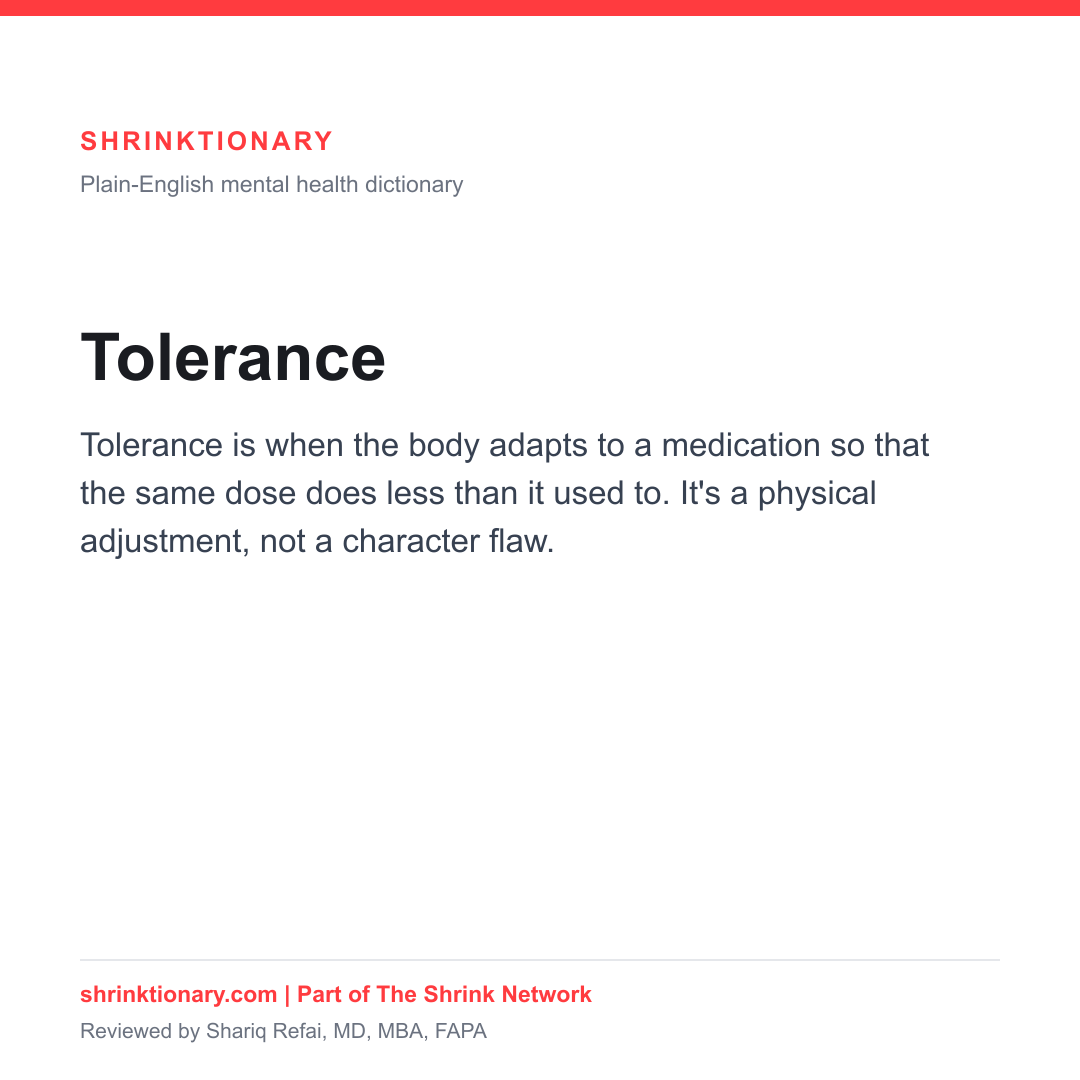
Tolerance is what happens when your body gets used to a drug. The dose that once did something now does less of it, and it can take more to get the same effect.
It’s a physical process. Repeated exposure nudges the body to adjust, dialing down its response to keep things in balance. That’s not a moral event and it doesn’t mean someone did anything wrong. It’s the same machinery that makes a first cup of coffee hit harder than the fifth cup of a daily habit.
Where it shows up
Tolerance isn’t equally likely across psychiatric medications, and that difference matters more than the word itself.
It’s a real consideration with benzodiazepines, where the calming and sedating effects can fade with steady use, which is one of the main reasons they’re usually meant for short or occasional use rather than daily forever. It comes up with sleep medications for similar reasons. It’s part of the picture with stimulants too, though the way tolerance behaves there is more nuanced than people assume.
It’s much less of a story with SSRIs and most antidepressants. If an antidepressant seems to stop working, tolerance is only one of several possible explanations, and often not the right one. That’s a question for a prescriber, not a conclusion to reach alone.
What tolerance isn’t
Tolerance isn’t addiction. Addiction is a pattern of compulsive use and loss of control that damages a person’s life. Tolerance is a physical adaptation that can happen to anyone taking a medication exactly as prescribed.
It also isn’t the same as physical dependence, though the two travel together. Tolerance is about the drug doing less. Dependence is about what happens when you stop.
And a medication working less well is not automatically tolerance. Life changes, illnesses change, other drugs get added, doses get missed. Naming it tolerance too quickly can send you looking for the wrong fix.
Related terms you’ll see next
When to seek professional care
If a medication that used to help isn’t helping anymore, that’s worth raising with your prescriber rather than quietly taking more. Taking extra on your own is how a manageable problem becomes a dangerous one, especially with benzodiazepines and sleep medications. If you find yourself needing more of something to feel normal, or you can’t cut back when you want to, talk to a clinician about it directly. If you have thoughts of harming yourself, get help right away by calling 911, or call or text 988 in the US to reach the Suicide and Crisis Lifeline.
When this word matters
It matters when a medication that used to help stops helping, because the tempting response is to take a little more. With benzodiazepines and sleep medications, that instinct is how a manageable problem becomes a dangerous one.
Commonly confused with
Frequently asked questions
Is tolerance the same as addiction?
No. Tolerance is a physical adaptation that can happen to anyone taking a medication exactly as prescribed. Addiction involves compulsive use, craving, and loss of control. They can occur together, but neither one implies the other.
Do antidepressants stop working over time?
If an antidepressant seems to stop working, tolerance is only one possible explanation and often not the right one. Missed doses, a new medication, a change in the illness, or life circumstances can all look the same from the outside. It's a question for a prescriber rather than a conclusion to reach alone.
Which psychiatric medications cause tolerance?
It's a real consideration with benzodiazepines and sleep medications, which is part of why they're usually meant for short-term use. It's part of the picture with stimulants too. It's much less of a story with SSRIs and most antidepressants.
Related terms
In these language clusters
Sources
- Mental Health Medications , National Institute of Mental Health
- Substance Use and Mental Health , National Institute of Mental Health
Use or cite this definition
Free to reuse with attribution. Paste the block into your own page, or grab a citation.
Embed on your site
<blockquote>
<p><strong>Tolerance:</strong> Tolerance is when the body adapts to a medication so that the same dose does less than it used to. It's a physical adjustment, not a character flaw.</p>
<p>— <a href="https://shrinktionary.com/terms/tolerance/">Shrinktionary</a>, a plain-English mental health dictionary, medically reviewed by a board certified psychiatrist.</p>
</blockquote>Cite (APA)
Refai, S. (2026). Tolerance. Shrinktionary. https://shrinktionary.com/terms/tolerance/
Cite (MLA)
"Tolerance." Shrinktionary, https://shrinktionary.com/terms/tolerance/. Accessed September 29, 2026.
Your next step in The Shrink Network
You are here: Shrinktionary, the language layer of The Shrink Network.
Each site in the network has one job. No matter where you enter, we help you find the next step that makes sense.
Want to understand more first?
See how this connects to everything else in the Term Web →
Take it with you
Free printable references you can save or share. For education, not medical advice.