What trichotillomania actually is
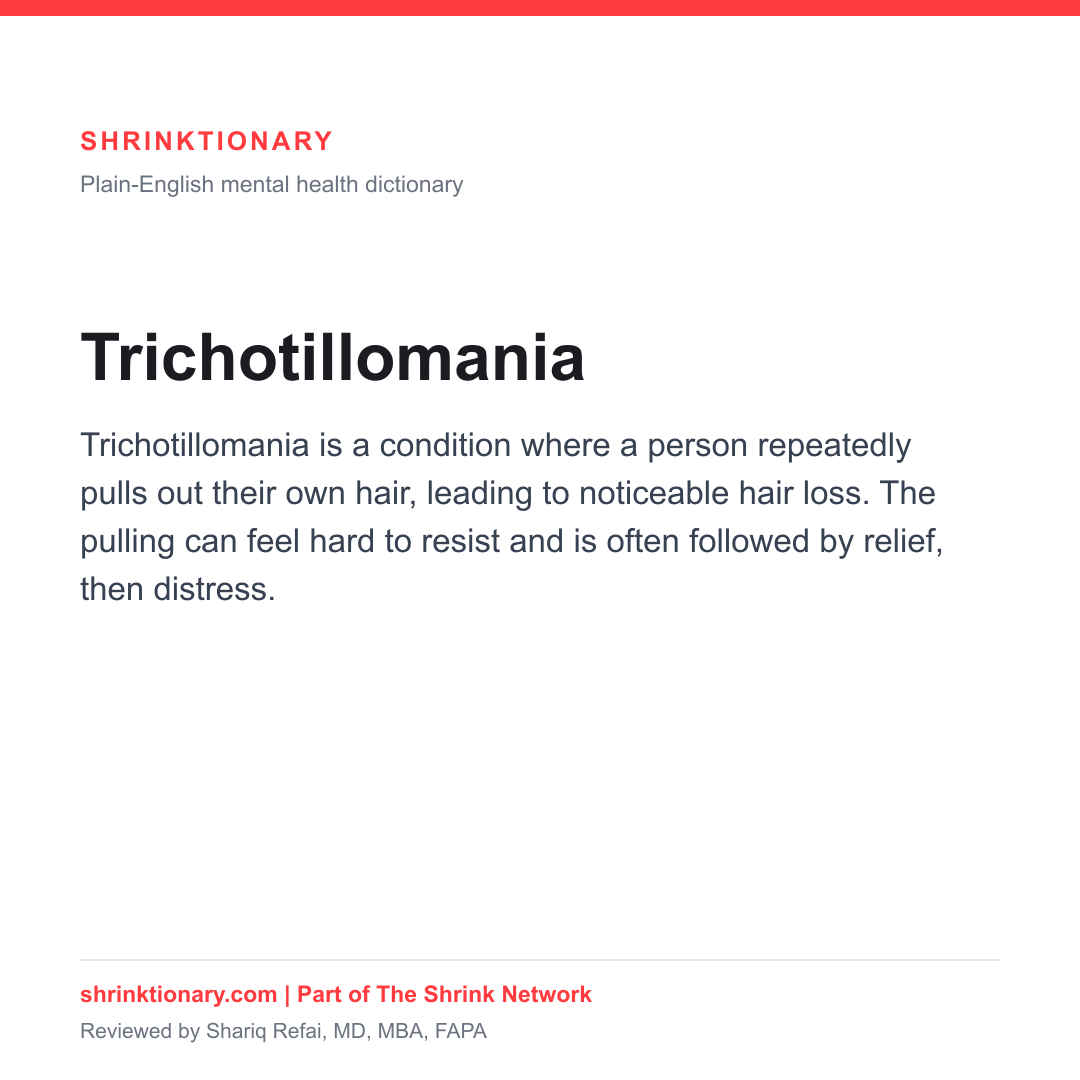
Trichotillomania is a condition in which a person repeatedly pulls out their own hair, often from the scalp, eyebrows, or eyelashes, leading to noticeable hair loss over time. The person usually tries to stop or cut back but finds it hard to resist the urge. It belongs to a group of body-focused repetitive behaviors, which also includes things like compulsive skin picking.
The pulling often follows a cycle. There may be a rising sense of tension or an urge, a feeling of relief or release while pulling, and then distress or regret afterward. For some people the pulling is fairly automatic, happening during quiet moments like reading or watching television, while for others it’s more deliberate.
How trichotillomania shows up
It can show up as bald patches, thinning brows, or missing lashes, sometimes hidden with hats, makeup, or hairstyles. People often pull during moments of stress, boredom, or deep focus, and may not fully notice they’re doing it until afterward.
There’s frequently a layer of shame and secrecy around it, which can lead someone to avoid haircuts, swimming, or close relationships. The condition can come and go in intensity, often getting worse during stressful periods. Despite real effort, willpower alone usually isn’t enough to stop it.
What trichotillomania isn’t
It isn’t a habit someone can simply decide to quit, and telling a person to “just stop” tends to add shame without helping. It also isn’t a form of self-harm in the way that term is usually meant, since the goal isn’t to hurt oneself, even though the result is hair loss.
It isn’t a sign of poor hygiene or vanity, and it isn’t rare or shameful. It’s a recognized condition, and many people who have it feel relieved to learn it has a name and effective treatments.
Related terms you’ll see next
When to seek professional care
It’s worth reaching out when hair pulling causes hair loss, distress, or shame, or when efforts to stop on your own haven’t worked. A specific approach called habit reversal training, often part of cognitive behavioral therapy, has good support for this condition. There’s no need to feel embarrassed bringing it up with a clinician, and effective help is available.
When evaluation may help
Not everyone reading about trichotillomania needs treatment. If it's getting in the way of your day, your sleep, your work, or your relationships, or if it isn't easing on its own, a professional evaluation is a reasonable next step. Most people start with their primary care doctor or a therapist. A psychiatrist is the right call when medication may be involved or the picture is complicated, though waits can be long.
We keep an honest, no-commission rundown of the options, from primary care to telepsychiatry to crisis lines, on one page.
If you're in crisis or thinking about suicide, call or text 988 in the US, or go to the nearest emergency room.
When this word matters
Occasional hair twisting is common, but it points toward trichotillomania when someone repeatedly pulls out their own hair enough to cause noticeable loss, tries to stop, and finds the urge hard to resist. It's one of the body-focused repetitive behaviors and is treatable, often with a specific behavioral approach.
Commonly confused with
Frequently asked questions
What is trichotillomania?
It's a condition in which a person repeatedly pulls out their own hair, often from the scalp, eyebrows, or eyelashes, leading to noticeable hair loss. It belongs to a group of body-focused repetitive behaviors.
Can someone just decide to stop pulling their hair?
Usually not. It isn't a habit someone can simply quit, and despite real effort, willpower alone usually isn't enough. Telling a person to just stop tends to add shame without helping.
Is trichotillomania a form of self-harm?
Not in the way that term is usually meant, since the goal isn't to hurt oneself even though the result is hair loss. It's a recognized condition with effective treatments, such as habit reversal training.
Related terms
Sources
- Obsessive-Compulsive Disorder (OCD) , National Institute of Mental Health
- Trichotillomania , MedlinePlus
Use or cite this definition
Free to reuse with attribution. Paste the block into your own page, or grab a citation.
Embed on your site
<blockquote>
<p><strong>Trichotillomania:</strong> Trichotillomania is a condition where a person repeatedly pulls out their own hair, leading to noticeable hair loss. The pulling can feel hard to resist and is often followed by relief, then distress.</p>
<p>— <a href="https://shrinktionary.com/terms/trichotillomania/">Shrinktionary</a>, a plain-English mental health dictionary, medically reviewed by a board certified psychiatrist.</p>
</blockquote>Cite (APA)
Refai, S. (2026). Trichotillomania. Shrinktionary. https://shrinktionary.com/terms/trichotillomania/
Cite (MLA)
"Trichotillomania." Shrinktionary, https://shrinktionary.com/terms/trichotillomania/. Accessed September 26, 2026.
Your next step in The Shrink Network
You are here: Shrinktionary, the language layer of The Shrink Network.
Each site in the network has one job. No matter where you enter, we help you find the next step that makes sense.
Want to understand more first?
See how this connects to everything else in the Term Web →
Take it with you
Free printable references you can save or share. For education, not medical advice.