What trauma dumping actually is
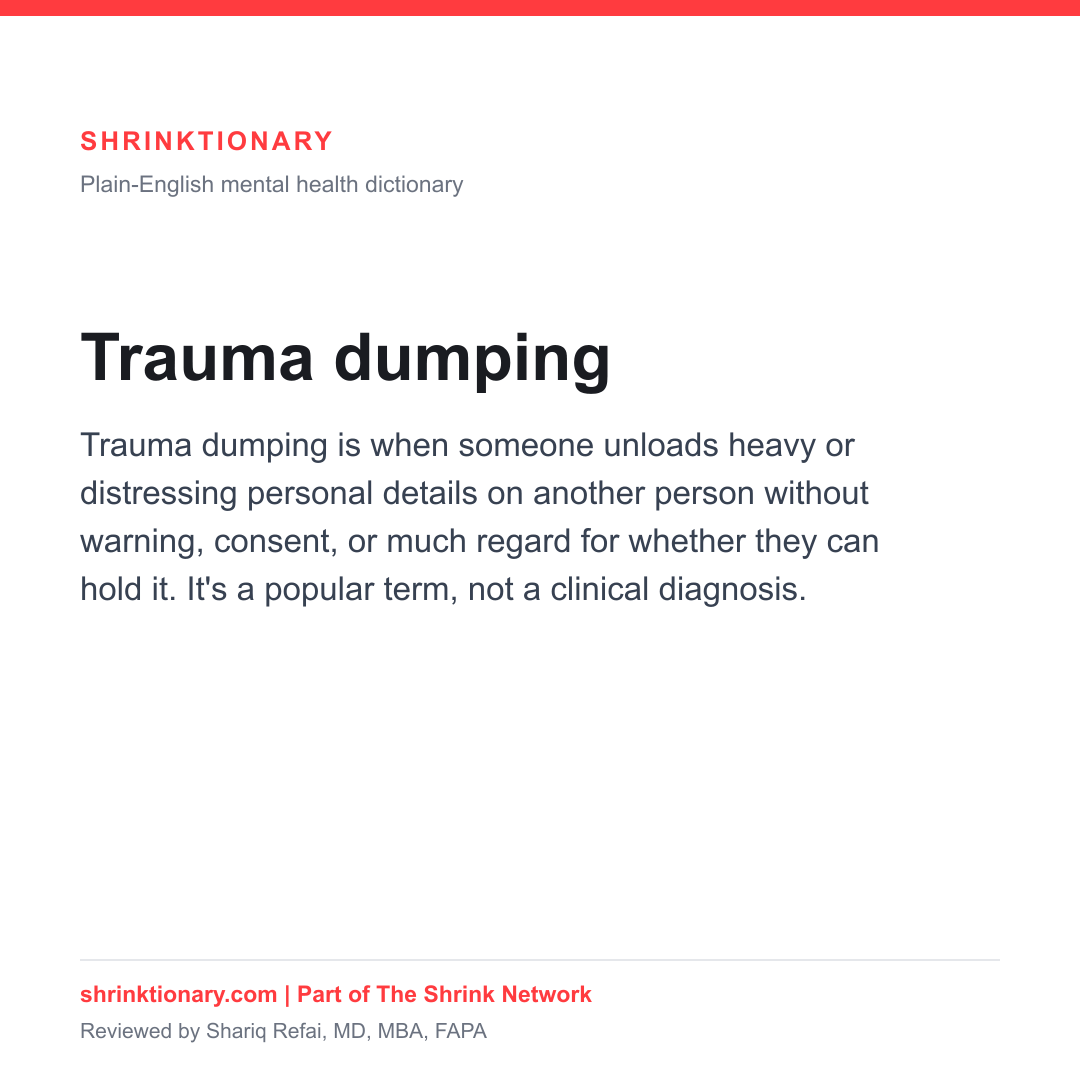
Trauma dumping is a popular phrase, not a clinical diagnosis. It describes a one-sided pattern where someone pours out intense or distressing material, often about past trauma, onto a listener who didn’t agree to take it on and may not be in a position to. The key features are timing and consent. The information arrives without a heads-up, it tends to be a lot at once, and it doesn’t leave much room for the other person to opt in or step back.
The term took off on social media, so it gets used loosely. It’s worth separating the behavior from the act of talking about hard things in general. Sharing pain is healthy. Trauma dumping points to a specific imbalance, where one person’s need to release overrides any check on whether the other person can hold it.
What trauma dumping can feel like
On the receiving end, it can feel like being handed something heavy with no warning. The conversation jumps from small talk to deeply personal in seconds. The listener may feel responsible for fixing it, drained afterward, or unsure how to set a limit without seeming cold.
For the person doing it, the experience is usually not calculated. It often comes from real distress and a lack of other outlets. People in crisis, people who are isolated, and people who never learned to pace disclosure can all land here without meaning harm. Recognizing the pattern is the point, not assigning blame.
What trauma dumping isn’t
Trauma dumping isn’t the same as opening up, asking for support, or processing something painful with a friend who has said they’re available. Vulnerability is part of close relationships, and naming hard experiences is often a sign of trust, not a problem.
It also isn’t a clinical label, so it shouldn’t be used to diagnose anyone or to shut down every difficult conversation. People sometimes weaponize the phrase to avoid supporting a friend, which misses the point. The useful version of the idea is about consent and reciprocity, not about silencing distress.
Related terms you’ll see next
Boundaries describe the limits that keep sharing mutual rather than one-sided. Emotional labor names the work of managing feelings, including someone else’s. Codependency can show up when one person consistently absorbs another’s distress at a cost to themselves.
When it helps to get support
If unloading on others is the main way distress gets managed, or if past trauma keeps surfacing in ways that strain relationships, talking with a mental health professional can help. Therapy offers a place built to hold heavy material, with someone trained to receive it. If trauma symptoms like flashbacks, nightmares, or constant edginess are present, an evaluation is a reasonable next step.
When this word matters
It matters when sharing becomes one-sided and consistently overwhelms the listener, because that imbalance can strain relationships and signal that distress needs a more supportive outlet. The pattern, not the act of sharing itself, is what is worth noticing.
Commonly confused with
Frequently asked questions
Is trauma dumping a real diagnosis?
No. Trauma dumping is a popular phrase that spread on social media, not a clinical diagnosis. It describes a one-sided pattern of unloading distressing details on someone without warning or consent, rather than a recognized mental health condition.
What is the difference between trauma dumping and venting?
Venting is usually shorter, mutual, and offered to someone who has agreed to listen. Trauma dumping tends to be a lot at once, arrives without a heads-up, and leaves little room for the other person to opt in or step back.
How do I respond if someone trauma dumps on me?
It is fine to set a kind limit, such as saying you care but cannot hold this right now, and to suggest they reach out to a therapist or crisis line. Setting that boundary protects the relationship rather than ending support.
Related terms
Sources
- Caring for Your Mental Health , National Institute of Mental Health
- Coping with Traumatic Events , National Institute of Mental Health
Use or cite this definition
Free to reuse with attribution. Paste the block into your own page, or grab a citation.
Embed on your site
<blockquote>
<p><strong>Trauma dumping:</strong> Trauma dumping is when someone unloads heavy or distressing personal details on another person without warning, consent, or much regard for whether they can hold it. It's a popular term, not a clinical diagnosis.</p>
<p>— <a href="https://shrinktionary.com/terms/trauma-dumping/">Shrinktionary</a>, a plain-English mental health dictionary, medically reviewed by a board certified psychiatrist.</p>
</blockquote>Cite (APA)
Refai, S. (2026). Trauma dumping. Shrinktionary. https://shrinktionary.com/terms/trauma-dumping/
Cite (MLA)
"Trauma dumping." Shrinktionary, https://shrinktionary.com/terms/trauma-dumping/. Accessed September 29, 2026.
Your next step in The Shrink Network
You are here: Shrinktionary, the language layer of The Shrink Network.
Each site in the network has one job. No matter where you enter, we help you find the next step that makes sense.
Want to understand more first?
See how this connects to everything else in the Term Web →
Take it with you
Free printable references you can save or share. For education, not medical advice.