What toxic positivity actually is
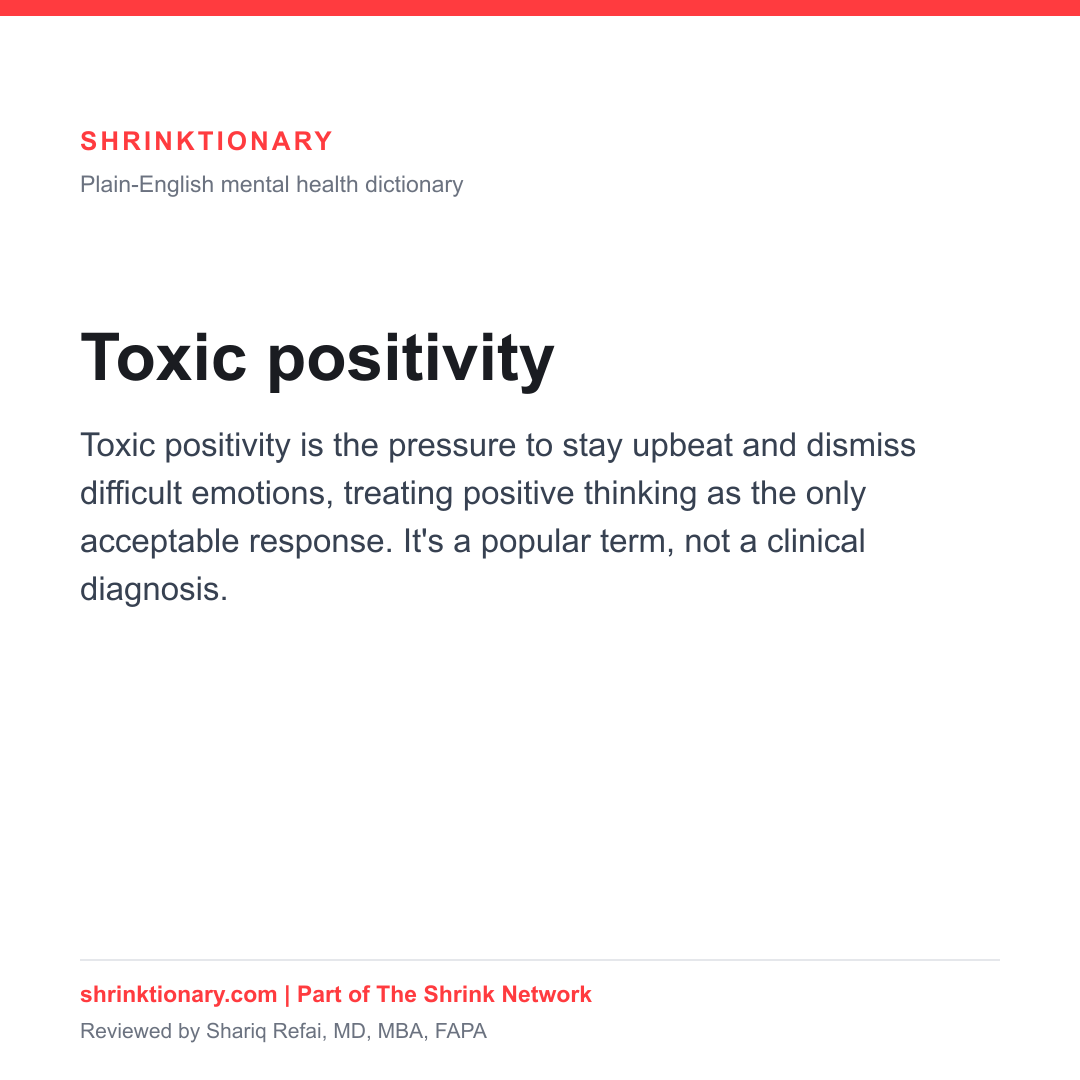
Toxic positivity is a popular term, not a clinical diagnosis. It describes the pressure to stay relentlessly upbeat and to wave away anything painful with a positive spin. Instead of making room for a hard feeling, it pushes the feeling aside with phrases like good vibes only, just stay positive, or everything happens for a reason.
The trouble isn’t optimism itself, which can be genuinely helpful. The trouble is using positivity to silence real emotions, either your own or someone else’s. When sadness, fear, anger, or grief get treated as failures of attitude, people learn to hide them. That tends to make distress harder to process, not easier.
What toxic positivity can feel like
On the receiving end, it can feel like being unheard. You share something painful and get handed a slogan instead of support. The message lands as it could be worse or you should be grateful, which can leave you feeling dismissed and oddly more alone.
Aimed inward, it shows up as guilt for not feeling okay. People push down worry or sadness, scold themselves for negativity, and perform cheerfulness they don’t feel. The effort of keeping that mask up is its own kind of strain, and the buried feelings rarely go anywhere.
What toxic positivity isn’t
Toxic positivity isn’t the same as hope, gratitude, or a genuinely sunny outlook. Healthy optimism leaves room for the full range of emotions. It says this is hard and we’ll get through it, rather than this isn’t hard, cheer up.
It also isn’t a reason to reject encouragement entirely. Support and realistic hope are good things. The marker of toxic positivity is the dismissal, the insistence that only the bright side is allowed, not the presence of positivity itself.
Related terms you’ll see next
Validation is the opposite move, acknowledging a feeling instead of erasing it. Self-compassion is the practice of meeting your own pain with kindness rather than a forced smile. Emotional labor often shows up when someone keeps performing cheer they don’t feel.
When it helps to get support
If staying positive has become a way to avoid feelings that keep building underneath, or if difficult emotions feel unmanageable when you stop pushing them away, talking with a mental health professional can help. Therapy is a place where hard feelings are allowed and worked through rather than spun away. If low mood, anxiety, or grief is persistent, an evaluation is a reasonable step.
When this word matters
It matters when the push to stay upbeat starts silencing real emotions, because buried feelings tend to be harder to process and people can end up feeling dismissed or alone. The dismissal, not the optimism, is the issue.
Commonly confused with
Frequently asked questions
What is toxic positivity?
Toxic positivity is the pressure to stay upbeat at all times and to dismiss difficult emotions with a positive spin. It is a popular term, not a clinical diagnosis, and the problem is using positivity to silence real feelings rather than optimism itself.
How is toxic positivity different from optimism?
Healthy optimism leaves room for the full range of emotions and says this is hard and we will get through it. Toxic positivity dismisses the hard feeling entirely and insists that only the bright side is allowed.
Why is toxic positivity harmful?
When painful feelings get treated as failures of attitude, people learn to hide them, which tends to make distress harder to process. On the receiving end it can feel dismissive, and aimed inward it can create guilt for not feeling okay.
Related terms
Sources
- Caring for Your Mental Health , National Institute of Mental Health
- How to Improve Mental Health , MedlinePlus
Use or cite this definition
Free to reuse with attribution. Paste the block into your own page, or grab a citation.
Embed on your site
<blockquote>
<p><strong>Toxic positivity:</strong> Toxic positivity is the pressure to stay upbeat and dismiss difficult emotions, treating positive thinking as the only acceptable response. It's a popular term, not a clinical diagnosis.</p>
<p>— <a href="https://shrinktionary.com/terms/toxic-positivity/">Shrinktionary</a>, a plain-English mental health dictionary, medically reviewed by a board certified psychiatrist.</p>
</blockquote>Cite (APA)
Refai, S. (2026). Toxic positivity. Shrinktionary. https://shrinktionary.com/terms/toxic-positivity/
Cite (MLA)
"Toxic positivity." Shrinktionary, https://shrinktionary.com/terms/toxic-positivity/. Accessed September 29, 2026.
Your next step in The Shrink Network
You are here: Shrinktionary, the language layer of The Shrink Network.
Each site in the network has one job. No matter where you enter, we help you find the next step that makes sense.
Want to understand more first?
See how this connects to everything else in the Term Web →
Take it with you
Free printable references you can save or share. For education, not medical advice.