What separation anxiety disorder actually is
Separation anxiety disorder is a condition marked by excessive fear or worry about being separated from the people a person feels most attached to, such as a parent, a child, or a partner. The worry is more intense than what’s expected for someone’s age and stage of life, and it tends to stick around rather than fade after a short adjustment period.
People with the condition often worry that something bad will happen to a loved one, or that an event like getting lost will pull them apart. To make the diagnosis, a clinician looks for these fears lasting a meaningful stretch of time, usually about four weeks or more in children and several months in adults, along with real distress or trouble functioning.
Although it’s often thought of as a childhood condition, separation anxiety disorder can begin or continue in adulthood. It can show up in school refusal, trouble sleeping away from home, or difficulty being alone.
What separation anxiety disorder can feel like
A person may feel a wave of dread when a separation is coming, even a routine one like going to work or school. Some people check in repeatedly, ask for reassurance, or stay physically close to the people they love.
Physical symptoms are common too. Headaches, stomachaches, nausea, or a racing heart can show up around the time of separation. Sleep can be hard, especially sleeping alone or away from home, and nightmares about being separated sometimes occur. These reactions can feel out of proportion to the situation, and that gap can be confusing or upsetting.
What separation anxiety disorder isn’t
Separation anxiety disorder isn’t the same as the normal clinginess that many young children show, which usually eases with development. It’s also not simply being close or devoted to family. The difference is the level of distress and how much it gets in the way of daily life.
It isn’t a sign of weakness or being overly dependent on purpose. The fear feels automatic and hard to switch off, which is part of why support helps. It’s also not untreatable. Therapies that gradually build comfort with separation, sometimes alongside other support, can make a real difference.
Related terms you’ll see next
Anxiety is the broader experience of fear and worry that underlies this condition. Attachment describes the close bonds that separation anxiety centers on. Avoidance explains how steering clear of separations can keep fear going. Generalized anxiety disorder is a related condition involving broad, ongoing worry.
When to seek professional care
If fear of separation is causing real distress or making it hard to work, attend school, or manage daily routines, an evaluation can help. A clinician can tell the difference between everyday worry and a condition that would benefit from treatment, and can discuss options such as therapy. Reaching out early can keep the fear from narrowing someone’s world. If you’re having thoughts of suicide or self-harm, seek help right away. If you’re in crisis, call or text 988 in the United States.
When evaluation may help
Not everyone reading about separation anxiety disorder needs treatment. If it's getting in the way of your day, your sleep, your work, or your relationships, or if it isn't easing on its own, a professional evaluation is a reasonable next step. Most people start with their primary care doctor or a therapist. A psychiatrist is the right call when medication may be involved or the picture is complicated, though waits can be long.
We keep an honest, no-commission rundown of the options, from primary care to telepsychiatry to crisis lines, on one page.
If you're in crisis or thinking about suicide, call or text 988 in the US, or go to the nearest emergency room.
When this word matters
It crosses into a clinical condition when fear about being apart from attachment figures is more intense than fits the person's age, lasts a meaningful stretch, and causes real distress or trouble functioning. It can begin or continue in adulthood, not just childhood, and shows up in school refusal or difficulty being alone.
Commonly confused with
Frequently asked questions
What is separation anxiety disorder?
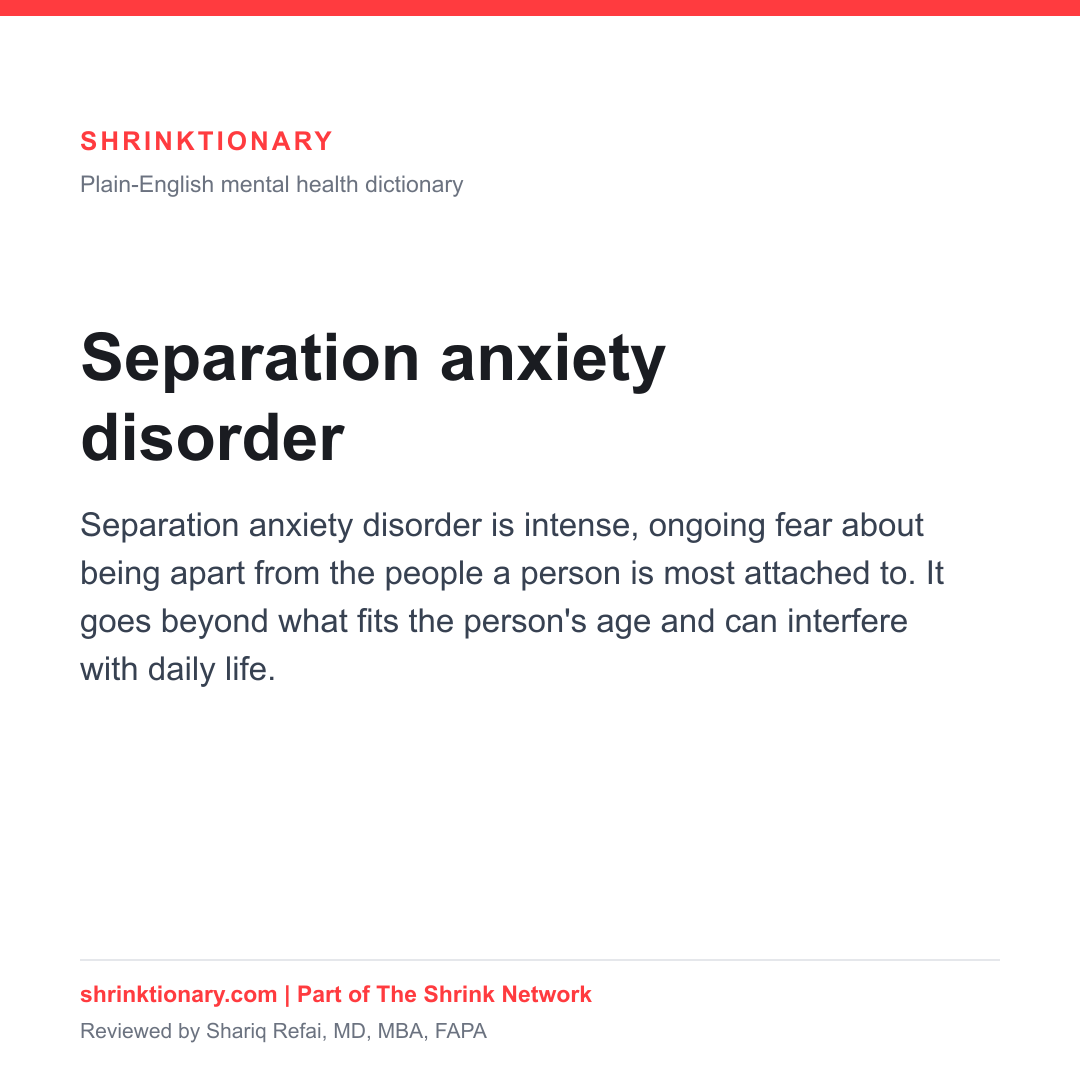
Separation anxiety disorder is intense, ongoing fear or worry about being apart from the people a person feels most attached to. The worry is more intense than expected for someone's age and stage of life and tends to stick around rather than fade.
Does separation anxiety disorder only affect children?
No, although it's often thought of as a childhood condition, it can begin or continue in adulthood. In adults it can show up as trouble sleeping away from home or difficulty being alone.
How is it different from normal clinginess or being close to family?
It isn't the same as the normal clinginess many young children show, which usually eases with development, or simply being devoted to family. The difference is the level of distress and how much it gets in the way of daily life.
Related terms
Sources
- Anxiety Disorders , National Institute of Mental Health
- Anxiety , MedlinePlus
Use or cite this definition
Free to reuse with attribution. Paste the block into your own page, or grab a citation.
Embed on your site
<blockquote>
<p><strong>Separation anxiety disorder:</strong> Separation anxiety disorder is intense, ongoing fear about being apart from the people a person is most attached to. It goes beyond what fits the person's age and can interfere with daily life.</p>
<p>— <a href="https://shrinktionary.com/terms/separation-anxiety-disorder/">Shrinktionary</a>, a plain-English mental health dictionary, medically reviewed by a board certified psychiatrist.</p>
</blockquote>Cite (APA)
Refai, S. (2026). Separation anxiety disorder. Shrinktionary. https://shrinktionary.com/terms/separation-anxiety-disorder/
Cite (MLA)
"Separation anxiety disorder." Shrinktionary, https://shrinktionary.com/terms/separation-anxiety-disorder/. Accessed September 26, 2026.
Your next step in The Shrink Network
You are here: Shrinktionary, the language layer of The Shrink Network.
Each site in the network has one job. No matter where you enter, we help you find the next step that makes sense.
Want to understand more first?
See how this connects to everything else in the Term Web →
Take it with you
Free printable references you can save or share. For education, not medical advice.