What love bombing actually is
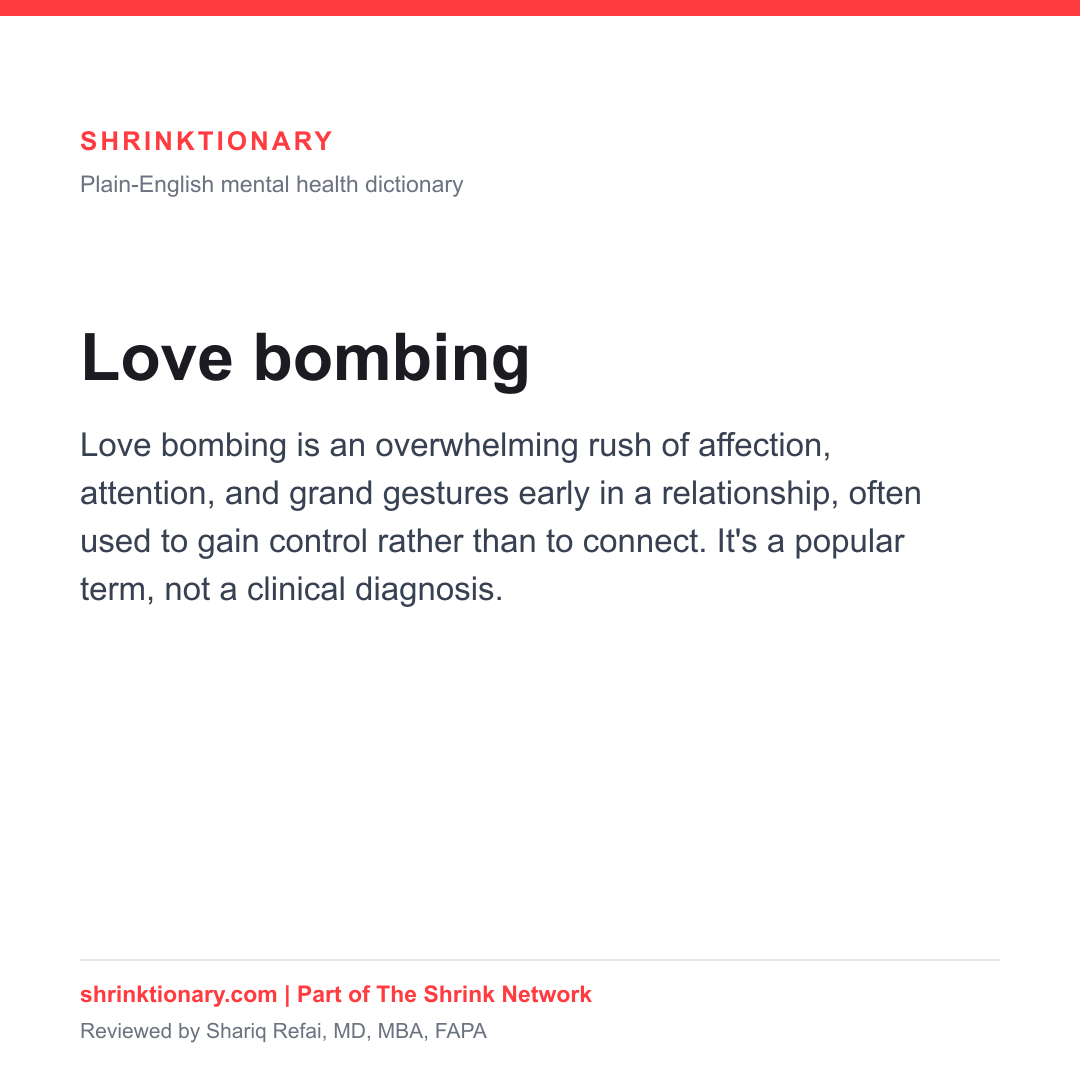
Love bombing is a popular term, not a clinical diagnosis. It describes an intense, fast-moving wave of affection at the start of a relationship, constant texts, lavish gifts, sweeping declarations, and a push to get serious quickly. On its own, intensity isn’t proof of anything. What makes love bombing distinct is the purpose behind it, using that flood of attention to gain influence over someone rather than to build a genuine connection.
The pattern often runs in cycles. The early idealization can later give way to criticism or withdrawal, and the promise of returning to that golden beginning becomes a way to keep the other person hooked. That shift from adoration to control is the part that does harm.
What love bombing can feel like
At first it can feel intoxicating. Being showered with attention and told you’re perfect is a powerful experience, especially if it arrives quickly and confidently. Many people describe feeling swept off their feet and a little off-balance, unsure why things are moving so fast.
The discomfort tends to come later. There may be pressure to commit before you’re ready, guilt when you ask for space, and a sense that the affection comes with strings. When the warmth turns cold, the contrast can be disorienting, and chasing the return of that early high can keep someone tied to a relationship that no longer feels safe.
What love bombing isn’t
Love bombing isn’t the same as healthy enthusiasm at the start of dating. New relationships can be exciting, generous, and affectionate without any agenda. The difference is consent and respect. Genuine interest slows down when you ask it to and respects a no. Love bombing tends to override your pace and your boundaries.
It also isn’t a clinical label or a diagnosis of the other person. The useful idea is about the pattern of control, not about labeling anyone who is simply warm and eager.
Related terms you’ll see next
Gaslighting often appears later in the same dynamic, once control sets in. Boundaries are the limits that intense affection should respect rather than steamroll. Trauma bonding can describe the strong attachment that forms across cycles of warmth and withdrawal.
When it helps to get support
If a relationship swings between intense affection and control, or if leaving feels impossible even when things don’t feel safe, talking with a mental health professional can help you sort it out. Therapy offers a clear-eyed place to look at the pattern. If you feel unsafe or are facing abuse, a domestic violence hotline or local support service can help with options and safety planning.
When this word matters
It matters when intense early affection is used to override someone's pace and boundaries and later turns into control, because that cycle can be hard to leave and unsafe. The purpose behind the attention, not the intensity alone, is what counts.
Commonly confused with
Frequently asked questions
What is love bombing?
Love bombing is an overwhelming rush of affection, gifts, and grand gestures early in a relationship, often used to gain control rather than to connect. It is a popular term, not a clinical diagnosis, and the purpose behind the attention is what makes it distinct.
How is love bombing different from genuine affection?
Genuine interest respects your pace and your boundaries and slows down when you ask. Love bombing tends to override both, pushing for fast commitment and reacting with guilt or pressure when you ask for space.
Why is love bombing hard to leave?
The pattern often cycles between intense adoration and withdrawal, and the promise of returning to that early high can keep someone hooked. Chasing the warm beginning can tie a person to a relationship that no longer feels safe.
Related terms
Sources
- Caring for Your Mental Health , National Institute of Mental Health
- Domestic Violence , MedlinePlus
Use or cite this definition
Free to reuse with attribution. Paste the block into your own page, or grab a citation.
Embed on your site
<blockquote>
<p><strong>Love bombing:</strong> Love bombing is an overwhelming rush of affection, attention, and grand gestures early in a relationship, often used to gain control rather than to connect. It's a popular term, not a clinical diagnosis.</p>
<p>— <a href="https://shrinktionary.com/terms/love-bombing/">Shrinktionary</a>, a plain-English mental health dictionary, medically reviewed by a board certified psychiatrist.</p>
</blockquote>Cite (APA)
Refai, S. (2026). Love bombing. Shrinktionary. https://shrinktionary.com/terms/love-bombing/
Cite (MLA)
"Love bombing." Shrinktionary, https://shrinktionary.com/terms/love-bombing/. Accessed September 29, 2026.
Your next step in The Shrink Network
You are here: Shrinktionary, the language layer of The Shrink Network.
Each site in the network has one job. No matter where you enter, we help you find the next step that makes sense.
Want to understand more first?
See how this connects to everything else in the Term Web →
Take it with you
Free printable references you can save or share. For education, not medical advice.