What trauma bonding actually is
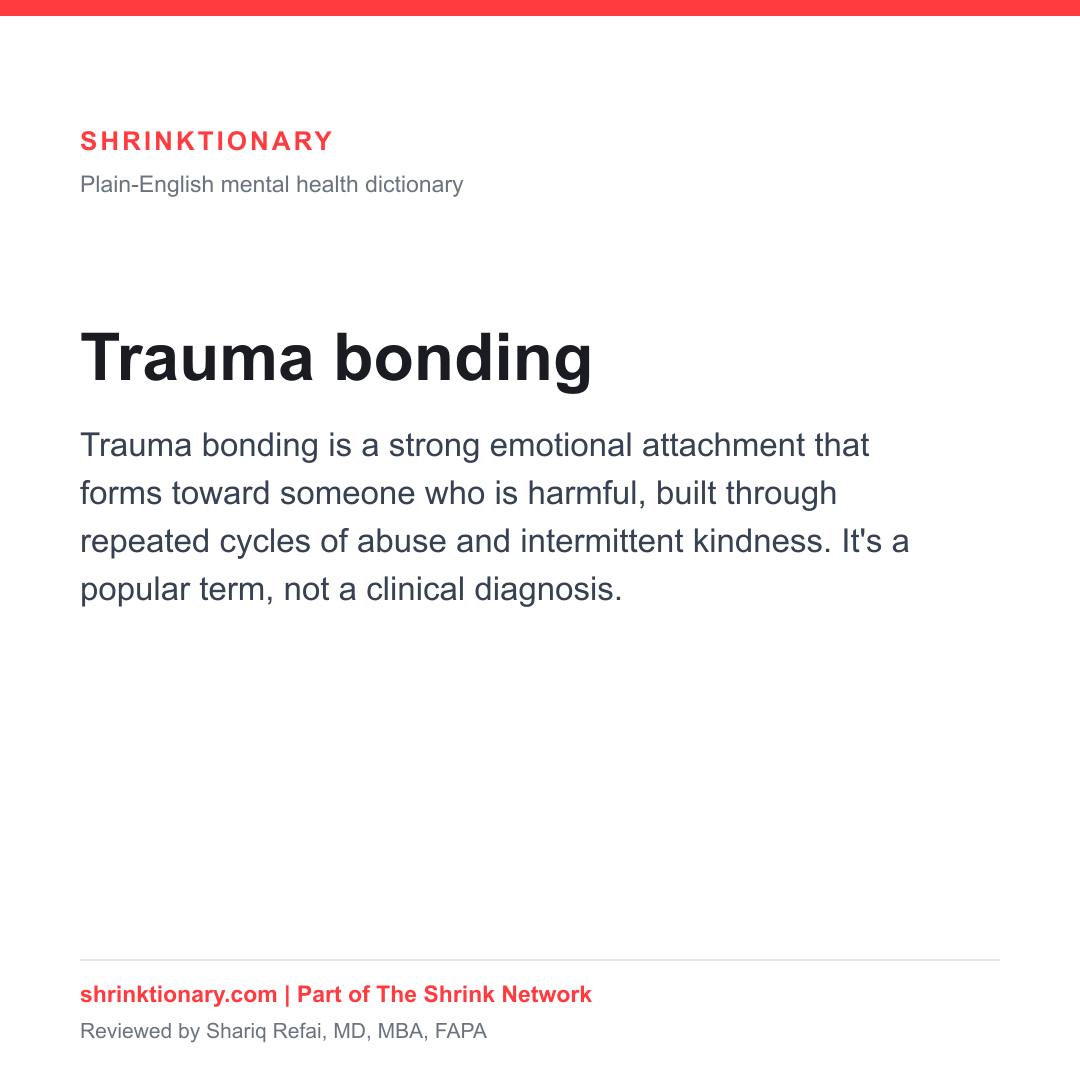
Trauma bonding is a popular term, not a clinical diagnosis. It describes a powerful emotional attachment that forms toward a person who is mistreating you, held together by repeating cycles of harm followed by warmth. The bad periods are real, but so are the moments of affection, apology, and relief that follow them, and that mix is what makes the attachment so sticky.
The mechanism is partly about unpredictability. When kindness arrives only sometimes, and you never know when, the brain learns to chase it hard. Each return of warmth feels like rescue, which deepens the tie even as the overall situation stays harmful. The term gets used broadly online, so it’s worth keeping it anchored to that specific cycle rather than applying it to any difficult relationship.
What trauma bonding can feel like
From the inside, it can feel like loyalty that doesn’t make sense even to the person feeling it. There’s often a strong pull to defend, excuse, or return to someone who has caused real pain. People describe feeling addicted to the relationship, replaying the good moments, and minimizing the bad ones.
Leaving can feel unbearable rather than freeing. The thought of being without the person can trigger more distress than the harm itself, which is confusing and easy to blame yourself for. That intensity is a feature of the bond, not a sign of weakness or poor judgment.
What trauma bonding isn’t
Trauma bonding isn’t simply loving someone who is flawed, and it isn’t ordinary relationship conflict. Every close relationship has rough patches. The marker here is a repeating cycle of mistreatment and reconciliation that keeps someone attached despite ongoing harm.
It also isn’t a moral failing or proof that someone wanted to be hurt. The attachment forms through predictable psychological mechanisms, not through choice. Naming it accurately is meant to reduce self-blame, not add to it.
Related terms you’ll see next
Love bombing is often how these dynamics begin, with intense early affection. Codependency can overlap when one person’s sense of self gets wrapped up in the relationship. Gaslighting frequently appears in the same setting and makes the bond harder to question.
When it helps to get support
If you feel tied to a relationship that keeps hurting you, or if leaving feels impossible even when you know it’s harmful, working with a mental health professional can help you understand the pull and plan a way forward. Therapy is a safe place to untangle it. If you are in danger or facing abuse, a domestic violence hotline or local support service can help with safety planning.
When this word matters
It matters when a repeating cycle of harm and warmth keeps someone attached to a relationship that is hurting them, because the bond can make leaving feel impossible. The cycle, not ordinary conflict, is what defines it.
Commonly confused with
Frequently asked questions
What is trauma bonding?
Trauma bonding is a strong emotional attachment to someone who is harmful, held together by repeating cycles of mistreatment followed by warmth. It is a popular term, not a clinical diagnosis, and the on-and-off pattern is what makes the bond so sticky.
Why is it so hard to leave a trauma bond?
When kindness arrives only sometimes and unpredictably, the brain learns to chase it hard, so each return of warmth feels like rescue and deepens the tie. The thought of leaving can trigger more distress than the harm itself.
Is trauma bonding the same as love?
No. Trauma bonding is anchored to a specific cycle of harm and reconciliation, not to ordinary love for a flawed person. The attachment forms through predictable psychological mechanisms, which is why it is not a moral failing or a sign of weakness.
Related terms
Sources
- Coping with Traumatic Events , National Institute of Mental Health
- Domestic Violence , MedlinePlus
Use or cite this definition
Free to reuse with attribution. Paste the block into your own page, or grab a citation.
Embed on your site
<blockquote>
<p><strong>Trauma bonding:</strong> Trauma bonding is a strong emotional attachment that forms toward someone who is harmful, built through repeated cycles of abuse and intermittent kindness. It's a popular term, not a clinical diagnosis.</p>
<p>— <a href="https://shrinktionary.com/terms/trauma-bonding/">Shrinktionary</a>, a plain-English mental health dictionary, medically reviewed by a board certified psychiatrist.</p>
</blockquote>Cite (APA)
Refai, S. (2026). Trauma bonding. Shrinktionary. https://shrinktionary.com/terms/trauma-bonding/
Cite (MLA)
"Trauma bonding." Shrinktionary, https://shrinktionary.com/terms/trauma-bonding/. Accessed September 29, 2026.
Your next step in The Shrink Network
You are here: Shrinktionary, the language layer of The Shrink Network.
Each site in the network has one job. No matter where you enter, we help you find the next step that makes sense.
Want to understand more first?
See how this connects to everything else in the Term Web →
Take it with you
Free printable references you can save or share. For education, not medical advice.