What informed consent actually is
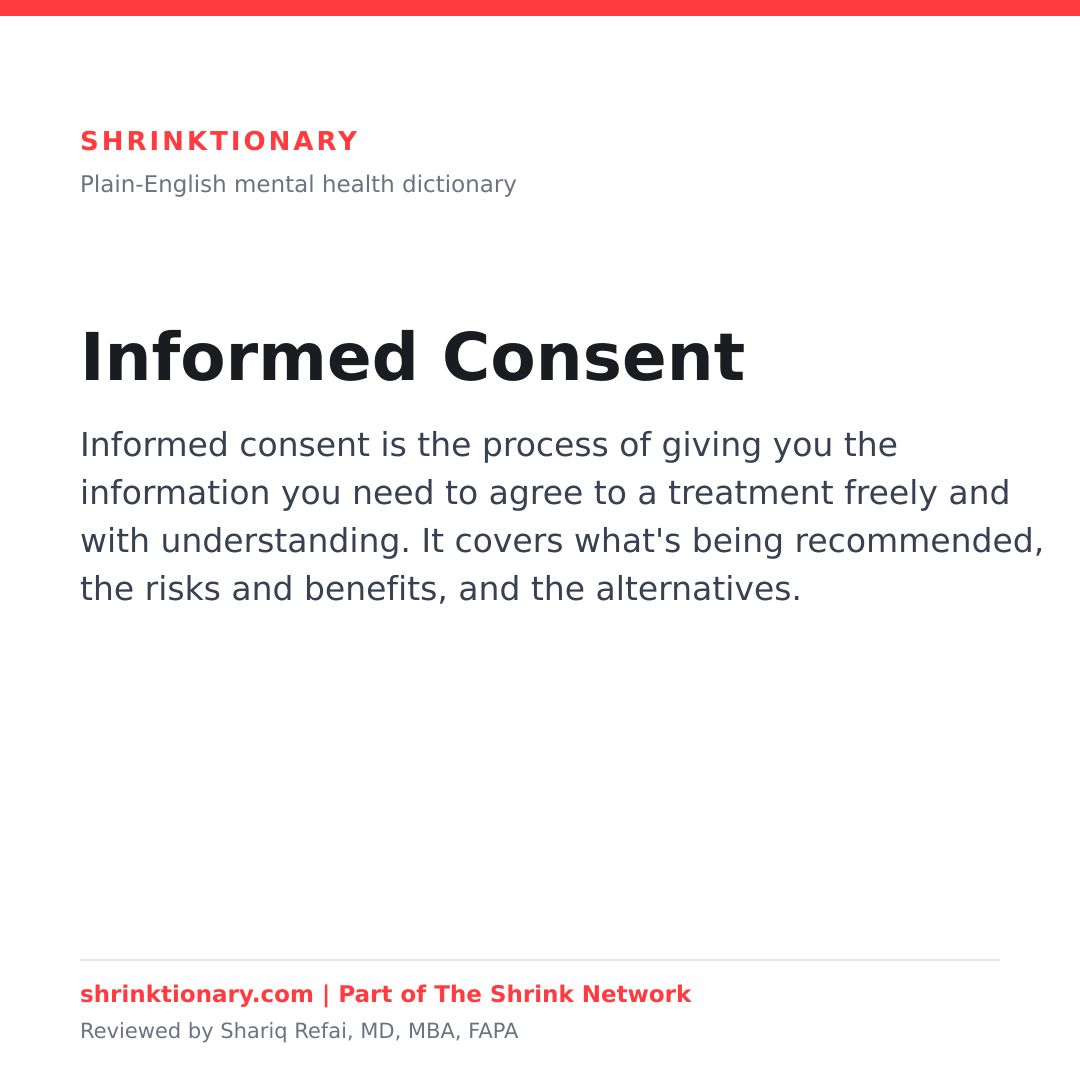
Informed consent is the process by which you agree to a treatment after being given enough information to make a real decision. It’s built on a simple idea. You should understand what’s being proposed, why, and what could happen before you say yes. Ethically and legally, it rests on three pillars: you get the relevant information, you have the capacity to understand it, and your choice is voluntary rather than coerced.
In practice it usually covers the recommended treatment, the main risks and benefits, the likely alternatives including doing nothing, and a chance to ask questions. It applies to medications, therapy approaches, and procedures alike. When a medication carries a black box warning or is prescribed off-label, that’s exactly the kind of thing a good consent conversation makes clear, since those details can change how you weigh the choice.
How it works in practice
A clinician explains the plan in language you can follow, not just medical terms. They lay out what the treatment is meant to do, the common and serious risks, how long it might take to help, and what other options exist. Then they leave room for your questions and your decision. Done well, this overlaps with psychoeducation, since understanding your condition helps you weigh the choices in front of you rather than deferring blindly.
Consent is also ongoing. You can ask more questions later, change your mind, or revisit a choice as things unfold and as you learn how a treatment affects you. For people who can’t make decisions for themselves, whether because of age or a condition affecting capacity, the law and clinical practice set out who can help decide on their behalf. Capacity is also decision-specific, so someone may be able to consent to one thing and need support with another, and it can change over time.
What it isn’t
It isn’t just a signature on a form. The form documents the conversation, but the real consent is the understanding and the agreement behind it. A signed page with no genuine discussion doesn’t meet the standard, even if it satisfies paperwork.
It also isn’t a one-time event you can never revisit. Agreeing today doesn’t lock you in forever, and withdrawing consent is your right. Consent given under pressure or without the key facts isn’t truly informed, which is why voluntariness matters as much as information. It’s also different from a clinician simply telling you what they’ve decided, since consent means the choice is genuinely yours to make.
Related terms you’ll see next
Why it matters
Informed consent matters because it puts you in the decision, not just on the receiving end of one. Good treatment depends on trust and understanding, and that’s hard to build if you don’t know what you’re agreeing to. It also reflects a basic respect for your autonomy, the principle that your body and your care are yours to direct. When the process is done well, you can weigh the trade-offs, ask what you need to, and choose a path that fits your values and your life. That shared understanding also tends to make the treatment itself go better, since you know what to expect and what to watch for.
When this word matters
Informed consent matters whenever you're deciding on a medication, therapy, or procedure, because it means understanding the risks, benefits, and alternatives before agreeing. It's an ongoing process you can revisit or withdraw, not just a signature on a form.
Commonly confused with
Frequently asked questions
What does informed consent involve?
It usually covers the recommended treatment, the main risks and benefits, the likely alternatives including doing nothing, and a chance to ask questions. It applies to medications, therapy approaches, and procedures alike.
Is informed consent just signing a form?
No. The form documents the conversation, but the real consent is the understanding and agreement behind it. A clinician is meant to explain the plan in language you can follow, not just medical terms.
Can I change my mind after giving consent?
Yes. Consent is ongoing, so you can ask more questions later, revisit a choice, or withdraw consent as things unfold. Agreeing today doesn't lock you in forever.
Related terms
Sources
- Mental Health Information , National Institute of Mental Health
- Patient Rights , MedlinePlus
Use or cite this definition
Free to reuse with attribution. Paste the block into your own page, or grab a citation.
Embed on your site
<blockquote>
<p><strong>Informed Consent:</strong> Informed consent is the process of giving you the information you need to agree to a treatment freely and with understanding. It covers what's being recommended, the risks and benefits, and the alternatives.</p>
<p>— <a href="https://shrinktionary.com/terms/informed-consent/">Shrinktionary</a>, a plain-English mental health dictionary, medically reviewed by a board certified psychiatrist.</p>
</blockquote>Cite (APA)
Refai, S. (2026). Informed Consent. Shrinktionary. https://shrinktionary.com/terms/informed-consent/
Cite (MLA)
"Informed Consent." Shrinktionary, https://shrinktionary.com/terms/informed-consent/. Accessed September 26, 2026.
Your next step in The Shrink Network
You are here: Shrinktionary, the language layer of The Shrink Network.
Each site in the network has one job. No matter where you enter, we help you find the next step that makes sense.
Want to understand more first?
See how this connects to everything else in the Term Web →
Take it with you
Free printable references you can save or share. For education, not medical advice.