What hoarding disorder actually is
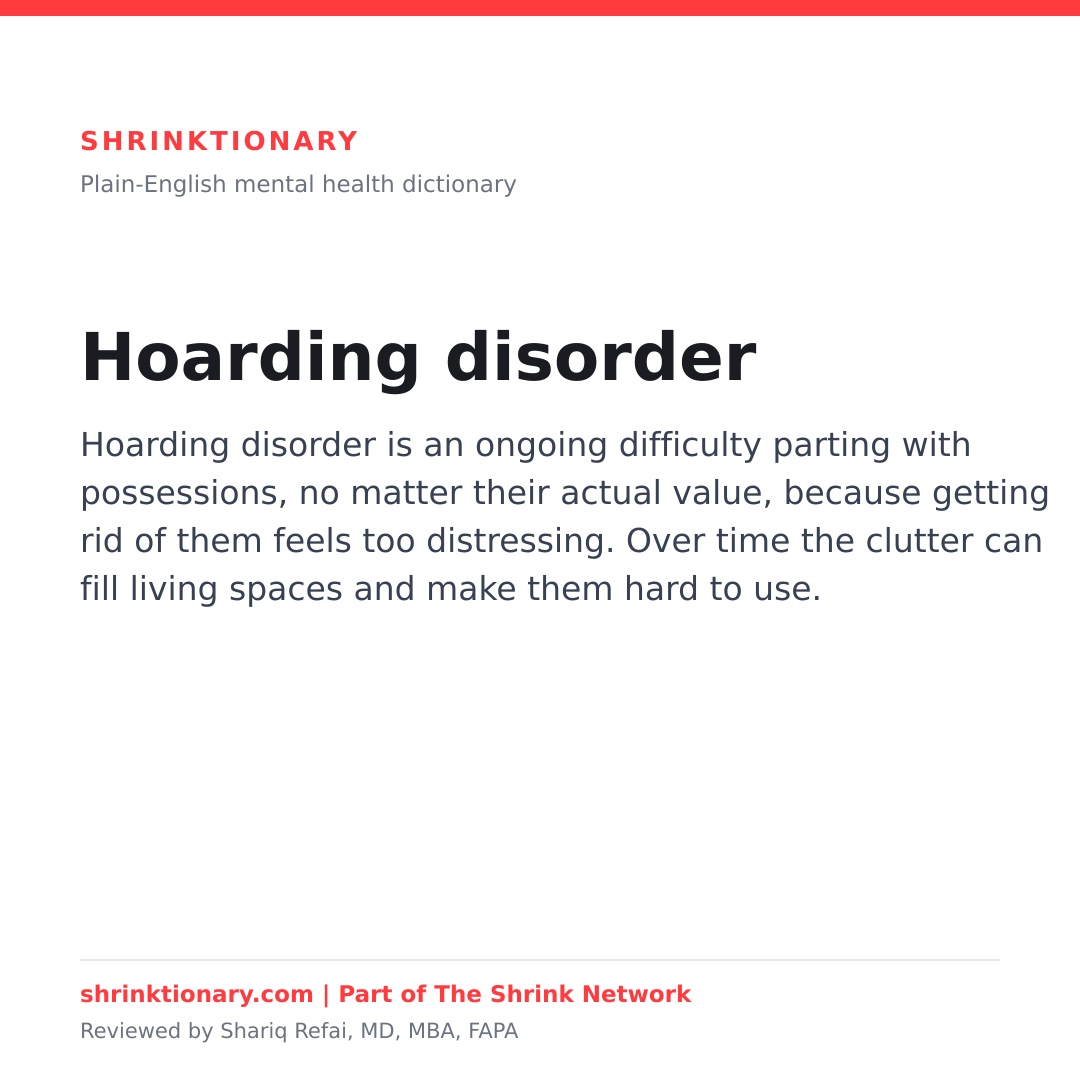
Hoarding disorder is a persistent difficulty letting go of possessions, regardless of whether they have real value. The trouble isn’t really about the items themselves. It’s about the strong distress a person feels at the thought of discarding them. As things accumulate, living spaces can become so full that rooms can no longer be used for their intended purpose.
It’s recognized as its own condition. People with hoarding disorder often feel a genuine need to save items and may experience real anxiety, guilt, or a sense of loss when trying to part with them. The behavior usually develops gradually and can become more pronounced with age.
How hoarding disorder shows up
It can look like saving newspapers, mail, clothing, containers, or seemingly random objects, often with the thought that they might be needed someday or that throwing them out would be wasteful. Surfaces, hallways, and rooms fill up, and the clutter can make cooking, sleeping, or moving around difficult.
Beyond the physical mess, there’s often deep emotional distress. People may feel ashamed, avoid having visitors, and feel overwhelmed at the idea of sorting through everything. Decisions about what to keep can feel paralyzing. The condition can also create safety concerns, like fire risk or falls, and strain on relationships.
What hoarding disorder isn’t
It isn’t the same as collecting, where items are organized, displayed, and enjoyed. It also isn’t simply being messy or having a cluttered home. With hoarding disorder, the difficulty discarding is persistent and tied to real distress, and the clutter interferes with everyday living.
It isn’t laziness or a moral failing, and shaming rarely helps. It’s a recognized mental health condition, and people who struggle with it are not choosing the chaos for the sake of it.
Related terms you’ll see next
When to seek professional care
It’s a good idea to seek help when clutter starts to interfere with using living spaces, causes safety concerns, or brings significant distress to the person or their household. Specialized therapy, often a form of cognitive behavioral therapy, can help people build skills for sorting, deciding, and discarding at a manageable pace. Compassion and patience tend to work far better than pressure, and support is available.
When evaluation may help
Not everyone reading about hoarding disorder needs treatment. If it's getting in the way of your day, your sleep, your work, or your relationships, or if it isn't easing on its own, a professional evaluation is a reasonable next step. Most people start with their primary care doctor or a therapist. A psychiatrist is the right call when medication may be involved or the picture is complicated, though waits can be long.
We keep an honest, no-commission rundown of the options, from primary care to telepsychiatry to crisis lines, on one page.
If you're in crisis or thinking about suicide, call or text 988 in the US, or go to the nearest emergency room.
When this word matters
Saving things crosses into hoarding disorder when difficulty discarding is persistent, tied to real distress, and clutter fills living spaces so rooms can't be used or safety is at risk. It can overlap with OCD, anxiety, and depression.
Commonly confused with
Frequently asked questions
What makes hoarding disorder different from collecting?
Collecting involves items that are organized, displayed, and enjoyed, while hoarding disorder involves persistent difficulty discarding tied to real distress, with clutter that interferes with everyday living. It also isn't simply being messy.
Why do people with hoarding disorder keep so many things?
The trouble isn't really about the items themselves but about the strong distress a person feels at the thought of discarding them. They often feel a genuine need to save things and may feel anxiety, guilt, or loss when trying to part with them.
When should someone seek help for hoarding?
It's a good idea to seek help when clutter interferes with using living spaces, causes safety concerns, or brings significant distress. Specialized therapy, often a form of cognitive behavioral therapy, can help build skills for sorting and discarding at a manageable pace.
Related terms
Sources
- Obsessive-Compulsive Disorder (OCD) , National Institute of Mental Health
- Hoarding Disorder , MedlinePlus
Use or cite this definition
Free to reuse with attribution. Paste the block into your own page, or grab a citation.
Embed on your site
<blockquote>
<p><strong>Hoarding disorder:</strong> Hoarding disorder is an ongoing difficulty parting with possessions, no matter their actual value, because getting rid of them feels too distressing. Over time the clutter can fill living spaces and make them hard to use.</p>
<p>— <a href="https://shrinktionary.com/terms/hoarding-disorder/">Shrinktionary</a>, a plain-English mental health dictionary, medically reviewed by a board certified psychiatrist.</p>
</blockquote>Cite (APA)
Refai, S. (2026). Hoarding disorder. Shrinktionary. https://shrinktionary.com/terms/hoarding-disorder/
Cite (MLA)
"Hoarding disorder." Shrinktionary, https://shrinktionary.com/terms/hoarding-disorder/. Accessed September 26, 2026.
Your next step in The Shrink Network
You are here: Shrinktionary, the language layer of The Shrink Network.
Each site in the network has one job. No matter where you enter, we help you find the next step that makes sense.
Want to understand more first?
See how this connects to everything else in the Term Web →
Take it with you
Free printable references you can save or share. For education, not medical advice.