What tardive dyskinesia actually is
Tardive dyskinesia is a movement disorder that can develop after taking certain medications for a long stretch of time. “Tardive” means late-appearing, and “dyskinesia” means abnormal movement. Put together, the name points to involuntary movements that show up after extended use rather than right away.
It’s most associated with antipsychotic medications, especially older ones, though other drugs can carry some risk. The movements are not under the person’s control.
What it looks like
The classic signs involve the face and mouth, such as lip smacking, tongue movements, chewing motions, or grimacing. It can also affect the limbs and trunk, with writhing or jerking movements of the fingers, arms, or body.
The movements often start subtly and can be easy to miss at first. They may be more noticeable to others than to the person experiencing them, which is one reason regular check-ins matter for anyone on long-term medication that carries this risk.
What it isn’t
It isn’t the restlessness of akathisia, which is driven by an urge to move and tends to appear early. Tardive dyskinesia is later-appearing and involves involuntary movements rather than a felt need to move.
It also isn’t simply a sign of nervousness or a habit. These are true involuntary movements tied to long-term medication exposure, not a behavior someone can stop by choosing to.
Related terms you’ll see next
What to do about it
Tardive dyskinesia can be serious and is sometimes lasting, so early recognition matters. If you or people around you notice new involuntary movements of the face, mouth, or limbs while on a long-term medication, contact a prescriber promptly. Don’t stop the medication on your own, since abrupt changes can cause other problems. A clinician monitors for these movements over time and can adjust the plan, and catching it early gives the best chance of a good outcome.
When this word matters
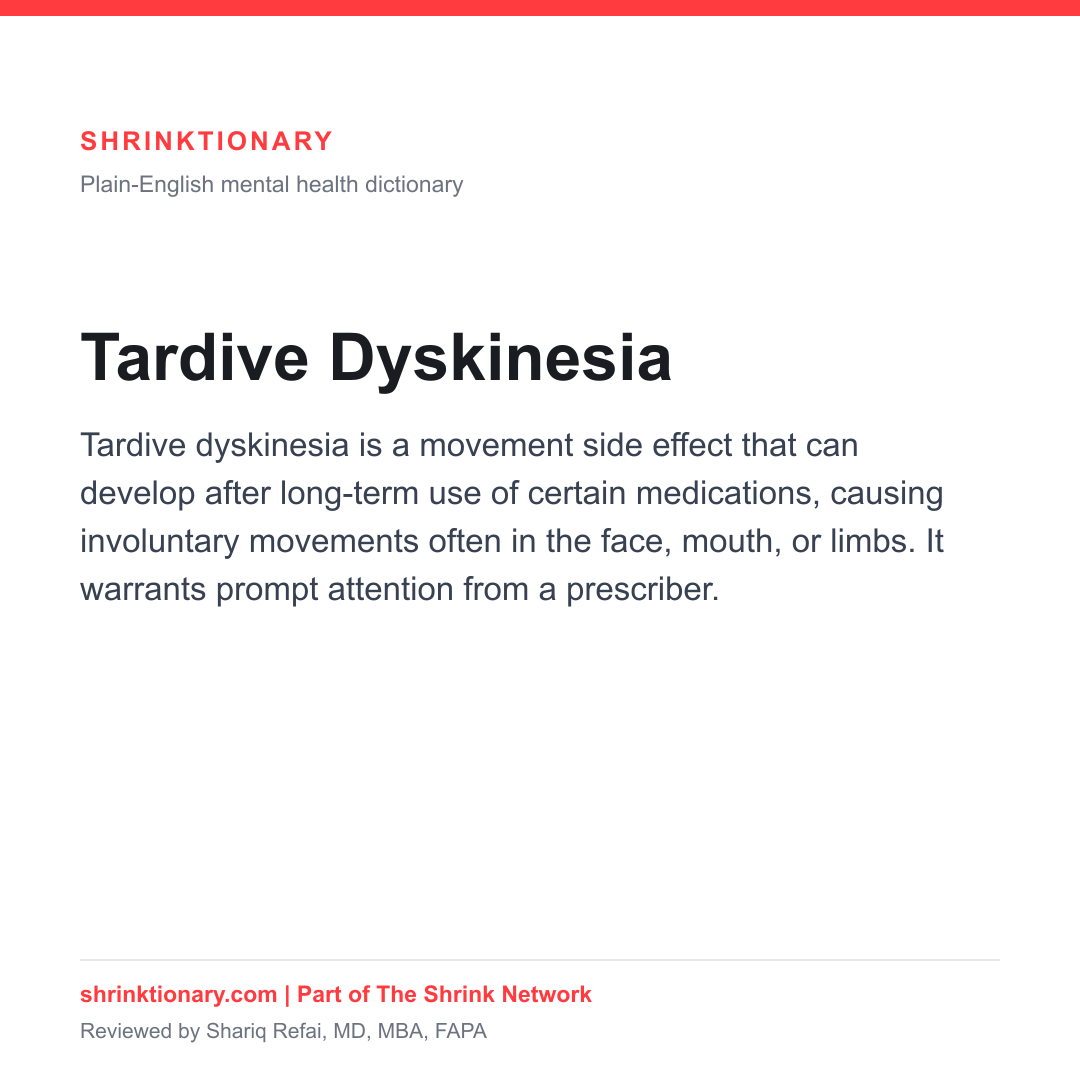
Tardive dyskinesia matters because it can develop after long-term use of certain medications, especially antipsychotics, and causes involuntary movements often in the face, mouth, or limbs that may not fully go away. New or worsening involuntary movements warrant prompt attention from a prescriber rather than stopping medication on your own.
Commonly confused with
Frequently asked questions
What causes tardive dyskinesia?
It can develop after taking certain medications for a long stretch of time, and it's most associated with antipsychotic medications, especially older ones. The name means late-appearing abnormal movement.
What does tardive dyskinesia look like?
Classic signs involve the face and mouth, such as lip smacking, tongue movements, chewing motions, or grimacing, and it can also affect the limbs and trunk. The movements are involuntary and often start subtly.
What should someone do if they notice these movements?
Tardive dyskinesia can be serious and is sometimes lasting, so early recognition matters. If new involuntary movements appear while on a long-term medication, contact a prescriber promptly and don't stop the medication on your own, since abrupt changes can cause other problems.
Related terms
Sources
- Mental Health Medications , National Institute of Mental Health
Use or cite this definition
Free to reuse with attribution. Paste the block into your own page, or grab a citation.
Embed on your site
<blockquote>
<p><strong>Tardive Dyskinesia:</strong> Tardive dyskinesia is a movement side effect that can develop after long-term use of certain medications, causing involuntary movements often in the face, mouth, or limbs. It warrants prompt attention from a prescriber.</p>
<p>— <a href="https://shrinktionary.com/terms/tardive-dyskinesia/">Shrinktionary</a>, a plain-English mental health dictionary, medically reviewed by a board certified psychiatrist.</p>
</blockquote>Cite (APA)
Refai, S. (2026). Tardive Dyskinesia. Shrinktionary. https://shrinktionary.com/terms/tardive-dyskinesia/
Cite (MLA)
"Tardive Dyskinesia." Shrinktionary, https://shrinktionary.com/terms/tardive-dyskinesia/. Accessed September 26, 2026.
Your next step in The Shrink Network
You are here: Shrinktionary, the language layer of The Shrink Network.
Each site in the network has one job. No matter where you enter, we help you find the next step that makes sense.
Want to understand more first?
See how this connects to everything else in the Term Web →
Take it with you
Free printable references you can save or share. For education, not medical advice.