What a syndrome actually is
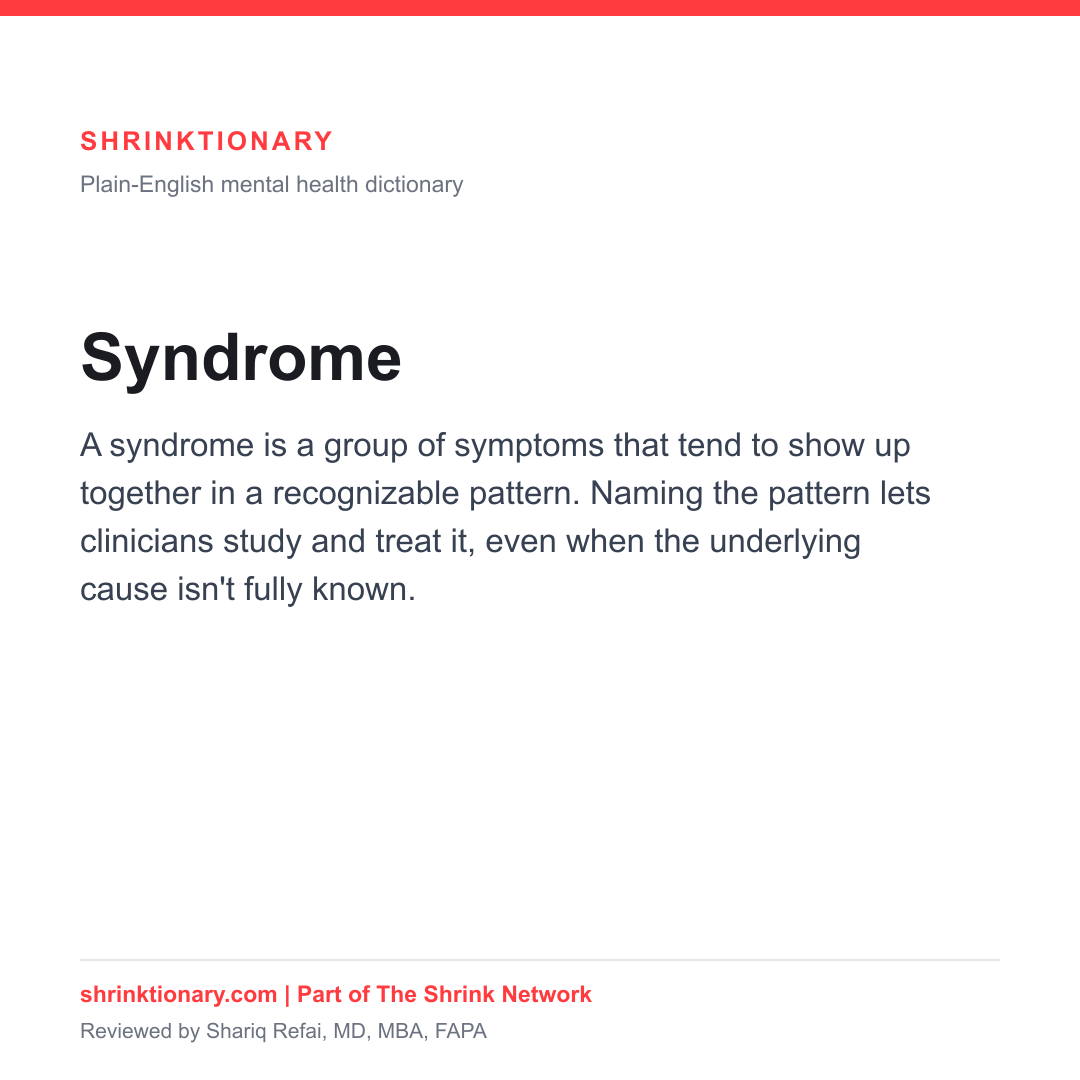
A syndrome is a pattern. Certain symptoms keep turning up together, often enough and consistently enough that the cluster gets a name. The name describes what’s seen, not necessarily what’s causing it.
That distinction is the whole point of the word. A disease usually implies a known mechanism. A syndrome says we recognize this pattern reliably, and we can study it and treat it, while being honest that the cause may not be settled.
Why the word matters
Most psychiatric diagnoses are, strictly speaking, syndromes. They’re defined by patterns of symptoms rather than by a blood test or a scan that confirms a mechanism. That isn’t a failure of psychiatry so much as a description of where the science currently stands for these conditions.
Knowing this changes how you read a diagnosis. It explains why two people with the same label can look different, why diagnoses get revised as understanding improves, and why a clinician can treat something effectively without being able to point to a single cause.
What a syndrome isn’t
A syndrome isn’t a made-up category. Patterns that recur reliably are real, and they carry real information about what tends to happen next and what tends to help. Being defined by pattern rather than mechanism doesn’t make a condition less genuine.
It also isn’t a statement that the cause is unknowable. Plenty of syndromes eventually get explained, and the label changes when they do.
Related terms you’ll see next
Diagnostic criteria are how a syndrome gets defined precisely enough to use. The DSM-5-TR is where those definitions live in US practice. Etiology is the question of cause that a syndrome name deliberately leaves open. Comorbidity is what it’s called when more than one is present at once.
Where you’ll see it
You’ll see the word in clinical writing and research more than in conversation. If you notice that a diagnosis is described as a syndrome, it isn’t a downgrade. It’s an accurate statement about how the condition is defined, and it’s a reason to focus on what helps rather than waiting for a test that settles it.
When this word matters
It matters because most psychiatric diagnoses are syndromes, defined by pattern rather than by a confirming test. That explains why two people with the same label can look different and why diagnoses get revised as understanding improves.
Commonly confused with
Frequently asked questions
What's the difference between a syndrome and a disease?
A disease usually implies a known underlying mechanism. A syndrome names a pattern of symptoms that reliably occur together, while being honest that the cause may not be settled.
Are psychiatric diagnoses syndromes?
Most are, strictly speaking. They're defined by patterns of symptoms rather than by a test that confirms a mechanism. That's a description of where the science stands, not a sign the conditions aren't real.
Does calling it a syndrome mean it's less real?
No. Patterns that recur reliably carry real information about what tends to happen and what tends to help. Being defined by pattern rather than mechanism doesn't make a condition less genuine.
Related terms
Sources
- Diagnostic and Statistical Manual of Mental Disorders (DSM-5-TR) , American Psychiatric Association
- Mental Health Topics , National Institute of Mental Health
Use or cite this definition
Free to reuse with attribution. Paste the block into your own page, or grab a citation.
Embed on your site
<blockquote>
<p><strong>Syndrome:</strong> A syndrome is a group of symptoms that tend to show up together in a recognizable pattern. Naming the pattern lets clinicians study and treat it, even when the underlying cause isn't fully known.</p>
<p>— <a href="https://shrinktionary.com/terms/syndrome/">Shrinktionary</a>, a plain-English mental health dictionary, medically reviewed by a board certified psychiatrist.</p>
</blockquote>Cite (APA)
Refai, S. (2026). Syndrome. Shrinktionary. https://shrinktionary.com/terms/syndrome/
Cite (MLA)
"Syndrome." Shrinktionary, https://shrinktionary.com/terms/syndrome/. Accessed September 29, 2026.
Your next step in The Shrink Network
You are here: Shrinktionary, the language layer of The Shrink Network.
Each site in the network has one job. No matter where you enter, we help you find the next step that makes sense.
Want to understand more first?
See how this connects to everything else in the Term Web →
Take it with you
Free printable references you can save or share. For education, not medical advice.