What reuptake actually is
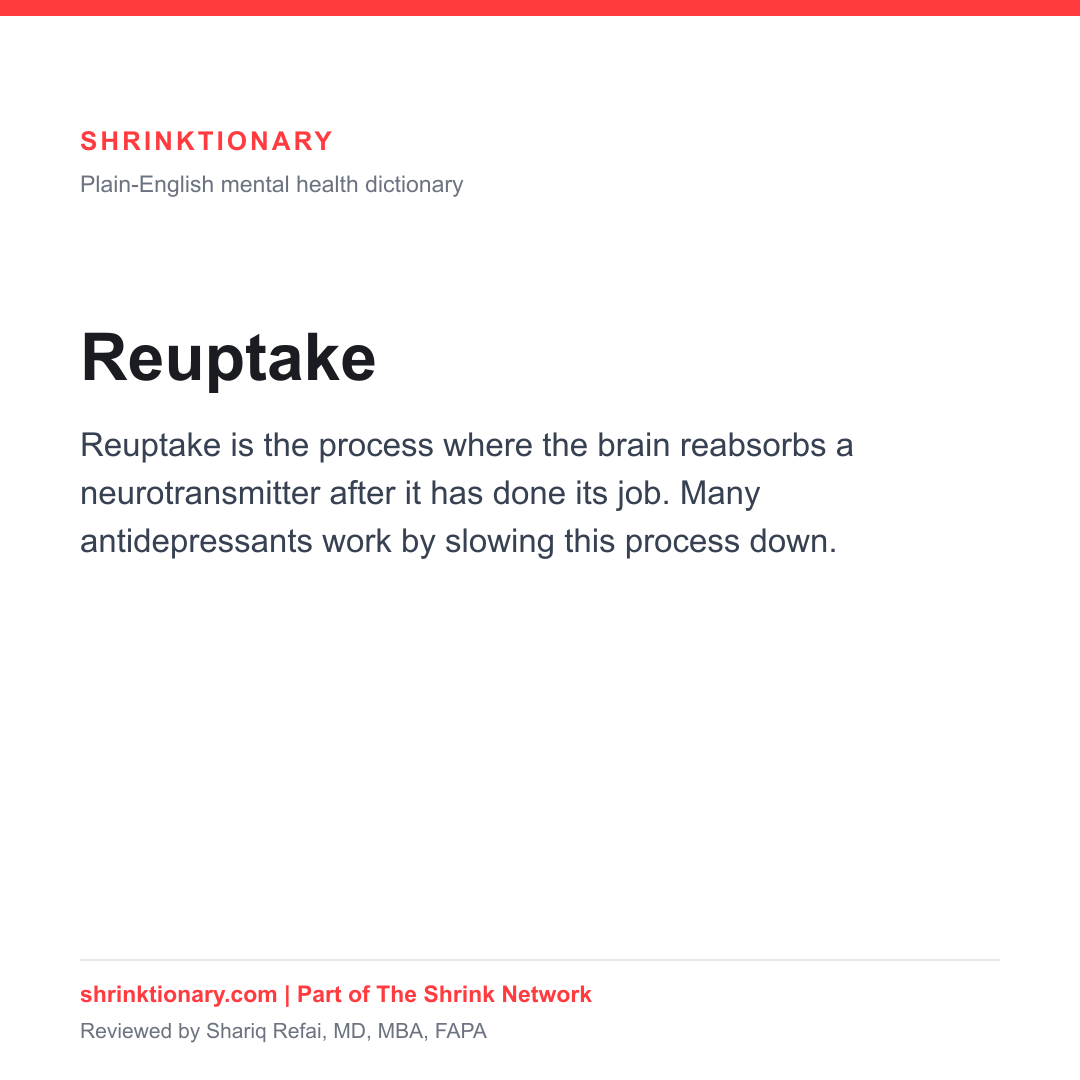
Reuptake is a normal recycling step in how brain cells communicate. Nerve cells, called neurons, send messages to each other across a tiny gap by releasing chemical messengers known as neurotransmitters. Serotonin, norepinephrine, and dopamine are well-known examples. Once a neurotransmitter has carried its signal across the gap, the cell that released it pulls a portion back inside to be reused. That pulling-back is reuptake.
It’s a tidy, efficient system. Reuptake clears the signal so the gap is ready for the next message and keeps neurotransmitter levels in a workable range. Special proteins called transporters sit on the neuron’s surface and do the actual reabsorbing, each one tuned to grab a particular neurotransmitter. None of this is a malfunction. Reuptake is part of healthy, ordinary brain signaling, and it’s the exact step many psychiatric medications are designed to act on.
How it works
The communication gap between two neurons is called the synapse. When a neuron fires, it releases neurotransmitter molecules into the synapse, where they attach to receptors on the next cell and pass the message along. Then the transporter proteins on the sending neuron reabsorb the leftover molecules, ending the signal and storing them for later.
Many antidepressants step into this moment. A selective serotonin reuptake inhibitor, or SSRI, blocks the transporter that reabsorbs serotonin. With reuptake slowed, more serotonin stays in the synapse and remains available to keep signaling. A serotonin-norepinephrine reuptake inhibitor, or SNRI, does the same for two neurotransmitters at once. These medications usually take several weeks to show their full effect, which suggests that the benefit comes not just from the immediate chemical change but from slower adjustments the brain makes in response.
What reuptake isn’t
Reuptake isn’t a disease or a problem to be fixed in itself. It’s a normal process, and the goal of a reuptake inhibitor isn’t to stop it entirely but to dial it back so more of a neurotransmitter stays available.
It also isn’t a complete explanation of depression. The old idea that depression is simply a chemical imbalance corrected by raising serotonin is too simple, and reuptake is only one piece of a much larger picture that involves brain networks, life circumstances, and biology. And blocking reuptake isn’t an instant fix. Because the brain adapts gradually, medications that act on reuptake take time to work and should be started and stopped only with a prescriber’s guidance.
Related terms you’ll see next
Neurotransmitter and serotonin are the chemicals reuptake recycles. SSRI and SNRI are the medication classes that work by blocking reuptake.
Why it matters
Reuptake matters because it’s the mechanism behind some of the most widely prescribed mental health medications. Understanding it helps make sense of how SSRIs and SNRIs work, why they take weeks rather than hours to help, and why stopping them abruptly can cause problems. It’s a useful concept for anyone trying to understand their treatment, and decisions about these medications always belong with a prescribing clinician.
When this word matters
It matters because reuptake is the mechanism behind some of the most widely prescribed mental health medications. Understanding it helps make sense of how SSRIs and SNRIs work, why they take weeks rather than hours to help, and why stopping them abruptly can cause problems. Decisions about these medications always belong with a prescribing clinician.
Commonly confused with
Frequently asked questions
What is reuptake?
Reuptake is a normal recycling step in how brain cells communicate. After a neurotransmitter like serotonin carries its signal across the gap between two neurons, the cell that released it pulls a portion back inside to be reused. That pulling-back is reuptake.
How do SSRIs affect reuptake?
A selective serotonin reuptake inhibitor, or SSRI, blocks the transporter protein that reabsorbs serotonin. With reuptake slowed, more serotonin stays in the synapse and remains available to keep signaling. An SNRI does the same for both serotonin and norepinephrine.
Why do reuptake inhibitors take weeks to work?
Because the brain adapts gradually. The benefit appears to come not just from the immediate chemical change but from slower adjustments the brain makes in response. These medications should be started and stopped only with a prescriber's guidance.
Related terms
In these language clusters
Sources
- Mental Health Medications , National Institute of Mental Health
- Selective Serotonin Reuptake Inhibitors (StatPearls) , National Center for Biotechnology Information
Use or cite this definition
Free to reuse with attribution. Paste the block into your own page, or grab a citation.
Embed on your site
<blockquote>
<p><strong>Reuptake:</strong> Reuptake is the process where the brain reabsorbs a neurotransmitter after it has done its job. Many antidepressants work by slowing this process down.</p>
<p>— <a href="https://shrinktionary.com/terms/reuptake/">Shrinktionary</a>, a plain-English mental health dictionary, medically reviewed by a board certified psychiatrist.</p>
</blockquote>Cite (APA)
Refai, S. (2026). Reuptake. Shrinktionary. https://shrinktionary.com/terms/reuptake/
Cite (MLA)
"Reuptake." Shrinktionary, https://shrinktionary.com/terms/reuptake/. Accessed September 26, 2026.
Your next step in The Shrink Network
You are here: Shrinktionary, the language layer of The Shrink Network.
Each site in the network has one job. No matter where you enter, we help you find the next step that makes sense.
Want to understand more first?
See how this connects to everything else in the Term Web →
Take it with you
Free printable references you can save or share. For education, not medical advice.