What a provisional diagnosis actually is
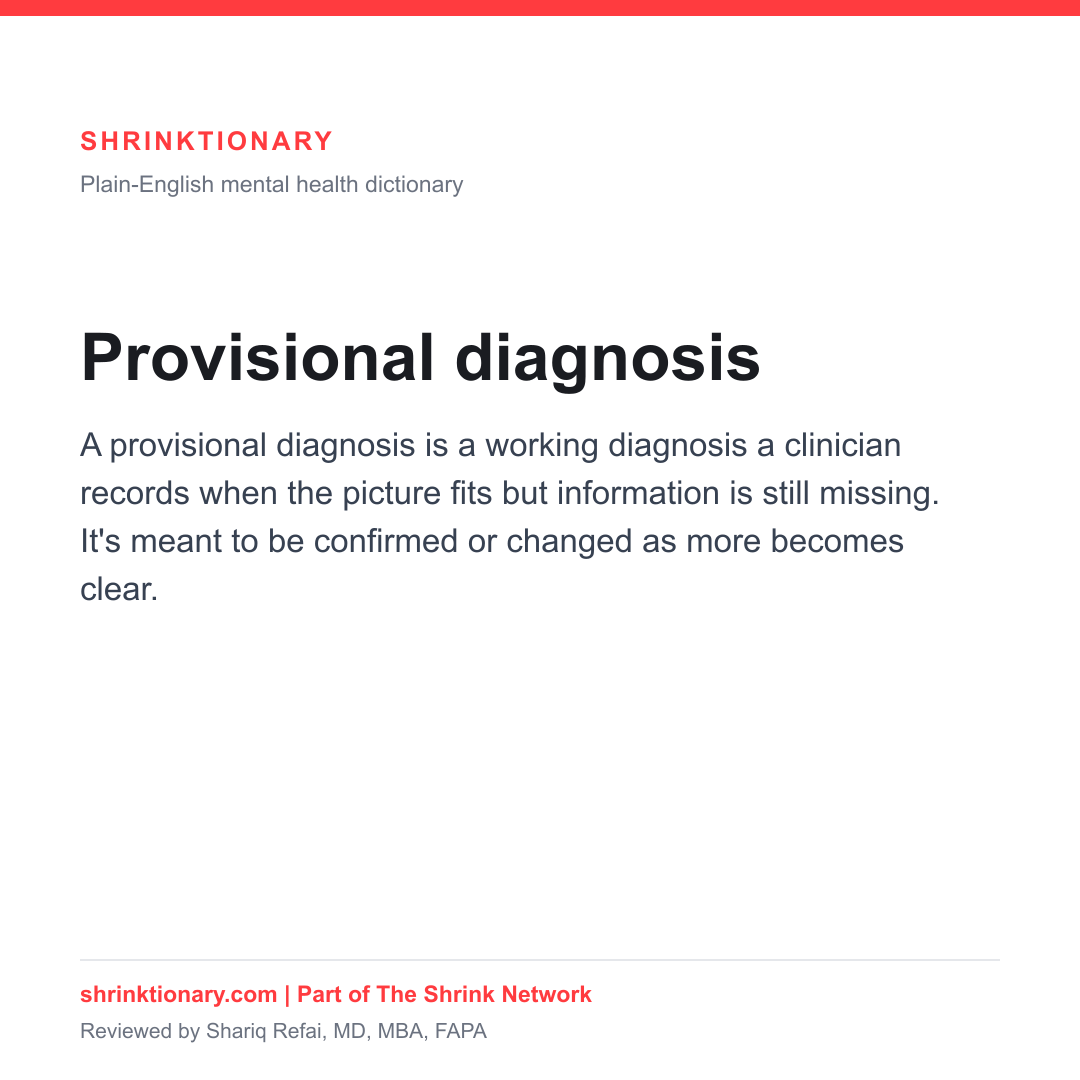
A provisional diagnosis is a clinician saying, in effect, this is what it looks like so far, and I’m not finished. It gets used when the presentation points strongly toward a condition but something needed to be sure isn’t available yet. Maybe not enough time has passed to meet a duration requirement. Maybe records or collateral history are missing. Maybe a medical cause still has to be excluded.
You’ll see a related phrase in notes: rule out. When a clinician writes rule out followed by a condition, they mean it’s still on the table and needs to be excluded, not that it’s been excluded already. People misread that constantly, and it’s worth knowing.
Why it matters
Recording a provisional diagnosis lets care start now instead of waiting for certainty that may take weeks. Treatment, referrals, and coverage often need a diagnosis on paper, and holding out for a perfect one can delay help.
It’s also a signal of honesty in the record. A provisional label tells the next clinician that this was an early read, made without complete information, and that it should be revisited rather than repeated as fact.
What it isn’t
A provisional diagnosis isn’t a guess, and it isn’t a final answer. It’s a considered working conclusion that’s explicitly marked as incomplete. The label is doing exactly what it says.
It also isn’t permanent. Provisional diagnoses are supposed to be revisited. One of the more common problems in medical records is an early provisional label that gets copied forward for years without anyone rechecking it. If an old diagnosis doesn’t seem to fit you, it’s fair to ask when it was last actually reviewed.
Related terms you’ll see next
Differential diagnosis is the list of possibilities a clinician is sorting between, and it’s usually what sits behind a provisional label. Diagnostic criteria are what a provisional diagnosis hasn’t fully confirmed yet. Formulation is the fuller working explanation of what’s going on.
Where you’ll see it
You’ll see provisional or rule out in evaluation notes, discharge paperwork, and referrals, especially early on. If you see one attached to you, it’s reasonable to ask what would confirm or rule it out, and when someone plans to look again.
When this word matters
It matters because a provisional label lets care start before certainty arrives, but it's meant to be revisited. Old provisional diagnoses that get copied forward unchecked are a real problem, and you can ask when yours was last reviewed.
Commonly confused with
Frequently asked questions
What does rule out mean in my notes?
It means that condition is still being considered and needs to be excluded, not that it has already been excluded. People often read it backwards.
Is a provisional diagnosis just a guess?
No. It's a considered working conclusion made with incomplete information, and it's explicitly labeled as such so it gets revisited rather than treated as final.
Can a provisional diagnosis be wrong or get stuck?
It can be changed, and it's supposed to be revisited. A known problem is an early provisional label getting copied forward for years, so if an old diagnosis doesn't fit, it's fair to ask when it was last reviewed.
Related terms
Sources
- Diagnostic and Statistical Manual of Mental Disorders (DSM-5-TR) , American Psychiatric Association
- Mental Health Topics , National Institute of Mental Health
Use or cite this definition
Free to reuse with attribution. Paste the block into your own page, or grab a citation.
Embed on your site
<blockquote>
<p><strong>Provisional diagnosis:</strong> A provisional diagnosis is a working diagnosis a clinician records when the picture fits but information is still missing. It's meant to be confirmed or changed as more becomes clear.</p>
<p>— <a href="https://shrinktionary.com/terms/provisional-diagnosis/">Shrinktionary</a>, a plain-English mental health dictionary, medically reviewed by a board certified psychiatrist.</p>
</blockquote>Cite (APA)
Refai, S. (2026). Provisional diagnosis. Shrinktionary. https://shrinktionary.com/terms/provisional-diagnosis/
Cite (MLA)
"Provisional diagnosis." Shrinktionary, https://shrinktionary.com/terms/provisional-diagnosis/. Accessed September 29, 2026.
Your next step in The Shrink Network
You are here: Shrinktionary, the language layer of The Shrink Network.
Each site in the network has one job. No matter where you enter, we help you find the next step that makes sense.
Want to understand more first?
See how this connects to everything else in the Term Web →
Take it with you
Free printable references you can save or share. For education, not medical advice.