What premenstrual dysphoric disorder actually is
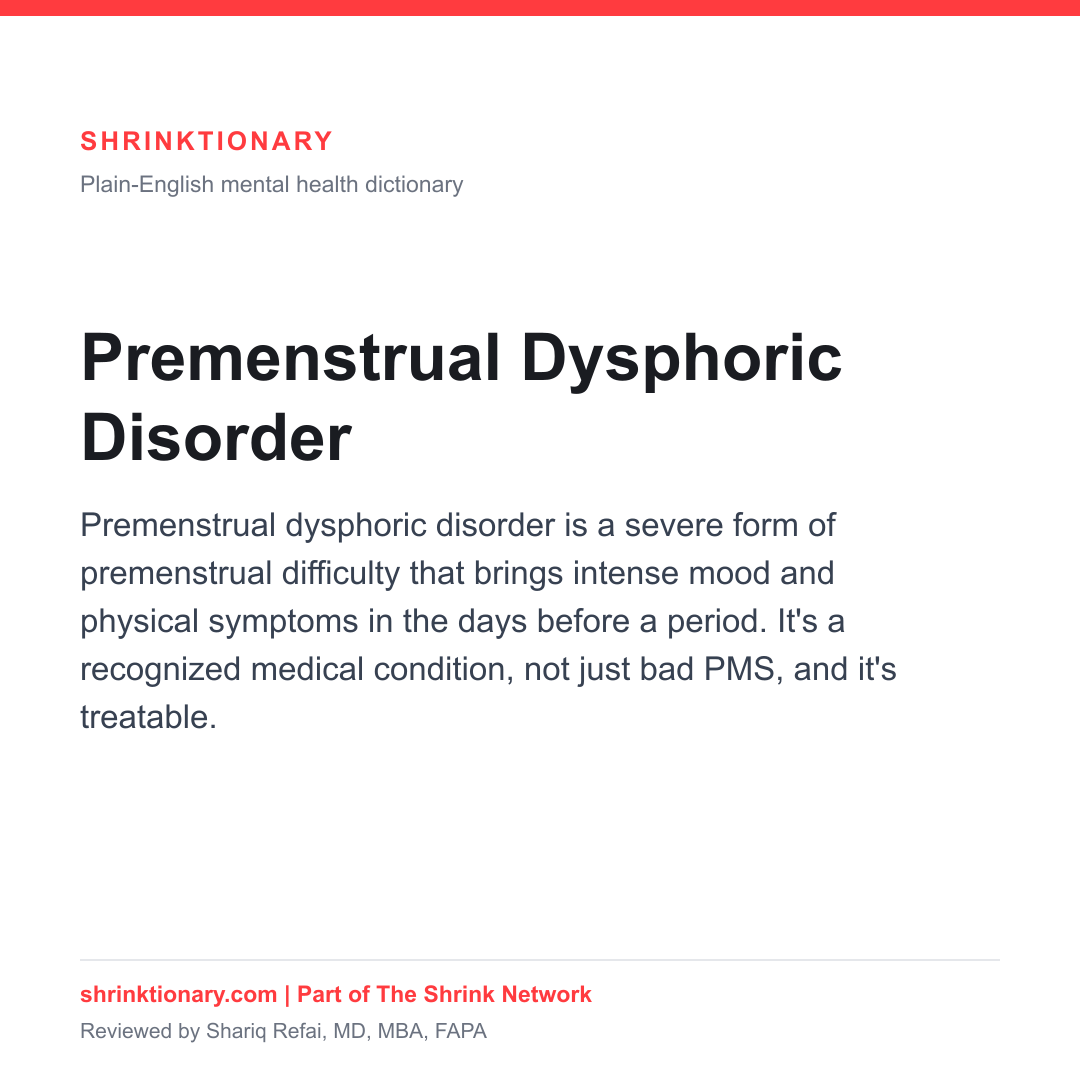
Premenstrual dysphoric disorder is a severe, recognized condition tied to the menstrual cycle. In the week or so before a period begins, a person experiences intense mood and physical symptoms that ease soon after the period starts. The pattern repeats cycle after cycle, following the body’s hormonal rhythm.
It sits at the far end of premenstrual difficulty. While many people notice mild changes before a period, premenstrual dysphoric disorder is different in degree and in impact. The symptoms are significant enough to disrupt relationships, work, and daily life. Researchers link it to how a sensitive nervous system responds to normal hormonal shifts, not to abnormal hormone levels.
How premenstrual dysphoric disorder shows up
The mood symptoms are often the most striking. People describe marked irritability, sadness or hopelessness, anxiety or tension, and sudden tearfulness or sensitivity. There can be a sense of being overwhelmed or out of control, and feeling like a different person for part of the month.
Physical and behavioral symptoms often join in, such as fatigue, sleep changes, appetite changes, trouble concentrating, and a loss of interest in usual activities. The key feature is timing. Symptoms cluster in the days before the period and reliably lift once it arrives, which tracking over a couple of cycles can reveal.
What premenstrual dysphoric disorder isn’t
It isn’t “just PMS” or something to brush off. Premenstrual dysphoric disorder is a distinct, well-recognized condition with significant impact, and the distress is real. It also isn’t a sign of weakness or something a person can simply will away.
It isn’t caused by abnormal hormones, so standard hormone tests usually look normal. The condition reflects how the brain responds to ordinary hormonal changes. And it isn’t the same as ongoing depression, since the symptoms follow the cycle rather than staying constant.
Related terms you’ll see next
When to seek professional care
If mood and physical symptoms in the days before your period are disrupting your life, it’s worth talking to a clinician. Tracking symptoms across a couple of cycles helps confirm the pattern, and effective treatments exist, including certain medications and therapy.
If you’re not sure whether it’s PMDD or a rough version of PMS, PMDD vs PMS and when it’s time to see a psychiatrist on shrinkMD walks through the difference. shrinkMD is part of The Shrink Network, founded by Shariq Refai, MD.
Reach out sooner if symptoms feel severe or if thoughts of self-harm come up around this time of the month. In the US you can call or text 988 any time.
When evaluation may help
Not everyone reading about premenstrual dysphoric disorder needs treatment. If it's getting in the way of your day, your sleep, your work, or your relationships, or if it isn't easing on its own, a professional evaluation is a reasonable next step. Most people start with their primary care doctor or a therapist. A psychiatrist is the right call when medication may be involved or the picture is complicated, though waits can be long.
We keep an honest, no-commission rundown of the options, from primary care to telepsychiatry to crisis lines, on one page.
If you're in crisis or thinking about suicide, call or text 988 in the US, or go to the nearest emergency room.
When this word matters
It becomes clinically meaningful when mood and physical symptoms in the days before a period are severe enough to disrupt relationships, work, or daily life, then reliably lift once the period starts. Tracking the pattern across a couple of cycles is what separates it from ordinary PMS or constant depression.
Commonly confused with
Frequently asked questions
What is premenstrual dysphoric disorder?
Premenstrual dysphoric disorder, or PMDD, is a severe, recognized condition tied to the menstrual cycle. In the week or so before a period, a person has intense mood and physical symptoms that ease soon after the period starts, and the pattern repeats cycle after cycle.
How is PMDD different from regular PMS?
PMDD sits at the far end of premenstrual difficulty and differs in degree and impact. The symptoms are severe enough to disrupt relationships, work, and daily life, so it isn't just bad PMS or something to brush off.
Is PMDD caused by abnormal hormone levels?
No. PMDD reflects how a sensitive nervous system responds to normal hormonal shifts, not to abnormal hormone levels, so standard hormone tests usually look normal. Tracking symptoms across a couple of cycles helps confirm the pattern.
Related terms
Sources
- Premenstrual Syndrome (PMS) , MedlinePlus
- Diagnostic and Statistical Manual of Mental Disorders, Fifth Edition, Text Revision (DSM-5-TR) , American Psychiatric Association
Use or cite this definition
Free to reuse with attribution. Paste the block into your own page, or grab a citation.
Embed on your site
<blockquote>
<p><strong>Premenstrual Dysphoric Disorder:</strong> Premenstrual dysphoric disorder is a severe form of premenstrual difficulty that brings intense mood and physical symptoms in the days before a period. It's a recognized medical condition, not just bad PMS, and it's treatable.</p>
<p>— <a href="https://shrinktionary.com/terms/premenstrual-dysphoric-disorder/">Shrinktionary</a>, a plain-English mental health dictionary, medically reviewed by a board certified psychiatrist.</p>
</blockquote>Cite (APA)
Refai, S. (2026). Premenstrual Dysphoric Disorder. Shrinktionary. https://shrinktionary.com/terms/premenstrual-dysphoric-disorder/
Cite (MLA)
"Premenstrual Dysphoric Disorder." Shrinktionary, https://shrinktionary.com/terms/premenstrual-dysphoric-disorder/. Accessed September 26, 2026.
Your next step in The Shrink Network
You are here: Shrinktionary, the language layer of The Shrink Network.
Each site in the network has one job. No matter where you enter, we help you find the next step that makes sense.
Want to understand more first?
See how this connects to everything else in the Term Web →
Take it with you
Free printable references you can save or share. For education, not medical advice.