What NDRI actually stands for
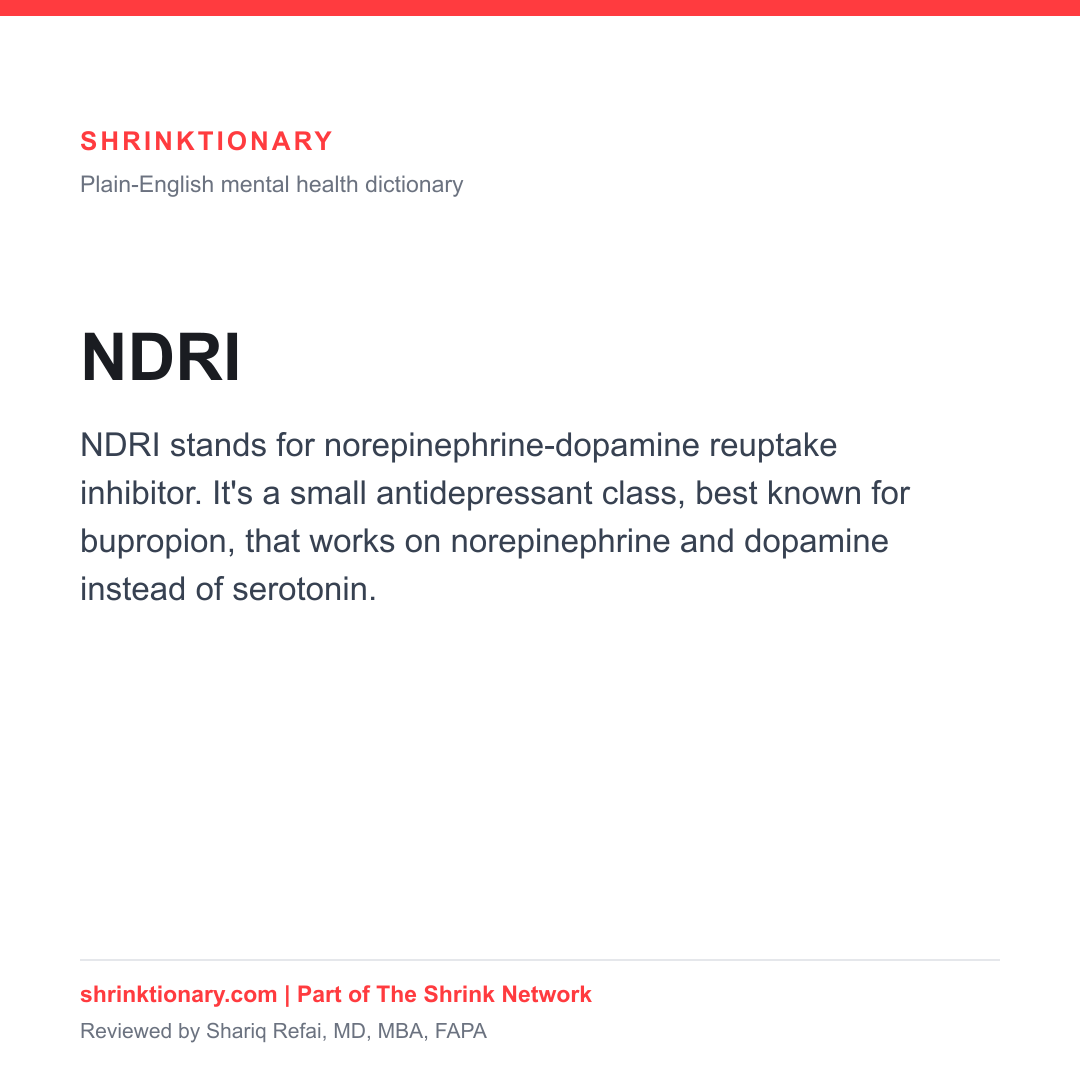
NDRI is norepinephrine-dopamine reuptake inhibitor. Unpacked, it means a medication that slows the reuptake of two chemical messengers, norepinephrine and dopamine, so more of each stays available between nerve cells.
The class is small. In practice, when someone says NDRI, they mean bupropion, sold as Wellbutrin.
See it in action: watch an NDRI at the synapse.
Why the class matters
It matters because of what it leaves out. SSRIs and SNRIs both act on serotonin. An NDRI doesn’t, and that single difference shapes everything people notice about it.
It tends not to cause the sexual side effects that lead a lot of people to quit SSRIs, and it tends not to cause weight gain. It’s often more activating than sedating, which can be welcome for someone flattened by fatigue and unwelcome for someone whose main problem is anxiety, since it can make that worse. It’s also used to help people stop smoking, which is a genuinely different job for an antidepressant.
There’s a specific caution too. Bupropion can lower the seizure threshold, so it’s generally avoided in people with a seizure disorder or certain eating disorders.
What an NDRI isn’t
It isn’t a stimulant, even though it affects dopamine and can feel energizing. It isn’t a controlled substance and it works differently from an ADHD medication.
It also isn’t better or worse than an SSRI. It’s different, and the difference is the point. The choice between them is usually made on side effects and on what a particular person’s depression actually looks like, not on some ranking of strength.
Related terms you’ll see next
When to seek professional care
If side effects like sexual dysfunction or weight gain are why you’re thinking about stopping an antidepressant, say so, because those are exactly the reasons a prescriber might consider a different class rather than giving up on treatment. Tell your prescriber if you have a history of seizures or an eating disorder before starting bupropion. If you have thoughts of harming yourself, get help right away by calling 911, or call or text 988 in the US to reach the Suicide and Crisis Lifeline.
When this word matters
It matters when someone is about to quit an antidepressant over sexual side effects or weight gain. That's exactly the situation where a class that doesn't touch serotonin becomes worth discussing.
Commonly confused with
Frequently asked questions
What does NDRI stand for?
Norepinephrine-dopamine reuptake inhibitor. It's a medication that slows the reuptake of norepinephrine and dopamine so more of each stays available between nerve cells. The class is small. In practice it means bupropion, sold as Wellbutrin.
How is an NDRI different from an SSRI?
An SSRI acts on serotonin. An NDRI doesn't, and that difference shapes everything people notice. NDRIs tend not to cause the sexual side effects or weight gain that lead many people to quit SSRIs, and they're often more activating, which can be unhelpful if anxiety is the main problem.
Is bupropion a stimulant?
No. It affects dopamine and can feel energizing, but it isn't a stimulant, it isn't a controlled substance, and it works differently from an ADHD medication.
Related terms
In these language clusters
Sources
- Bupropion: MedlinePlus Drug Information , MedlinePlus (U.S. National Library of Medicine)
- Mental Health Medications , National Institute of Mental Health
Use or cite this definition
Free to reuse with attribution. Paste the block into your own page, or grab a citation.
Embed on your site
<blockquote>
<p><strong>NDRI:</strong> NDRI stands for norepinephrine-dopamine reuptake inhibitor. It's a small antidepressant class, best known for bupropion, that works on norepinephrine and dopamine instead of serotonin.</p>
<p>— <a href="https://shrinktionary.com/terms/ndri/">Shrinktionary</a>, a plain-English mental health dictionary, medically reviewed by a board certified psychiatrist.</p>
</blockquote>Cite (APA)
Refai, S. (2026). NDRI. Shrinktionary. https://shrinktionary.com/terms/ndri/
Cite (MLA)
"NDRI." Shrinktionary, https://shrinktionary.com/terms/ndri/. Accessed September 29, 2026.
Your next step in The Shrink Network
You are here: Shrinktionary, the language layer of The Shrink Network.
Each site in the network has one job. No matter where you enter, we help you find the next step that makes sense.
Want to understand more first?
See how this connects to everything else in the Term Web →
Take it with you
Free printable references you can save or share. For education, not medical advice.