What the limbic system actually is
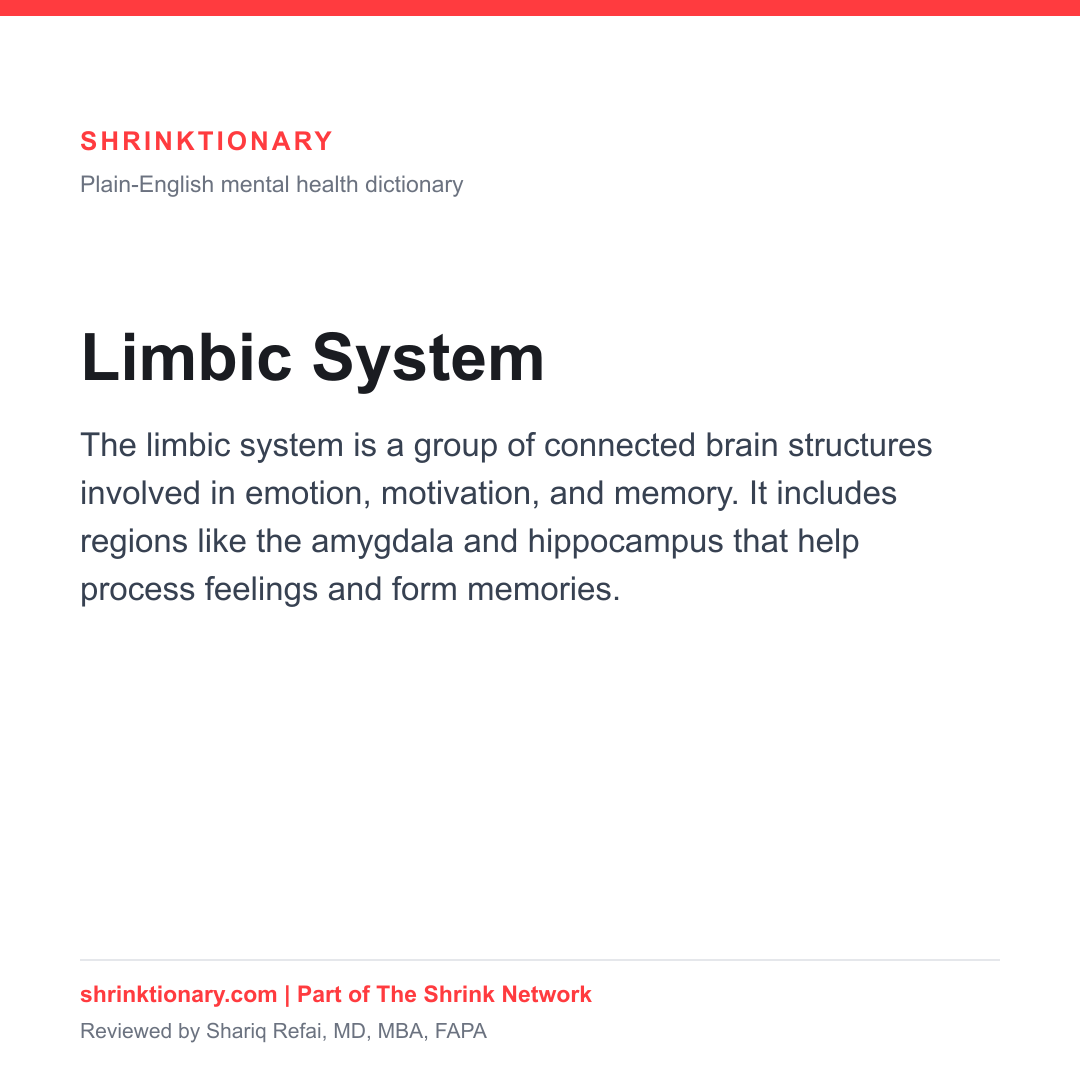
The limbic system is a set of brain structures that sit deep in the middle of the brain and work closely together on emotion, memory, and motivation. It isn’t a single organ. It’s more like a team of regions, including the amygdala and the hippocampus, that are wired to communicate with one another.
People sometimes call it the “emotional brain” because of its role in feelings. That nickname is a useful shorthand, but it’s worth knowing that emotion isn’t produced by the limbic system alone. These regions are connected to many other parts of the brain, including the areas that handle planning and reasoning.
What it does
The limbic system helps tag experiences with emotional meaning and connect those experiences to memory. The amygdala is heavily involved in detecting things that might be threatening and kicking off a quick emotional or stress response. The hippocampus is central to forming new memories and giving them context, like where and when something happened.
These structures also help drive motivation, linking up with reward-related circuits so that we seek out things that feel good and avoid things that don’t. In day-to-day life, the limbic system is working alongside the prefrontal cortex, the thinking and planning region, which can dampen or redirect emotional reactions. Emotion and reason aren’t separate machines. They’re constantly talking to each other.
What it isn’t
The limbic system isn’t a precisely fixed list of parts that every scientist agrees on. The term has been used in slightly different ways over the years, and the brain doesn’t divide neatly into an emotional half and a logical half. That popular split is an oversimplification.
It also isn’t where a single emotion “lives.” Feelings emerge from networks spread across the brain, not from one spot lighting up. And the limbic system isn’t beyond influence. Through experience and practice, the brain can change how these circuits respond.
Related terms you’ll see next
Why it matters for mental health
Many mental health conditions involve the circuits the limbic system is part of. In anxiety and trauma-related conditions, for example, the threat-detection system can become overactive, leaving a person feeling on edge even when they’re safe. Mood and memory difficulties also connect to these regions.
Understanding the limbic system helps explain why strong emotions can feel automatic and hard to talk yourself out of in the moment. It also points to why treatments that build new skills and experiences, like therapy, can gradually reshape how a person responds.
When this word matters
The limbic system matters when discussing how the brain handles emotion, memory, and motivation, especially in anxiety and trauma, where its threat-detection circuits can become overactive. It's a team of regions working with the rest of the brain, not where a single emotion lives.
Commonly confused with
Frequently asked questions
What does the limbic system do?
The limbic system helps tag experiences with emotional meaning and connect them to memory, with the amygdala involved in detecting threats and the hippocampus central to forming new memories. It also helps drive motivation by linking up with reward-related circuits.
Is the limbic system the brain's emotional center?
It's sometimes called the emotional brain, but emotion isn't produced by the limbic system alone. Feelings emerge from networks spread across the brain, and these regions work alongside the prefrontal cortex, which handles planning and reasoning.
Why does the limbic system matter for mental health?
Many mental health conditions involve circuits the limbic system is part of. In anxiety and trauma-related conditions, for example, the threat-detection system can become overactive, leaving a person feeling on edge even when they're safe.
Related terms
Sources
- Brain basics: Know your brain , National Institute of Neurological Disorders and Stroke (NINDS)
- Brain diseases , MedlinePlus
Use or cite this definition
Free to reuse with attribution. Paste the block into your own page, or grab a citation.
Embed on your site
<blockquote>
<p><strong>Limbic System:</strong> The limbic system is a group of connected brain structures involved in emotion, motivation, and memory. It includes regions like the amygdala and hippocampus that help process feelings and form memories.</p>
<p>— <a href="https://shrinktionary.com/terms/limbic-system/">Shrinktionary</a>, a plain-English mental health dictionary, medically reviewed by a board certified psychiatrist.</p>
</blockquote>Cite (APA)
Refai, S. (2026). Limbic System. Shrinktionary. https://shrinktionary.com/terms/limbic-system/
Cite (MLA)
"Limbic System." Shrinktionary, https://shrinktionary.com/terms/limbic-system/. Accessed September 26, 2026.
Your next step in The Shrink Network
You are here: Shrinktionary, the language layer of The Shrink Network.
Each site in the network has one job. No matter where you enter, we help you find the next step that makes sense.
Want to understand more first?
See how this connects to everything else in the Term Web →
Take it with you
Free printable references you can save or share. For education, not medical advice.