What the circadian rhythm actually is
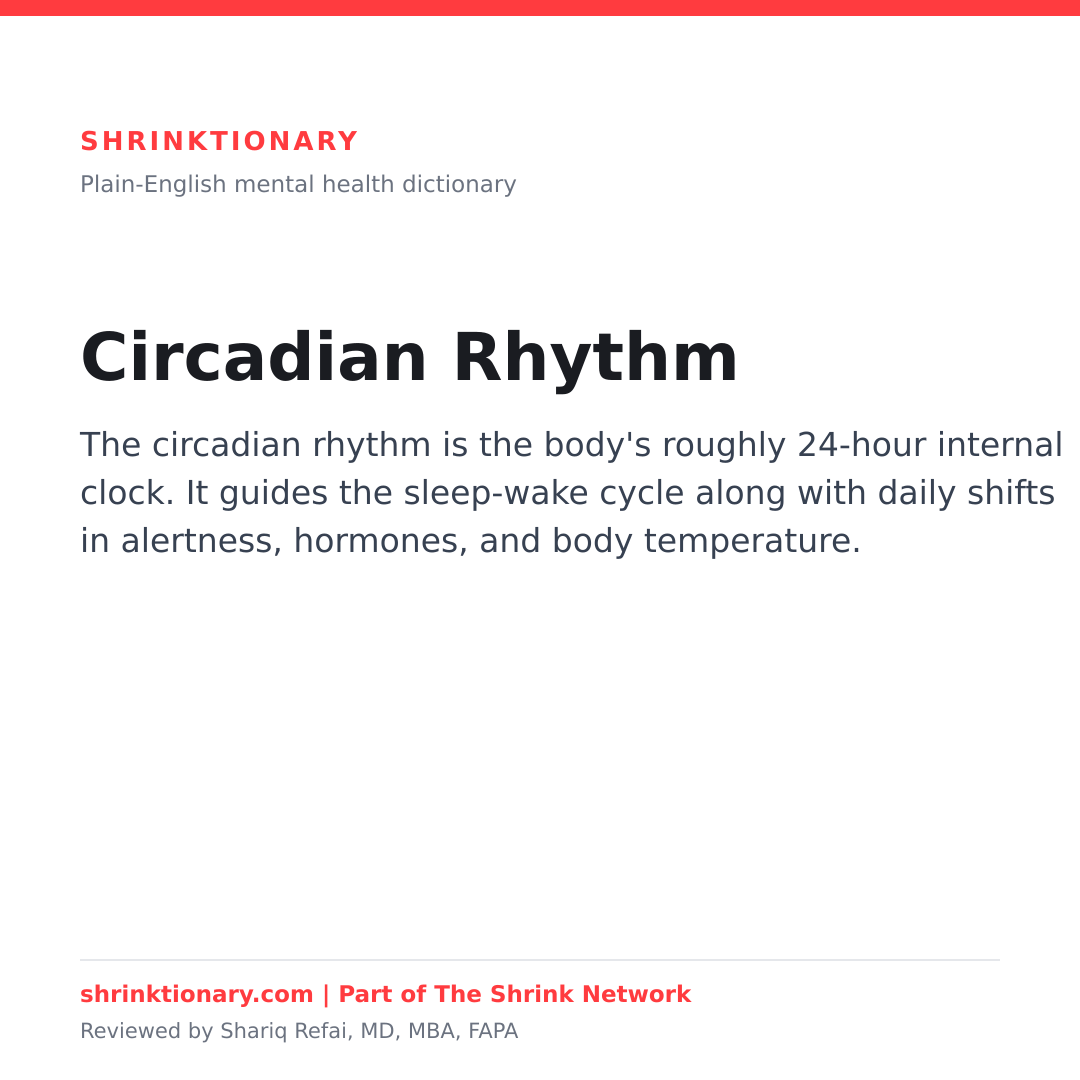
The circadian rhythm is the body’s internal clock that runs on a cycle of about 24 hours. It’s the reason we tend to feel alert during the day and sleepy at night, even without checking a clock. The word “circadian” comes from Latin roots meaning “about a day.”
This clock isn’t just about sleep. It quietly shapes a lot of the body’s daily timing, including body temperature, the release of certain hormones, hunger, and mental sharpness at different hours. A small region deep in the brain acts as the master timekeeper, coordinating these rhythms across the body.
How it works
The body’s master clock takes its main cue from light. When morning light reaches the eyes, it signals the brain that it’s daytime, helping reset the clock and keep it aligned with the outside world. As darkness falls, the body ramps up melatonin, a hormone that helps signal it’s time to wind down for sleep.
Throughout the day, the clock helps orchestrate a rise and fall in alertness and other functions. Cortisol, a stress and wakefulness hormone, typically peaks in the morning to help us get going, then tapers off. When the rhythm stays in sync with the day-night cycle, sleep tends to come more easily and energy is steadier. When it drifts out of sync, from jet lag, shift work, or irregular schedules, people often feel tired, foggy, or off.
What it isn’t
The circadian rhythm isn’t exactly 24 hours for everyone, and it isn’t fixed at birth in a way that can never shift. It does respond to cues like light and routine, which is why consistent habits can help it stay on track.
It also isn’t only about how many hours someone sleeps. Two people can sleep the same amount but feel very different depending on whether that sleep lined up with their internal clock. And a “night owl” tendency isn’t simply a matter of willpower or laziness. Some of it reflects real differences in people’s clocks.
Related terms you’ll see next
Why it matters for mental health
Sleep and mood are tightly linked, and the circadian rhythm sits at the center of that link. When the body clock is disrupted, people often notice their mood, focus, and stress levels suffer. Conditions like depression, bipolar disorder, and seasonal affective disorder are all connected to circadian patterns in various ways.
Understanding this rhythm is also practical. Keeping a fairly regular sleep schedule and getting daylight exposure are simple, evidence-supported ways to support both sleep and mental health.
When this word matters
It matters when the body's roughly 24-hour clock falls out of sync with daily life, which can disrupt sleep, mood, and energy. It comes up in talk about insomnia, shift work, jet lag, and seasonal affective disorder.
Commonly confused with
Frequently asked questions
What is the circadian rhythm?
It's the body's internal clock that runs on a cycle of about 24 hours, guiding the sleep-wake cycle along with daily shifts in alertness, hormones, and body temperature. A small region deep in the brain acts as the master timekeeper.
What controls the circadian rhythm?
The body's master clock takes its main cue from light. Morning light signals the brain that it's daytime, while darkness prompts the body to ramp up melatonin to help signal that it's time to wind down for sleep.
Why does the circadian rhythm matter for mental health?
Sleep and mood are tightly linked, and the body clock sits at the center of that link. When it's disrupted, people often notice their mood, focus, and stress levels suffer, and conditions like depression and seasonal affective disorder connect to circadian patterns.
Related terms
Sources
- Sleep Disorders , MedlinePlus
- Brain basics: Understanding sleep , National Institute of Neurological Disorders and Stroke (NINDS)
Use or cite this definition
Free to reuse with attribution. Paste the block into your own page, or grab a citation.
Embed on your site
<blockquote>
<p><strong>Circadian Rhythm:</strong> The circadian rhythm is the body's roughly 24-hour internal clock. It guides the sleep-wake cycle along with daily shifts in alertness, hormones, and body temperature.</p>
<p>— <a href="https://shrinktionary.com/terms/circadian-rhythm/">Shrinktionary</a>, a plain-English mental health dictionary, medically reviewed by a board certified psychiatrist.</p>
</blockquote>Cite (APA)
Refai, S. (2026). Circadian Rhythm. Shrinktionary. https://shrinktionary.com/terms/circadian-rhythm/
Cite (MLA)
"Circadian Rhythm." Shrinktionary, https://shrinktionary.com/terms/circadian-rhythm/. Accessed September 26, 2026.
See also on ShrinkDaily
For a three-minute daily lesson on this idea, read the daily concept on circadian rhythm.
Your next step in The Shrink Network
You are here: Shrinktionary, the language layer of The Shrink Network.
Each site in the network has one job. No matter where you enter, we help you find the next step that makes sense.
Want to understand more first?
See how this connects to everything else in the Term Web →
Take it with you
Free printable references you can save or share. For education, not medical advice.