What intermittent explosive disorder actually is
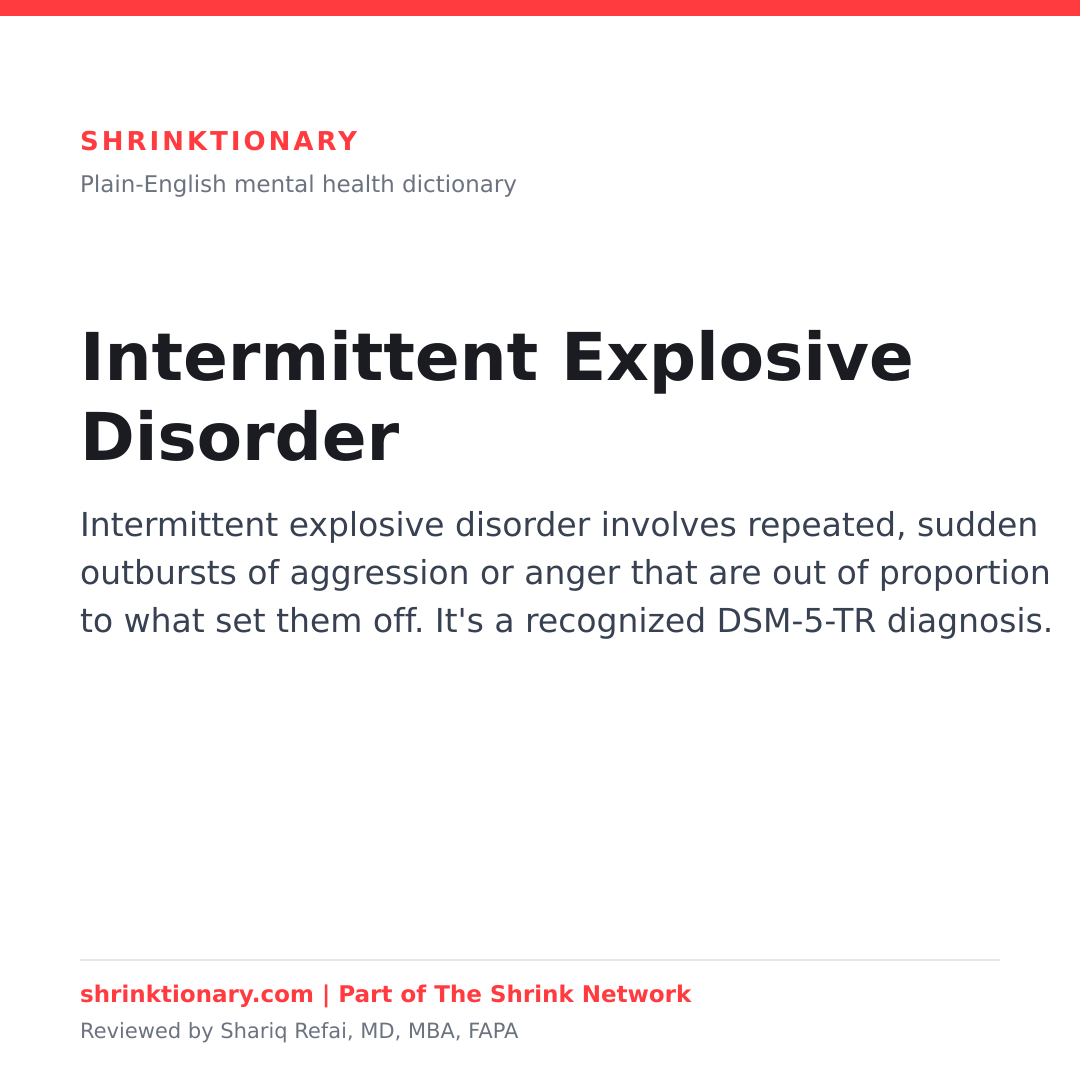
Intermittent explosive disorder, often shortened to IED, is a DSM-5-TR diagnosis defined by repeated outbursts of aggression that a person can’t hold back. The reaction is grossly out of proportion to whatever triggered it, and it isn’t planned. The aggression is impulsive and anger-driven rather than aimed at getting something tangible.
The DSM-5-TR describes two patterns that can meet criteria. One is frequent, lower-intensity outbursts, such as verbal arguments or aggression that doesn’t damage property or hurt anyone, happening roughly twice a week for at least three months. The other is more serious outbursts that involve damage, injury, or physical assault, occurring three times within a year. Either pattern can support the diagnosis.
The outbursts have to cause real distress, problems at work or home, or legal and financial fallout. The diagnosis is generally made in people at least 6 years old, and the aggression can’t be better explained by another condition, a medication, or a substance.
What intermittent explosive disorder can feel like
People often describe the outbursts as coming on fast, with little warning. Tension or irritability builds, and then there’s a sudden release of anger that feels almost automatic. Some notice physical signs first, like a racing heart or a flush of heat.
Afterward, many feel remorse, embarrassment, or confusion about what just happened. The gap between how small the trigger was and how big the reaction was can be distressing on its own. Over time, the outbursts strain relationships, jobs, and a person’s sense of control.
What intermittent explosive disorder isn’t
IED isn’t ordinary anger or a short temper. Everyone gets angry, and occasional blowups don’t meet the diagnostic threshold. The disorder is about a recurring pattern of impulsive aggression that’s clearly disproportionate and causes real harm or distress.
It also isn’t the same as planned or goal-directed aggression. The outbursts in IED are impulsive, not calculated, which is one way it’s separated from conditions like antisocial personality disorder. And it’s different from a single, isolated incident, since the diagnosis depends on a repeated pattern.
Related terms you’ll see next
Irritability and emotional dysregulation describe the inner state that often precedes outbursts. Distress tolerance is a skill used in treatment, and agitation is a related state of restlessness and tension.
When to seek professional care
If anger leads to repeated outbursts that feel out of control and are damaging relationships, work, or safety, a clinical evaluation is appropriate. IED can be treated, often with therapy that builds impulse control and sometimes with medication. If aggression has put anyone’s safety at risk, reaching out for help sooner rather than later is the safer path.
When evaluation may help
Not everyone reading about intermittent explosive disorder needs treatment. If it's getting in the way of your day, your sleep, your work, or your relationships, or if it isn't easing on its own, a professional evaluation is a reasonable next step. Most people start with their primary care doctor or a therapist. A psychiatrist is the right call when medication may be involved or the picture is complicated, though waits can be long.
We keep an honest, no-commission rundown of the options, from primary care to telepsychiatry to crisis lines, on one page.
If you're in crisis or thinking about suicide, call or text 988 in the US, or go to the nearest emergency room.
When this word matters
It matters when anger turns into repeated, impulsive outbursts that are clearly out of proportion to the trigger and cause real harm or distress, not just an occasional bad temper. The recurring, disproportionate pattern is what defines the disorder.
Commonly confused with
Frequently asked questions
What is intermittent explosive disorder?
Intermittent explosive disorder, or IED, is a DSM-5-TR diagnosis defined by repeated, impulsive outbursts of aggression that are grossly out of proportion to what triggered them. The outbursts aren't planned and cause real distress or problems.
How is IED different from a short temper?
Everyone gets angry sometimes. IED is a recurring pattern of impulsive aggression that's clearly disproportionate and causes harm or distress, not just occasional frustration or a quick fuse.
Can intermittent explosive disorder be treated?
Yes. Treatment often includes therapy that builds impulse control, such as approaches focused on distress tolerance, and sometimes medication. A clinical evaluation is the place to start.
Related terms
Sources
- Intermittent Explosive Disorder , Cleveland Clinic
- Intermittent Explosive Disorder , StatPearls (NCBI)
Use or cite this definition
Free to reuse with attribution. Paste the block into your own page, or grab a citation.
Embed on your site
<blockquote>
<p><strong>Intermittent Explosive Disorder:</strong> Intermittent explosive disorder involves repeated, sudden outbursts of aggression or anger that are out of proportion to what set them off. It's a recognized DSM-5-TR diagnosis.</p>
<p>— <a href="https://shrinktionary.com/terms/intermittent-explosive-disorder/">Shrinktionary</a>, a plain-English mental health dictionary, medically reviewed by a board certified psychiatrist.</p>
</blockquote>Cite (APA)
Refai, S. (2026). Intermittent Explosive Disorder. Shrinktionary. https://shrinktionary.com/terms/intermittent-explosive-disorder/
Cite (MLA)
"Intermittent Explosive Disorder." Shrinktionary, https://shrinktionary.com/terms/intermittent-explosive-disorder/. Accessed September 29, 2026.
Your next step in The Shrink Network
You are here: Shrinktionary, the language layer of The Shrink Network.
Each site in the network has one job. No matter where you enter, we help you find the next step that makes sense.
Want to understand more first?
See how this connects to everything else in the Term Web →
Take it with you
Free printable references you can save or share. For education, not medical advice.