What binge eating disorder actually is
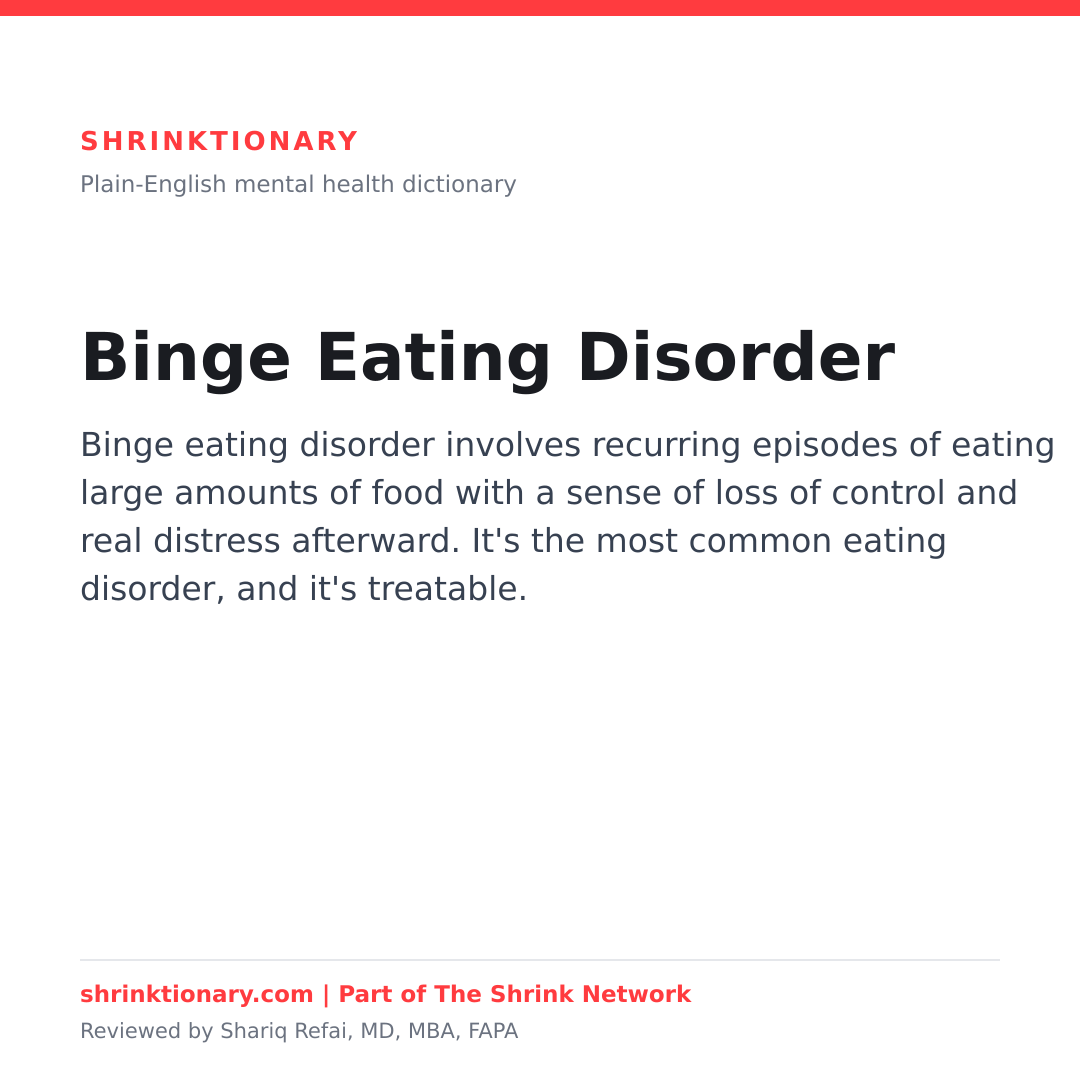
Binge eating disorder is a recognized mental health condition, not a willpower problem. It involves repeated episodes of eating in a way that feels out of control, along with real distress about it afterward. The eating usually happens quickly, often in private, and often when the person isn’t physically hungry.
What sets it apart from occasional overeating is the sense of loss of control during the episode and the emotional weight that follows. Unlike some other eating disorders, the person doesn’t regularly try to undo the eating through other behaviors. Binge eating disorder is the most common eating disorder, and it responds well to treatment.
How binge eating disorder shows up
Many people describe a kind of numb, automatic state during an episode, like they’re watching themselves rather than choosing. Afterward there’s often a wave of shame, guilt, or disgust. Episodes are frequently tied to difficult emotions such as stress, sadness, loneliness, or boredom, with food becoming a way to cope.
Because of the shame involved, people often hide it carefully, even from those closest to them. This secrecy can make the cycle feel lonelier and harder to break. It’s worth knowing that this pattern is well understood by clinicians and is not a moral failing.
What binge eating disorder isn’t
It isn’t simply a lack of discipline or self-control. The loss of control is part of the disorder, not a character flaw. It also isn’t defined by a person’s body size. People in larger and smaller bodies can both have binge eating disorder.
Enjoying a big meal or eating past fullness now and then is a normal part of life and is not a disorder. Binge eating disorder is a recurring, distressing pattern that a clinician evaluates with care.
Related terms you’ll see next
When to seek professional care
If eating feels out of control and is causing distress, help is available and it works. Talk therapies built for eating disorders, along with support from a doctor and sometimes a dietitian, can interrupt the cycle.
You deserve support without judgment. If you’re struggling, reach out to a clinician or a trusted person. In the US you can call or text 988 any time for free, confidential support.
When evaluation may help
Not everyone reading about binge eating disorder needs treatment. If it's getting in the way of your day, your sleep, your work, or your relationships, or if it isn't easing on its own, a professional evaluation is a reasonable next step. Most people start with their primary care doctor or a therapist. A psychiatrist is the right call when medication may be involved or the picture is complicated, though waits can be long.
We keep an honest, no-commission rundown of the options, from primary care to telepsychiatry to crisis lines, on one page.
If you're in crisis or thinking about suicide, call or text 988 in the US, or go to the nearest emergency room.
When this word matters
It matters when episodes of eating large amounts with a sense of loss of control and real distress recur, since it's the most common eating disorder and it's treatable. The absence of regular purging is part of what separates it from bulimia.
Commonly confused with
Frequently asked questions
What does binge eating disorder mean?
It's a recognized mental health condition involving repeated episodes of eating in a way that feels out of control, along with real distress afterward. What sets it apart from occasional overeating is the sense of loss of control during the episode and the emotional weight that follows.
What is the difference between binge eating disorder and bulimia?
Both involve eating that feels out of control, but in binge eating disorder the person doesn't regularly try to undo the eating through other behaviors the way someone with bulimia does. Binge eating disorder is the most common eating disorder.
Is binge eating disorder just a lack of willpower?
No. The loss of control is part of the disorder, not a character flaw, and it isn't defined by a person's body size. It responds well to treatment, including talk therapies built for eating disorders.
Related terms
Sources
- Eating Disorders , National Institute of Mental Health
- Eating Disorders , MedlinePlus
- Diagnostic and Statistical Manual of Mental Disorders, Fifth Edition, Text Revision (DSM-5-TR) , American Psychiatric Association
Use or cite this definition
Free to reuse with attribution. Paste the block into your own page, or grab a citation.
Embed on your site
<blockquote>
<p><strong>Binge Eating Disorder:</strong> Binge eating disorder involves recurring episodes of eating large amounts of food with a sense of loss of control and real distress afterward. It's the most common eating disorder, and it's treatable.</p>
<p>— <a href="https://shrinktionary.com/terms/binge-eating-disorder/">Shrinktionary</a>, a plain-English mental health dictionary, medically reviewed by a board certified psychiatrist.</p>
</blockquote>Cite (APA)
Refai, S. (2026). Binge Eating Disorder. Shrinktionary. https://shrinktionary.com/terms/binge-eating-disorder/
Cite (MLA)
"Binge Eating Disorder." Shrinktionary, https://shrinktionary.com/terms/binge-eating-disorder/. Accessed September 26, 2026.
Your next step in The Shrink Network
You are here: Shrinktionary, the language layer of The Shrink Network.
Each site in the network has one job. No matter where you enter, we help you find the next step that makes sense.
Want to understand more first?
See how this connects to everything else in the Term Web →
Take it with you
Free printable references you can save or share. For education, not medical advice.