What secure attachment actually is
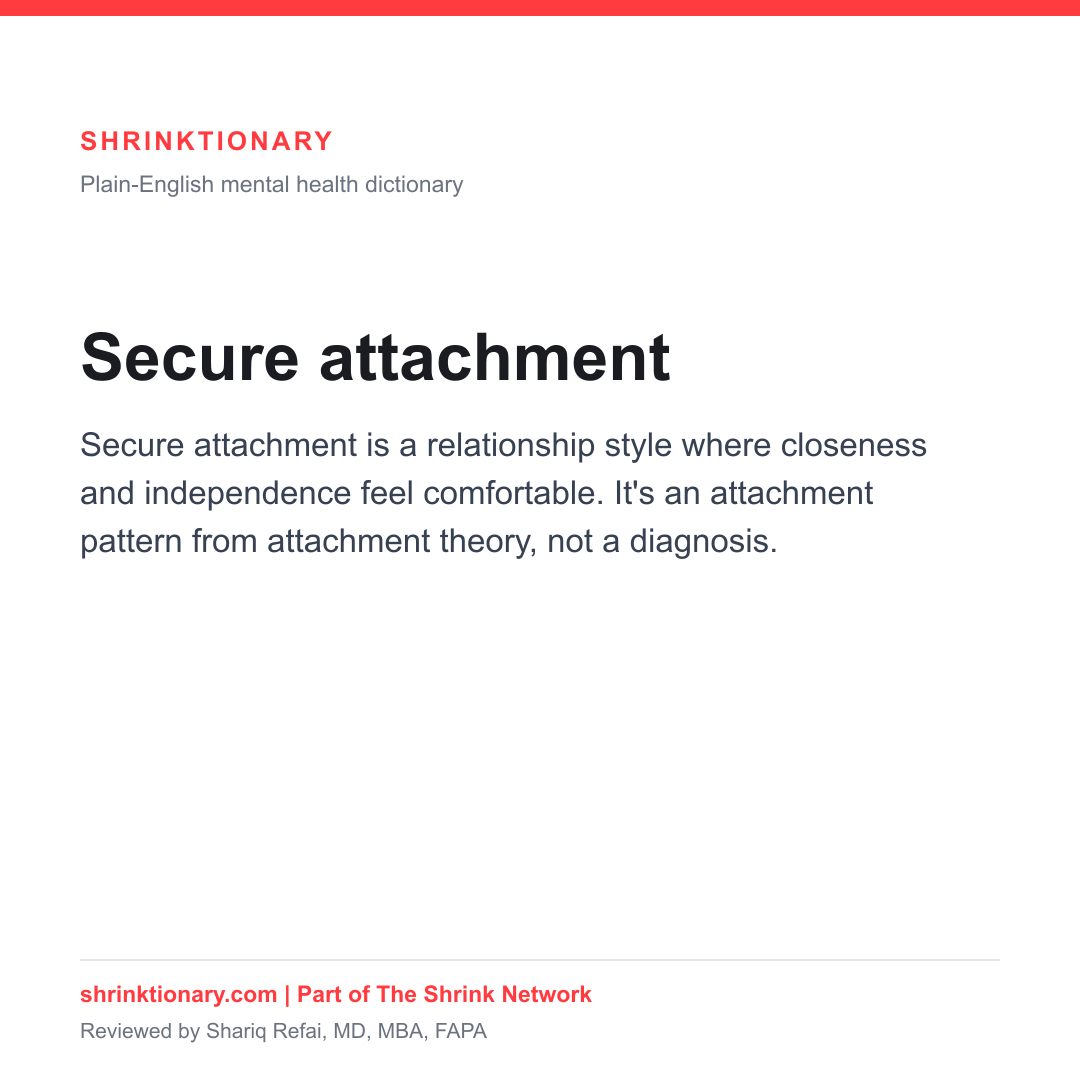
Secure attachment is one of the patterns described in attachment theory, and it’s generally seen as the steadiest of them. Someone with a secure style is comfortable with closeness and comfortable on their own. They can lean on others when they need support, offer support in return, and trust that a relationship can hold up through conflict and time apart.
The pattern is thought to develop when early care was warm, consistent, and responsive, so a child learns that reaching out usually brings comfort and that their needs matter. That early experience becomes a kind of inner template, a baseline expectation that closeness is safe. It’s worth being clear that this is a general tendency, not a fixed label or a diagnosis, and that styles can shift over time and across relationships.
How it tends to show up
In adult relationships, secure attachment often looks fairly unremarkable, which is part of the point. A securely attached person can express needs directly, hear a partner’s needs without feeling threatened, and weather disagreements without assuming the relationship is in danger. They tend to give the benefit of the doubt and to recover from conflict rather than spiral after it.
It also shows up as flexibility. They can be close without losing themselves and independent without pulling away coldly. When a partner is upset, they can stay present instead of either panicking or shutting down. None of this means a secure person never feels insecure. It means the baseline tends to be trust rather than alarm.
What secure attachment isn’t
Secure attachment isn’t the same as having a perfect relationship or never feeling anxious or distant. Everyone has off days and harder seasons. The difference is the general baseline of trust and the ability to come back to it. It also isn’t a clinical diagnosis or an achievement that, once reached, can never be lost. It describes a relationship style, not a permanent status.
It’s also not something only a lucky few are born with. While early care shapes the pattern, people who didn’t start with security can move toward it through safe relationships and therapy. Secure attachment is a direction, not a closed club.
Related terms you’ll see next
Attachment is the broader idea these styles come from. Anxious attachment and avoidant attachment are the less secure leans, one toward pursuit and one toward distance, that secure attachment sits between.
Why it matters
Secure attachment is useful as a reference point rather than a scorecard. Knowing what a steady relationship pattern looks like can help a person notice what they’re reaching for and recognize the difference between a passing rough patch and a deeper insecurity. It can also be reassuring to learn that security isn’t fixed at birth, since the research suggests people can grow toward it. Therapists who work with attachment can support that growth, though it tends to unfold gradually and no approach can promise a particular outcome.
When this word matters
It matters as a reference point rather than a scorecard. Knowing what a steady relationship pattern looks like can help a person notice what they're reaching for and tell the difference between a passing rough patch and a deeper insecurity worth support.
Commonly confused with
Frequently asked questions
What is secure attachment?
Secure attachment is one of the patterns described in attachment theory, and it's generally seen as the steadiest. Someone with a secure style is comfortable with both closeness and independence, can lean on others and support them in return, and trusts that a relationship can hold up through conflict and time apart.
Does secure attachment mean a perfect relationship?
No. Securely attached people still have off days, disagreements, and harder seasons. The difference is a general baseline of trust and the ability to come back to it, rather than never feeling anxious or distant.
Can you become securely attached later in life?
Yes. While early care shapes the pattern, secure attachment isn't fixed at birth or limited to a lucky few. People who didn't start with security can grow toward it through safe relationships and therapy. It's a direction, not a closed club, and progress tends to be gradual.
Related terms
Sources
- Health Topics A to Z , Eunice Kennedy Shriver National Institute of Child Health and Human Development
- Parenting , American Psychological Association
Use or cite this definition
Free to reuse with attribution. Paste the block into your own page, or grab a citation.
Embed on your site
<blockquote>
<p><strong>Secure attachment:</strong> Secure attachment is a relationship style where closeness and independence feel comfortable. It's an attachment pattern from attachment theory, not a diagnosis.</p>
<p>— <a href="https://shrinktionary.com/terms/secure-attachment/">Shrinktionary</a>, a plain-English mental health dictionary, medically reviewed by a board certified psychiatrist.</p>
</blockquote>Cite (APA)
Refai, S. (2026). Secure attachment. Shrinktionary. https://shrinktionary.com/terms/secure-attachment/
Cite (MLA)
"Secure attachment." Shrinktionary, https://shrinktionary.com/terms/secure-attachment/. Accessed September 26, 2026.
Your next step in The Shrink Network
You are here: Shrinktionary, the language layer of The Shrink Network.
Each site in the network has one job. No matter where you enter, we help you find the next step that makes sense.
Want to understand more first?
See how this connects to everything else in the Term Web →
Take it with you
Free printable references you can save or share. For education, not medical advice.