What mood actually is
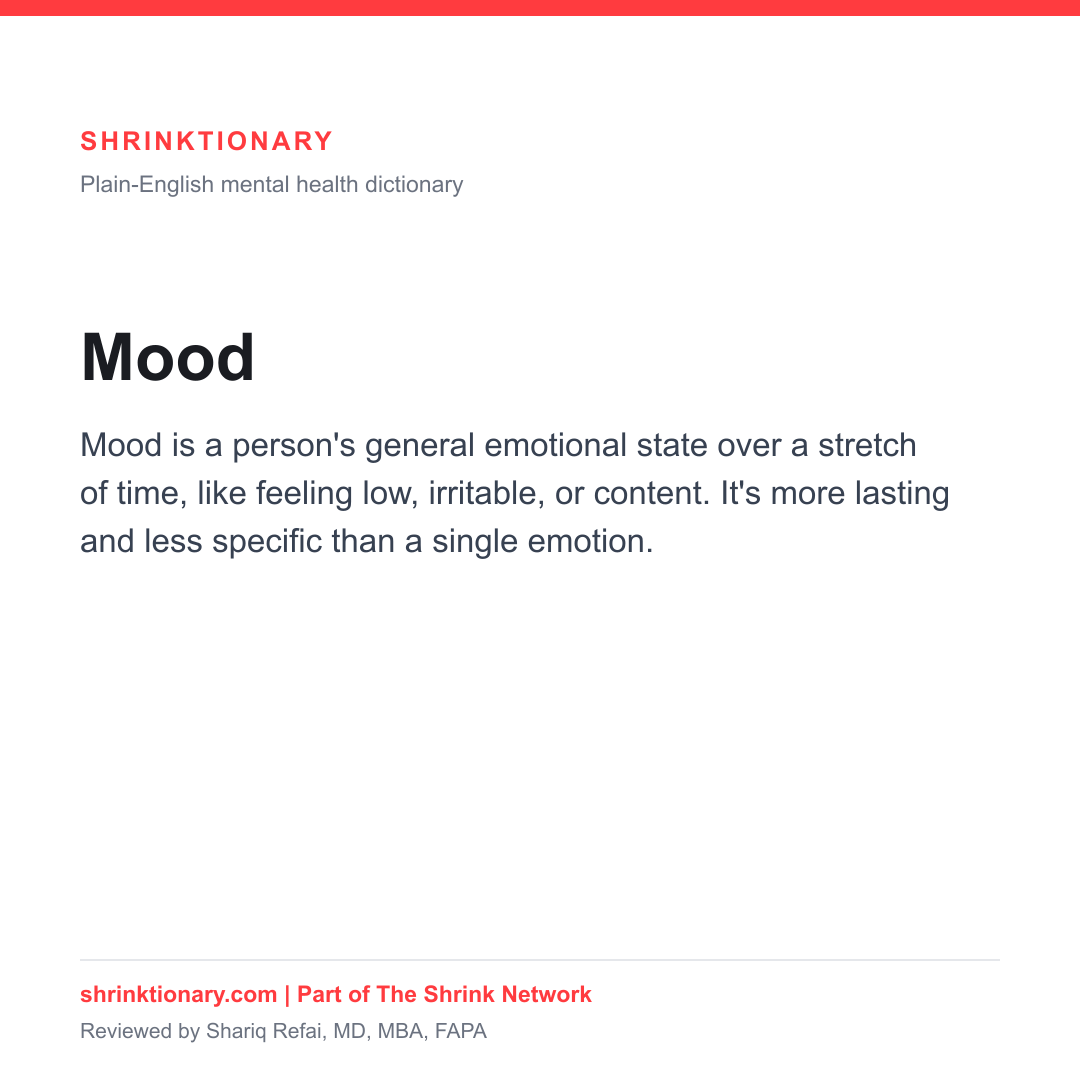
Mood is a person’s general emotional state that lasts over a stretch of time, anywhere from hours to days or longer. It’s the background tone of how someone feels, like being low, irritable, content, or up. Unlike a quick flash of anger or a moment of joy, mood lingers and colors how a person experiences much of what happens around them.
In mental health, mood is a central concept. Clinicians ask about it because lasting shifts in mood are at the heart of conditions like depression and bipolar disorder. Mood is also something people can track over time, which makes it a useful window into how someone is doing.
What people usually mean
When people say they’re “in a good mood” or a “bad mood,” they’re usually describing that overall emotional weather, not one specific feeling. A mood can be hard to pin to a single cause, which is part of what sets it apart from an emotion that’s clearly tied to an event.
In everyday talk, people also use mood loosely, as in “I’m not in the mood.” Clinically, the word points to something more sustained. When a low or elevated mood lasts for weeks and starts affecting sleep, energy, and daily life, that’s when it moves from ordinary ups and downs into territory worth paying attention to.
What it isn’t
Mood isn’t the same as an emotion. Emotions tend to be brief, intense, and tied to a specific trigger, like fear at a loud noise. Mood is longer-lasting, more diffuse, and often harder to trace to one event. The two are related but not interchangeable.
Mood also isn’t the same as a mood disorder. Everyone’s mood rises and falls, and that’s normal. A mood disorder involves lasting, significant changes in mood that interfere with daily life, which is a clinical issue rather than an ordinary fluctuation.
Related terms you’ll see next
Why the distinction matters
Telling mood apart from emotion, and ordinary mood swings apart from a mood disorder, helps people make sense of what they’re experiencing. A rough afternoon is not the same as weeks of persistent low mood, and knowing the difference can guide whether something is worth raising with a professional. Tracking mood over time is one practical way clinicians and patients spot patterns that point toward conditions like depression or bipolar disorder.
When this word matters
Mood becomes clinically meaningful when a low, high, or irritable state lasts for weeks and starts affecting sleep, energy, or daily functioning, which is what separates everyday mood from conditions like depression or bipolar disorder.
Commonly confused with
Frequently asked questions
What is the difference between mood and emotion?
Emotions tend to be brief, intense, and tied to a specific trigger, like fear at a loud noise. Mood is longer-lasting, more diffuse, and often harder to trace to one event.
Is mood the same as a mood disorder?
No, everyone's mood rises and falls, and that's normal. A mood disorder involves lasting, significant changes in mood that interfere with daily life, which is a clinical issue rather than an ordinary fluctuation.
Why do clinicians ask about mood?
Lasting shifts in mood are at the heart of conditions like depression and bipolar disorder. Tracking mood over time is one practical way clinicians and patients spot patterns that point toward these conditions.
Related terms
Sources
- Caring for Your Mental Health , National Institute of Mental Health
- Mental Health , MedlinePlus
Use or cite this definition
Free to reuse with attribution. Paste the block into your own page, or grab a citation.
Embed on your site
<blockquote>
<p><strong>Mood:</strong> Mood is a person's general emotional state over a stretch of time, like feeling low, irritable, or content. It's more lasting and less specific than a single emotion.</p>
<p>— <a href="https://shrinktionary.com/terms/mood/">Shrinktionary</a>, a plain-English mental health dictionary, medically reviewed by a board certified psychiatrist.</p>
</blockquote>Cite (APA)
Refai, S. (2026). Mood. Shrinktionary. https://shrinktionary.com/terms/mood/
Cite (MLA)
"Mood." Shrinktionary, https://shrinktionary.com/terms/mood/. Accessed September 26, 2026.
Your next step in The Shrink Network
You are here: Shrinktionary, the language layer of The Shrink Network.
Each site in the network has one job. No matter where you enter, we help you find the next step that makes sense.
Want to understand more first?
See how this connects to everything else in the Term Web →
Take it with you
Free printable references you can save or share. For education, not medical advice.