What metacognition actually is
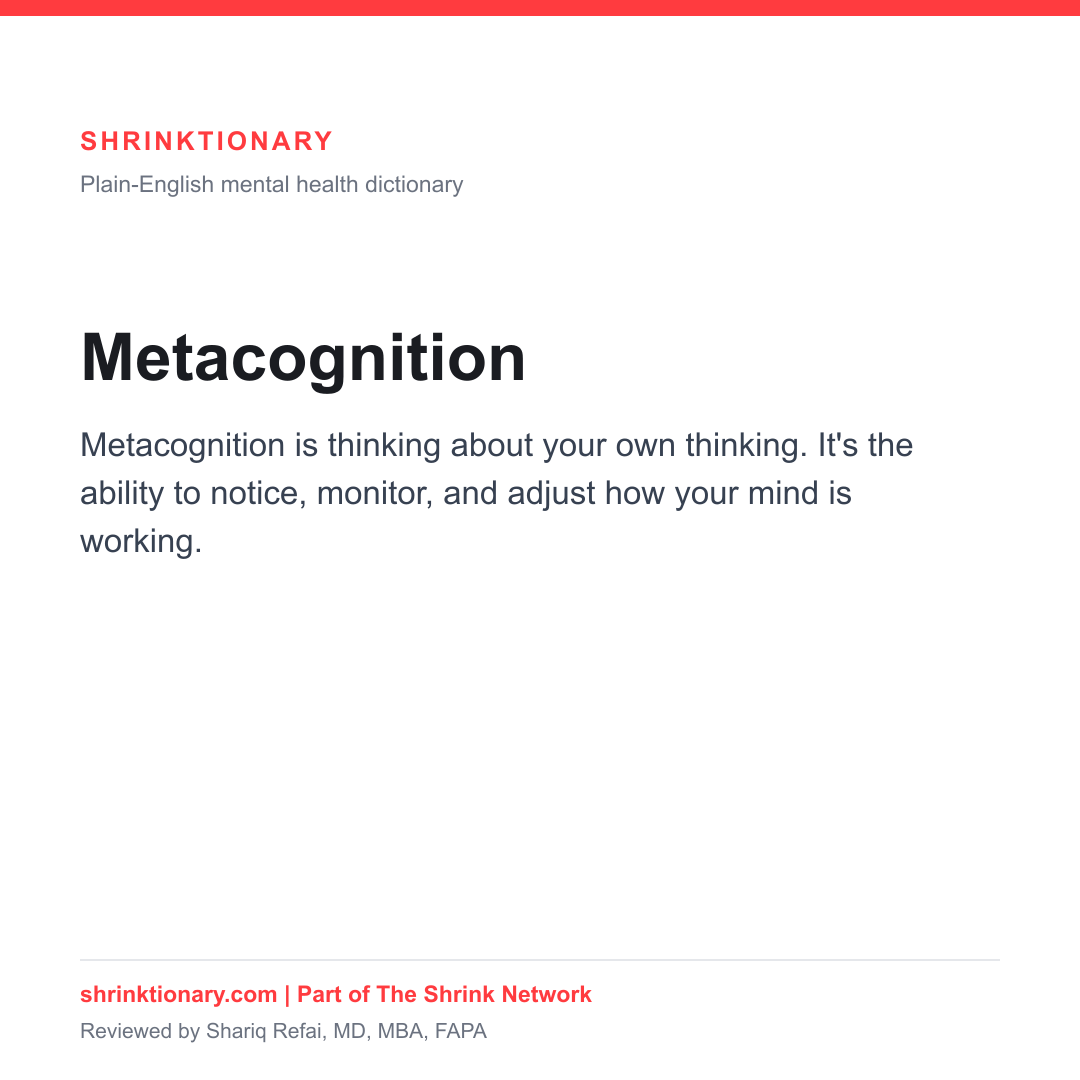
Metacognition is the mind watching itself. It’s the part of you that notices you’re confused before a test, realizes a study method isn’t working, or catches yourself spiraling into the same worried loop again. Instead of just having thoughts, you’re aware that you’re having them and you can comment on them.
Psychologists usually split it into two pieces. One is knowledge about your own thinking, like knowing you remember things better when you write them down. The other is regulation, which means planning, checking your progress, and changing course when something isn’t landing.
How it works
Metacognition runs alongside whatever else your brain is doing. You read a paragraph, and a quiet inner voice asks, “Did I actually understand that?” If the answer is no, you slow down and reread. That self-check is metacognition at work.
It develops slowly through childhood and keeps maturing into early adulthood, growing alongside the brain’s executive functions. People can also get better at it on purpose. Asking yourself simple questions like “What’s my plan here?” or “Is this strategy working?” strengthens the habit over time.
What it isn’t
Metacognition isn’t the same as intelligence. A person can be sharp at solving problems but weak at noticing when they’re stuck. It also isn’t just having a lot of self-doubt or overthinking. Endless second-guessing is closer to rumination, which spins without leading anywhere useful.
It’s also not a fixed trait you’re born with. People can build it, and it can dip when they’re tired, stressed, or under pressure.
Related terms you’ll see next
Why it matters
Metacognition shows up everywhere in mental health care. A big part of therapies like CBT is learning to step back and observe your own thoughts instead of treating every one as a fact. That skill, noticing a thought and questioning it, is metacognition in action. When people strengthen it, they often handle setbacks, learning, and difficult emotions with more flexibility.
When this word matters
Metacognition matters in therapy like CBT, where learning to step back and observe your own thoughts instead of treating each as fact helps people handle setbacks and difficult emotions with more flexibility. It isn't the same as intelligence or endless second-guessing.
Commonly confused with
Frequently asked questions
What is metacognition in simple terms?
Metacognition is thinking about your own thinking. It's the part of you that notices you're confused, realizes a study method isn't working, or catches yourself spiraling into the same worried loop again.
Is metacognition the same as intelligence?
No, a person can be sharp at solving problems but weak at noticing when they're stuck. Metacognition is also different from overthinking, since endless second-guessing is closer to rumination.
Can you improve your metacognition?
Yes, it isn't a fixed trait. Asking yourself simple questions like what's my plan here or is this strategy working strengthens the habit over time, though it can dip when you're tired or stressed.
Related terms
Sources
- Memory, Forgetting, and the Science of Learning , American Psychological Association
- Attention and Cognition , National Institute of Mental Health
Use or cite this definition
Free to reuse with attribution. Paste the block into your own page, or grab a citation.
Embed on your site
<blockquote>
<p><strong>Metacognition:</strong> Metacognition is thinking about your own thinking. It's the ability to notice, monitor, and adjust how your mind is working.</p>
<p>— <a href="https://shrinktionary.com/terms/metacognition/">Shrinktionary</a>, a plain-English mental health dictionary, medically reviewed by a board certified psychiatrist.</p>
</blockquote>Cite (APA)
Refai, S. (2026). Metacognition. Shrinktionary. https://shrinktionary.com/terms/metacognition/
Cite (MLA)
"Metacognition." Shrinktionary, https://shrinktionary.com/terms/metacognition/. Accessed September 26, 2026.
Your next step in The Shrink Network
You are here: Shrinktionary, the language layer of The Shrink Network.
Each site in the network has one job. No matter where you enter, we help you find the next step that makes sense.
Want to understand more first?
See how this connects to everything else in the Term Web →
Take it with you
Free printable references you can save or share. For education, not medical advice.