What a washout period actually is
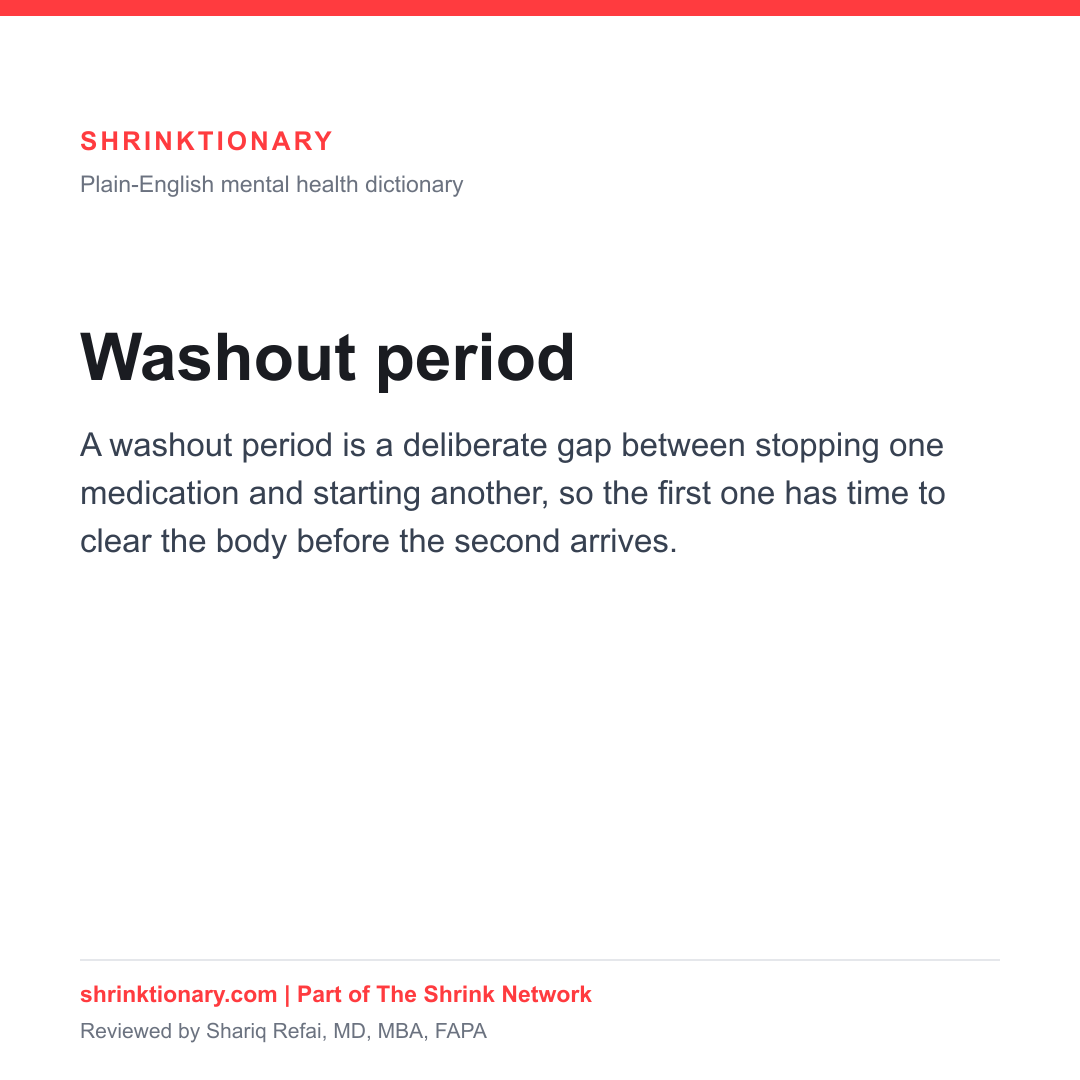
A washout is a waiting period on purpose. You stop one medication, you wait, and only then do you start the next one. The gap exists so the first drug can leave your system before the second one shows up, because the two overlapping could be a problem.
It sounds like an inconvenience, and it is one. It’s also sometimes the difference between a safe switch and a dangerous one.
Why the word matters
Because switching medications isn’t always as simple as swapping one pill for another, and people are often surprised by that.
How long a washout needs to be depends on half-life, which is how long the drug takes to clear. A medication that leaves quickly needs a short gap. Fluoxetine, which has an unusually long half-life, lingers for weeks after the last dose, so switching away from it needs more patience than switching away from most others.
The most serious washouts involve MAOIs. Combining an MAOI with other serotonergic medications can cause serotonin syndrome, which is a medical emergency, so the required gap on either side of an MAOI is long and it’s not negotiable.
Washout also has a second meaning in research, where a study builds in a drug-free stretch so one treatment’s effect doesn’t bleed into the measurement of the next.
What a washout isn’t
A washout isn’t the same as a taper. A taper is how you come down off a drug. A washout is the empty space afterward, before the next one begins. A switch may involve both.
It also isn’t a delay your prescriber invented to be cautious. It’s usually built around the specific pharmacology of the two drugs involved, and shortening it on your own initiative is a genuinely bad idea.
And it isn’t always necessary. Plenty of switches involve a direct changeover or an overlap, and which approach applies depends entirely on what’s being swapped.
Related terms you’ll see next
When to seek professional care
Medication switches belong to a prescriber, and washout timing in particular is not something to improvise. If a gap between medications is leaving you unwell, say so rather than starting the new one early on your own. Get medical help right away for agitation, confusion, fever, a racing heart, muscle rigidity, or twitching after starting a new medication, since those can indicate serotonin syndrome. If you have thoughts of harming yourself, get help right away by calling 911, or call or text 988 in the US to reach the Suicide and Crisis Lifeline.
When this word matters
It matters during a medication switch, when the gap between the old drug and the new one feels like an arbitrary delay and starting early feels harmless. With MAOIs in particular, it is not harmless.
Commonly confused with
Frequently asked questions
Why do I have to wait between two medications?
So the first drug can clear your system before the second arrives, because the two overlapping could be a problem. How long the gap needs to be depends on the half-life of the drug you're coming off.
Which medications need the longest washout?
MAOIs need long gaps on either side, because combining them with other serotonergic medications can cause serotonin syndrome, which is a medical emergency. Fluoxetine also needs more patience than most, because its unusually long half-life means it lingers for weeks after the last dose.
Do all medication switches need a washout?
No. Plenty of switches involve a direct changeover or a deliberate overlap. Which approach applies depends entirely on the two drugs involved, and it isn't something to improvise.
Related terms
In these language clusters
Sources
- Fluoxetine: MedlinePlus Drug Information , MedlinePlus (U.S. National Library of Medicine)
- Mental Health Medications , National Institute of Mental Health
Use or cite this definition
Free to reuse with attribution. Paste the block into your own page, or grab a citation.
Embed on your site
<blockquote>
<p><strong>Washout period:</strong> A washout period is a deliberate gap between stopping one medication and starting another, so the first one has time to clear the body before the second arrives.</p>
<p>— <a href="https://shrinktionary.com/terms/washout-period/">Shrinktionary</a>, a plain-English mental health dictionary, medically reviewed by a board certified psychiatrist.</p>
</blockquote>Cite (APA)
Refai, S. (2026). Washout period. Shrinktionary. https://shrinktionary.com/terms/washout-period/
Cite (MLA)
"Washout period." Shrinktionary, https://shrinktionary.com/terms/washout-period/. Accessed September 29, 2026.
Your next step in The Shrink Network
You are here: Shrinktionary, the language layer of The Shrink Network.
Each site in the network has one job. No matter where you enter, we help you find the next step that makes sense.
Want to understand more first?
See how this connects to everything else in the Term Web →
Take it with you
Free printable references you can save or share. For education, not medical advice.