What p-value actually is
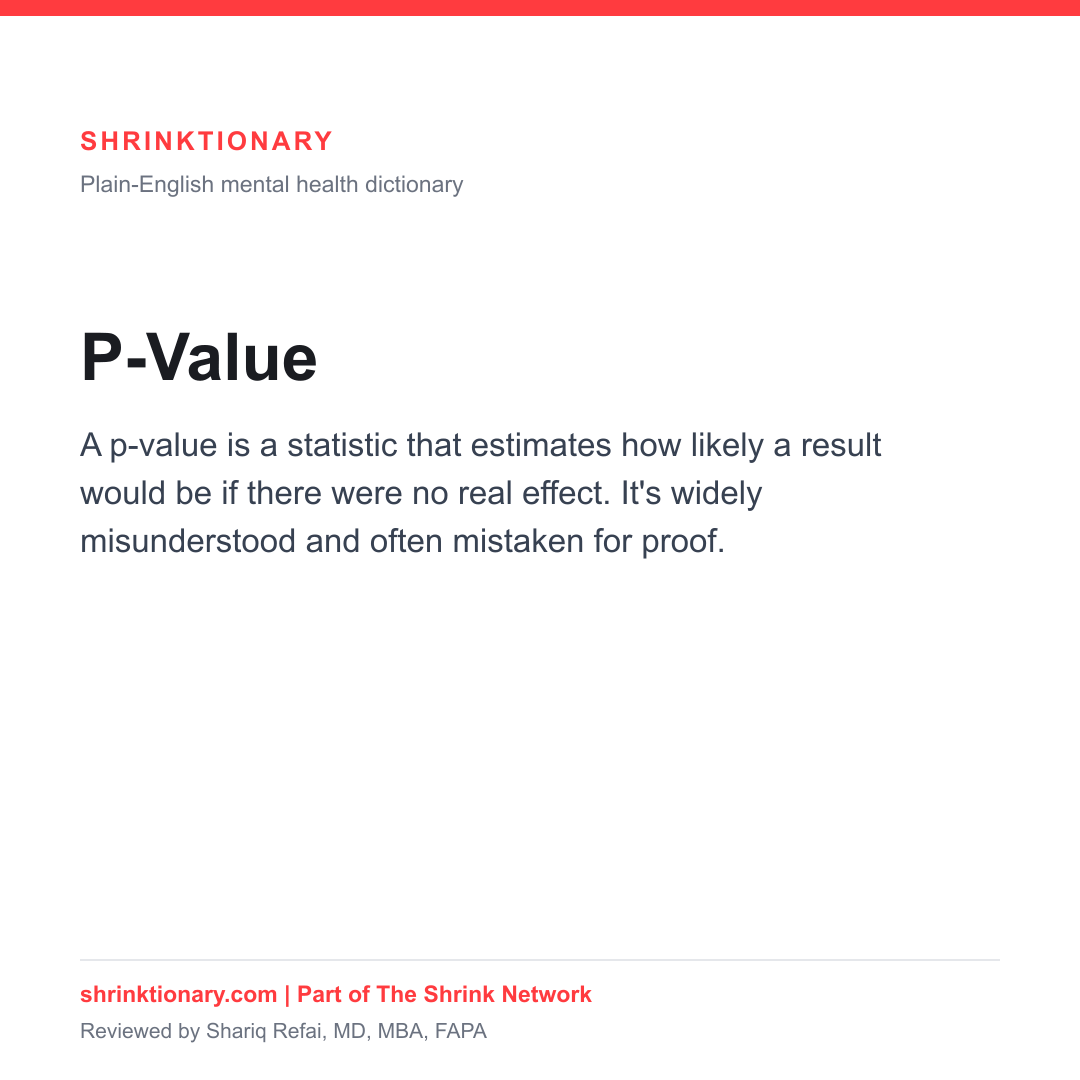
A p-value is a number that helps researchers judge whether a result might just be a fluke. It estimates how likely you’d be to see results at least as extreme as the ones you got, if there were actually no real effect at all. A small p-value suggests the result would be unlikely under that “nothing’s going on” assumption.
Researchers often use a cutoff, commonly 0.05, to decide whether to call a result “statistically significant.” If the p-value falls below the cutoff, they treat the finding as unlikely to be pure chance. That’s the whole job of a p-value, and it’s a narrower job than most people assume.
How it works
Imagine testing whether a new therapy beats a placebo. You start from the assumption that it makes no difference, then look at your data. The p-value tells you how surprising your data would be if that no-difference assumption were true. The more surprising the data, the smaller the p-value.
A small p-value doesn’t tell you the effect is large, important, or even definitely real. It only tells you the result would be uncommon if there were no effect. That’s a useful flag, but it’s just a flag.
What it isn’t
A p-value isn’t the probability that the finding is true, and it isn’t the probability that the result happened by chance. Those are the most common misreadings, and they’re wrong. It also says nothing about how big the effect is. For that you need an effect size.
It also isn’t a pass or fail line that settles a question. A p-value just under 0.05 and one just over it are nearly identical. Treating that cutoff as a hard boundary between “real” and “not real” is a mistake that even experienced researchers fall into.
Related terms you’ll see next
Effect size tells you how large a result is, which the p-value doesn’t. Bias can distort results in ways no p-value will reveal. A randomized controlled trial is a setting where p-values are commonly reported. Understanding correlation and causation keeps you from over-reading any single statistic.
Why it matters when you read about mental health
The word “significant” gets thrown around a lot, and a p-value is usually what’s behind it. But significant only means “probably not chance.” It doesn’t mean large, meaningful, or proven. When a study reports a low p-value, the right next questions are how big the effect was, how the study was run, and whether other studies found the same thing. One p-value, on its own, settles very little.
When this word matters
The distinction matters when reading research claims, since a p-value estimates how surprising a result would be if there were no real effect and doesn't measure how big, important, or certain the effect is.
Commonly confused with
Frequently asked questions
What does a p-value actually tell you?
A p-value estimates how likely you'd see results at least as extreme as the ones you got if there were really no effect at all. A small p-value flags that the result would be uncommon under that no-effect assumption, and that's the whole job it does.
Does a low p-value mean a result is true or important?
No. A low p-value isn't the probability that a finding is true, and it doesn't tell you how big or meaningful an effect is. For the size of an effect you need to look at the effect size, and for confidence you need to see whether other studies found the same thing.
What does statistically significant really mean?
It usually just means the p-value fell below a chosen cutoff, often 0.05, so the result is probably not pure chance. It does not mean the effect is large, meaningful, or proven, which is why the word significant is easy to over-read.
Related terms
Sources
- Hypothesis Testing, P Values, Confidence Intervals, and Significance , StatPearls, NCBI Bookshelf
- National Library of Medicine , National Library of Medicine
Use or cite this definition
Free to reuse with attribution. Paste the block into your own page, or grab a citation.
Embed on your site
<blockquote>
<p><strong>P-Value:</strong> A p-value is a statistic that estimates how likely a result would be if there were no real effect. It's widely misunderstood and often mistaken for proof.</p>
<p>— <a href="https://shrinktionary.com/terms/p-value/">Shrinktionary</a>, a plain-English mental health dictionary, medically reviewed by a board certified psychiatrist.</p>
</blockquote>Cite (APA)
Refai, S. (2026). P-Value. Shrinktionary. https://shrinktionary.com/terms/p-value/
Cite (MLA)
"P-Value." Shrinktionary, https://shrinktionary.com/terms/p-value/. Accessed September 26, 2026.
Your next step in The Shrink Network
You are here: Shrinktionary, the language layer of The Shrink Network.
Each site in the network has one job. No matter where you enter, we help you find the next step that makes sense.
Want to understand more first?
See how this connects to everything else in the Term Web →
Take it with you
Free printable references you can save or share. For education, not medical advice.